
Home · Science · Nov 25 archive
Voyager 1 Reaches One Light-Day From Earth
Confirmed
In Short: NASA's Voyager 1 spacecraft, launched in 1977, has reached a distance of one light-day from Earth, marking a significant milestone in its journey through interstellar space.
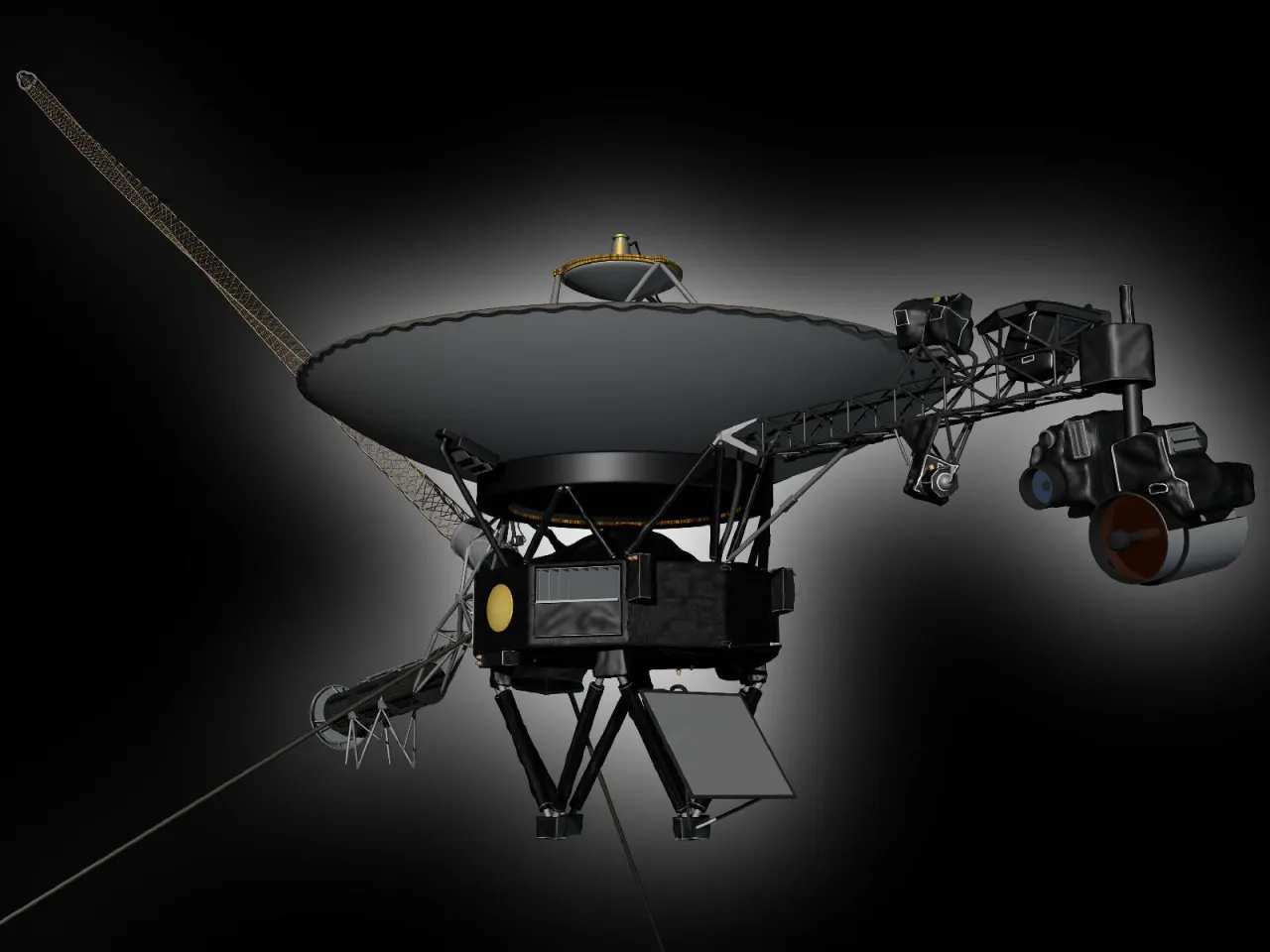
Voyager 1 has traveled farther than any other human-made object, and it is the only spacecraft to have operated outside of the heliosphere, which acts like a protective shield of the solar system.
In a symbolic celebration, NASA is asking the public to send Voyager's call sign V-G-R into the sky in Morse code on Tuesday night as part of the 'Shine Bright for Voyager's Light-Day' event.
The spacecraft is carrying the Golden Record, an interstellar 'time capsule' designed to communicate Earth's story to extraterrestrials.
Voyager 1 is now so far away that radio signals traveling at the speed of light require approximately 24 hours to reach it, making every command into a two-day conversation.
Voyager 1 has been traveling through space for nearly 50 years and has only two working science instruments left, with its power supply shrinking each year.
When Voyager 1 launched in September 1977, it had 10 operational scientific instruments and was originally sent to fly past Saturn and Jupiter.
The spacecraft is headed in the direction of a star more than 17 light-years away from Earth called AC +79 3888 (also known as Gliese 445) in the constellation Ursa Minor.
Voyager 1's plasma wave instrument, designed at the University of Iowa, now takes a full day traveling at the speed of light to reach Earth.
Launched in 1977, the probe crossed 25.9 billion kilometers from Earth on November 18, making every two-way signal exchange a 48-hour wait The spacecraft built in the 1970s became the first human-made object to reach approximately 16.1 billion miles from Earth, a distance that now turns every command into a two-day conversation.
NASA's Voyager 1 has traveled farther than anything else that humans have launched into space.
In 1980, the spacecraft took detailed photos of Saturn's rings and moons.
For Fran Bagenal, a planetary scientist at the University of Colorado, Boulder, who began working with Voyager 1 as a graduate student during its earliest years, the occasion is a momentous technological feat.
What this adds
On Voyager 1's journey, noting its significant milestones and contributions to space exploration.
Voyager 1's twin, Voyager 2, entered interstellar space in 2018, continuing the legacy of these pioneering spacecraft.
Background
NASA's Voyager 1 spacecraft, launched in 1977, has reached a distance of one light-day from Earth, marking a significant milestone in its journey through interstellar space.
NASA's Voyager 1 spacecraft, launched in 1977, has reached a distance of one light-day from Earth, marking a significant milestone in its journey through interstellar space.
What's confirmed
- NASA's Voyager 1 has traveled farther than anything else that humans have launched into space.
- Launched in 1977, Voyager 1 has traveled farther than any other human-made object.
What's still developing
- In 1980, the spacecraft took detailed photos of Saturn's rings and moons.
- For Fran Bagenal, a planetary scientist at the University of Colorado, Boulder, who began working with Voyager 1 as a graduate student during its earliest years, the occasion is a momentous technological feat.
- Launched in 1977, the probe crossed 25.9 billion kilometers from Earth on November 18, making every two-way signal exchange a 48-hour wait The spacecraft built in the 1970s became the first human-made object to reach approximately 16.1 billion miles from Earth, a distance that now turns every command into a two-day conversation.
- A mosaic view of Callisto taken from Voyager 1 photos at a distance of about 250,000 miles (400,000 km) Some of Voyager's close-up observations also confirmed old theories.
- Even though the team has not received science and engineering data from Voyager 1 since Nov. 14, the spacecraft is sending what is called a carrier signal, which typically conveys that data to Earth.
- Now, NASA’s Voyager 1 is approaching another extraordinary milestone.
- Importantly, Voyager 1 restored communication before engineers had sent commands to troubleshoot the issue.
Sources
- NPRlink
- Spaceflight Nowlink
- WIREDlink
- Gadgetreviewlink
- Science Newslink
- BBClink
- Space.comlink
- Mymodernmetlink
- Popscilink
- Live Sciencelink
- Taipeitimeslink
- NASAlink
- Nowlink
- Thedigitalbriefnewslink
- WarpBeat — background on Voyager 1 Reaches One Light-Day From Earth After 49 Years link
- WarpBeat — background on Voyager 1 Reaches One Light-Day From Earth link
- ASTRAVOX — video link