
Home · Politics · Nov 16 archive
Supreme Court Upholds Maryland's Gun Ban
· Confirmed
In Short: The Supreme Court on Monday rejected a challenge to Maryland's laws that prohibit firearms in sensitive places like schools, parks, and government buildings.
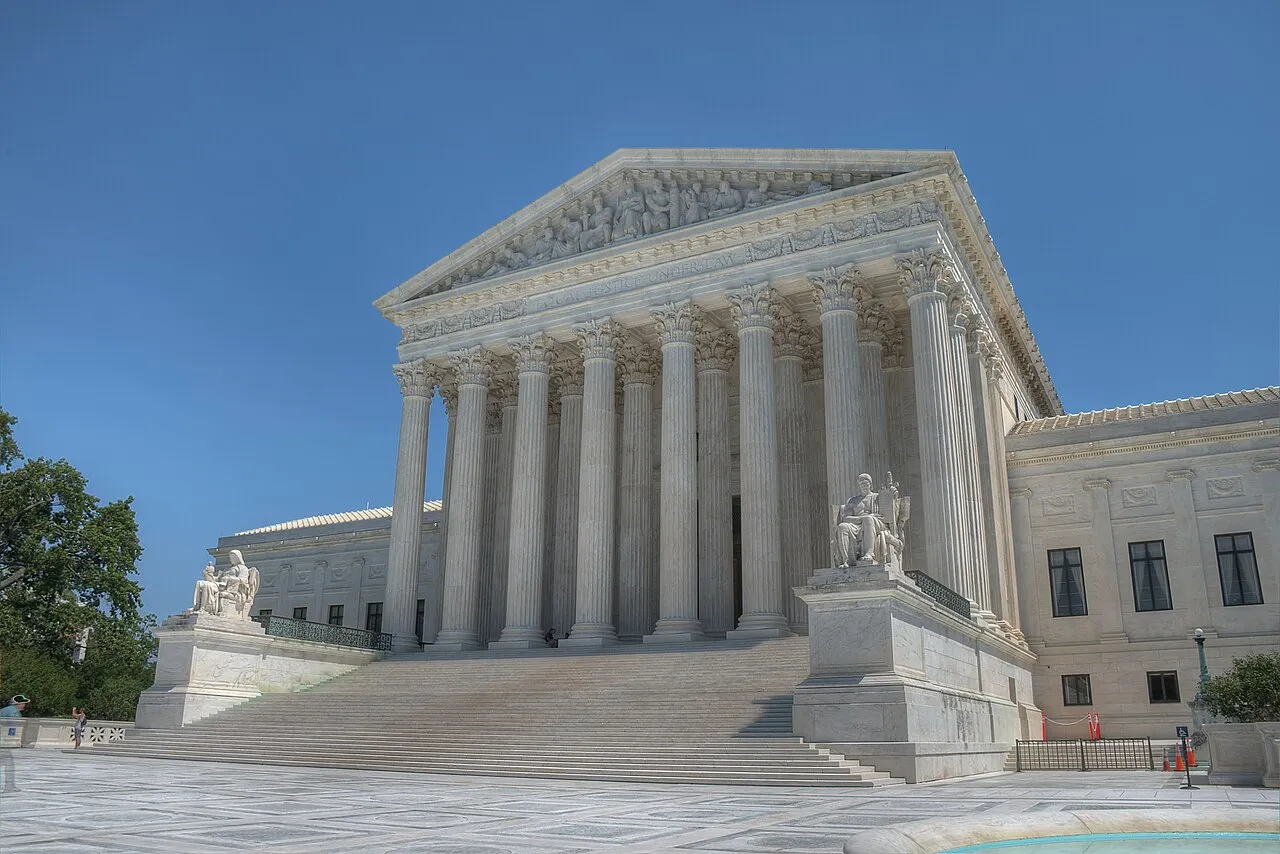
United States Supreme Court 2022 SCOTUS United States Capitol Building.
In a 6-3 decision, the court left in place a lower court ruling that upheld the rules.
The Supreme Court's 2022 decision in New York State Rifle & Pistol Association v. Bruen recognized the constitutional right to carry firearms outside the home.
However, the court's decision on Monday did not address the broader question of what constitutes a 'sensitive place' where guns can be banned.
The court's decision leaves in place a wide range of restrictions, including prohibitions on carrying firearms in schools, government buildings, parks, sports venues, and areas within 1,000 feet of public demonstrations.
What this adds
The court's decision does not address the broader question of what constitutes a 'sensitive place' where guns can be banned.
The Supreme Court's 2022 decision in New York State Rifle & Pistol Association v. Bruen recognized the constitutional right to carry firearms outside the home.
The court's decision leaves in place a wide range of restrictions, including prohibitions on carrying firearms in schools, government buildings, parks, sports venues, and areas within 1,000 feet of public demonstrations.
Background
The US Supreme Court on Friday rejected the Trump administration's policy to deny asylum to migrants who cross the US-Mexico border illegally, ruling 5-4 against the ban.
What's confirmed
- In rejecting the appeal from a group of Maryland residents and gun rights groups, the high court leaves in place a lower court decision that upheld the rules.
- The court’s 6-3 conservative majority has frequently backed gun rights in a series of rulings that have expanded the scope of the Constitution’s Second Amendment, which protects the right to bear arms.
- Maryland officials are “openly hostile” to gun rights, with the restrictions so broad they severely limit the ability to carry firearms in public at all, lawyers challenging the Maryland law said in court papers.
- The Supreme Court appeared to recognize that challenge in 2024, when it upheld a federal law barring people under domestic violence restraining orders from having guns, a ruling that frustrated gun rights activists.
- The case does not necessarily mean the Court will issue a new ruling on the full constitutional limits of school diversity policies.
What's still developing
- "The constitutionality of these so-called 'sensitive place' bans is among the most critical questions facing the judiciary in the wake of" the Supreme Court's 2022 decision, they wrote in their petition.
- In addition to pointing to historical analogues of some of Maryland's regulations, the 4th Circuit said the Supreme Court has twice, in decisions from 2008 and 2010, asserted that laws forbidding guns in government buildings and on school grounds are allowed.
- "entertainment, educational enrichment or other collective social pursuits."
- The Supreme Court is expected to hear the case and rule by the end of June.
- Thomas still agreed that the justices should not take up the Maryland case, concluding that the challengers had targeted too many different restrictions at once, but he explicitly called on the court to address the constitutional limits of so-called "sensitive place" gun restrictions in a future case.
- The Supreme Court agreed on Monday to hear the group's appeal.
- In their court filings, the challengers said Asian American students at high-performing schools "disproportionately must obtain substantially higher" standardized test scores to qualify for the lottery than students of other races who attend lower-performing schools.
- The US Supreme Court on Friday rejected the Trump administration's policy to deny asylum to migrants who cross the US-Mexico border illegally, ruling 5-4 against the ban.
- Thomas, meanwhile, dissented in 2015 when the Supreme Court declined to hear a challenge to a municipal ban on AR-15-style weapons, writing that the “overwhelming majority” of people who owned the weapons used them for lawful purposes like self-defense.
- As an appeals court judge in 2011, Kavanaugh wrote a dissent saying that a similar measure in Washington, D.C., was unconstitutional.