
Home · Science · Oct 29 archive
Rubin Observatory Detects Potential Dwarf Planet and Hidden Galaxies
· Confirmed
In Short: The discovery of potential hidden satellite galaxies and the dwarf planet candidate highlights the importance of the Rubin Observatory in reshaping our understanding of the Universe.
Using ultra-high-resolution simulations and sophisticated modeling, the team suggests there could be 80 to 100 additional satellite galaxies orbiting near the Milky Way.
With the advent of powerful new instruments like the Rubin Observatory, scientists believe they are finally approaching the ability to spot these hidden companions.
The Rubin Observatory has also detected a potential new dwarf planet candidate located beyond Pluto's orbit.
Matthew Holman, a team member and senior astrophysicist from the Center for Astrophysics | Harvard & Smithsonian, discovered the object.
The Vera Rubin Observatory's Simonyi Survey Telescope detected the dwarf planet 30 times in 20 separate nights between March 4th and July 11th.
Holman and his colleague Mario Jurić of the University of Washington found 30 more observations of the object by Rubin that dated to between March and July 2026.
The discovery highlights the observatory's ability to detect faint, elusive objects that were previously hidden.
The Rubin Observatory's wide and deep field catches moving objects that other telescopes struggle to detect.
Holman works on the algorithms that shape the Rubin's search for transient objects in the night sky.
The Rubin Observatory's superpower is the ability to clearly capture movement and change among a vast number of objects and phenomena that humans have never seen before.
The observatory's ability to detect these hidden companions is attributed to its advanced technology and the vast amount of data it collects.
These faint, elusive 'orphan galaxies' may have been stripped of their dark matter halos, making them nearly invisible to current telescopes.
What this adds
The Rubin Observatory's detection of the potential dwarf planet and hidden galaxies adds to the growing body of evidence that our understanding of the Milky Way and its surroundings is far from complete.
The observatory's ability to detect these hidden companions is attributed to its advanced technology and the vast amount of data it collects.
The discovery of the dwarf planet candidate and the potential hidden galaxies underscores the importance of the Rubin Observatory in reshaping our understanding of the Universe.
Background
The Vera Rubin Observatory's ability to detect these hidden companions is attributed to its advanced technology and the vast amount of data it collects.
The discovery of potential hidden satellite galaxies and the dwarf planet candidate highlights the importance of the Rubin Observatory in reshaping our understanding of the Universe.
What's confirmed
- “Objects like this are very rare, so I immediately started checking whether I or the code had done something wrong.” When Holman and his colleague Mario Jurić of the University of Washington went to double-check, they found 30 more observations of the object by Rubin that dated to between March and July 2026.
- “My first reaction was one of excited disbelief,” Holman said.
What's still developing
- According to LCDM theory, many more Milky Way companion galaxies should exist than cosmological simulations have so far produced, or astronomers have been able to see.
- Astronomers may have just discovered our solar system’s sixth dwarf planet Located farther away from Earth than Pluto, the object was hidden in the light of the Milky Way’s stars In the outer reaches of our solar system, beyond the orbit of Pluto, the Vera C.
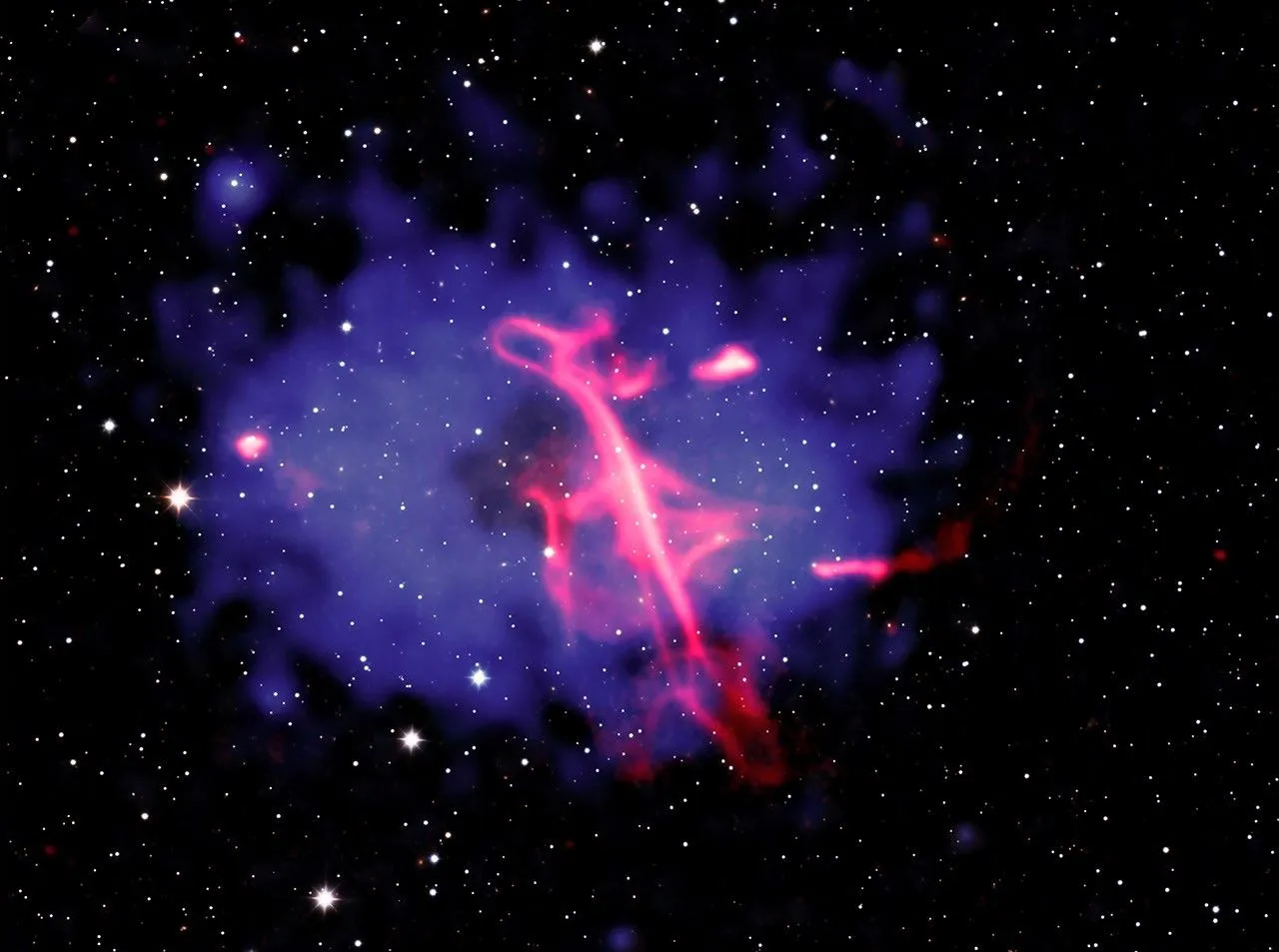
- Published in Astronomy & Astrophysics on October 14, 2026, by a team led by Andrea Botteon of Italy's National Institute for Astrophysics (INAF), the study used observations from NASA's Chandra X-ray Observatory and other telescopes to piece together how the collision reshaped streams of energetic particles released by the black hole into this massive structure.
- The structure, nicknamed Treble Clef for its appearance, was difficult for astronomers to study because it is located directly behind the plane of the Milky Way.
- Astronomers using ESO’s Visible and Infrared Survey Telescope for Astronomy (VISTA) have observed the densest, most crowded regions at the centers of the Large and Small Magellanic Clouds, our Milky Way Galaxy’s closest dwarf companions, offering an unprecedented look at areas that have long resisted detailed study.
- Astronomers have traced the origins of an unusual radio structure resembling a musical treble clef to an ancient black hole outburst and the collision of two galaxy clusters, using NASA’s Chandra X-ray Observatory and other telescopes.
- Nicknamed the “Treble Clef”, the formation was difficult to investigate because it lies almost directly behind the Milky Way’s disc, where stars, gas and dust obstruct observations.
- Astronomers have used NASA’s Chandra X-ray Observatory to break down the cause of a remarkable formation of radio waves they have nicknamed the “Treble Clef” because its distinct shape strongly resembles the musical symbol.
- Radio data shown in red from the LOw Frequency ARray (LOFAR), a large network of radio telescopes in Europe reveals the doppelganger of the musical notation.
- An explanation for the Treble Clef has been particularly difficult to find because the formation lies almost directly behind the plane of the Milky Way, meaning that stars, gas, and dust from our home galaxy largely block the view from Earth.
- Astronomers have discovered the fastest known star in our galaxy, the Milky Way, orbiting the black hole at its centre.
- The team used the VLTI, a facility at ESO’s Paranal Observatory in Chile and its GRAVITY instrument, now known as GRAVITY+ following an infrastructure upgrade. [2] The VLTI’s superpower lies in its ability to combine the light from four 8-metre telescopes to create a ‘virtual’ telescope with 15 times the spatial resolution of a single 8-metre telescope.
Sources
- SciTechDailylink
- Starlustlink
- Scilink
- Newindianexpresslink
- NASAlink
- Universe Todaylink
- Esolink
- Ktvqlink
- Scientific Americanlink
- Skyandtelescopelink
- Bdnews24link
- WarpBeat — background on Rubin Observatory Reveals Two Hidden Companions of the Milky Way link
- WarpBeat — background on Rubin Observatory Reveals Potential Dwarf Planet and Hidden Galaxies link
- Ohmhytte — video link