
Home · Science · Oct 29 archive
Rubin Observatory Reveals Potential Dwarf Planet and Hidden Galaxies
· Confirmed
In Short: The Vera Rubin Observatory has found its first dwarf planet candidate, located farther away from Earth than Pluto.
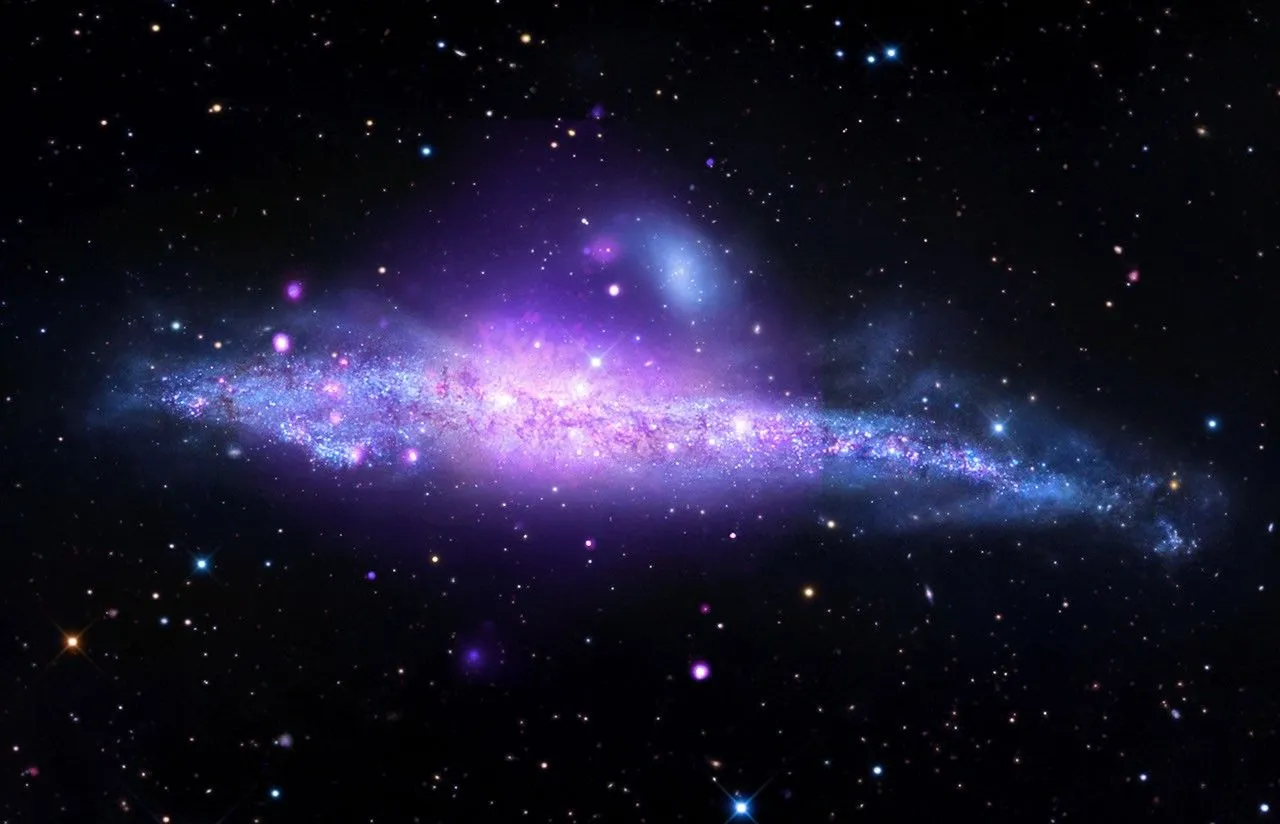
Researchers at Durham University predict the Milky Way could be surrounded by up to 100 previously undetected satellite galaxies, according to new simulations.
Using ultra-high-resolution simulations and sophisticated modeling, scientists believe powerful new instruments like the Rubin Observatory could confirm these predictions.
The Vera Rubin Observatory has found its first dwarf planet candidate, located farther away from Earth than Pluto.
Matthew Holman, a senior astrophysicist from the Center for Astrophysics | Harvard & Smithsonian, discovered the object using data from the Rubin Observatory.
The dwarf planet was detected 30 times in 20 separate nights between March 4th and July 11th, 2026.
The 'Treble Clef' structure was difficult to study due to its location, but observations from NASA's Chandra X-ray Observatory and other telescopes revealed it was formed by an ancient black hole outburst and the collision of two galaxy clusters.
The Vera Rubin Observatory's ability to detect these hidden companions is attributed to its advanced technology and the vast amount of data it collects.
Astronomers using ESO’s Visible and Infrared Survey Telescope for Astronomy (VISTA) have observed the densest regions at the centers of the Large and Small Magellanic Clouds, offering an unprecedented look at areas that have long resisted detailed study.
The team used the VLTI, a facility at ESO’s Paranal Observatory in Chile, to detect the fastest known star in our galaxy, orbiting the black hole at its center.
The star, named S301, reaches speeds of 25,000 km/s as it travels around the black hole.
The Roman telescope, named after Nancy Grace Roman, will offer astronomers an unprecedented view of planets across the Milky Way.
Astronomers believe the Rubin Observatory and other telescopes will continue to uncover many exciting discoveries in the future.
What this adds
The Vera Rubin Observatory's ability to detect these hidden companions is attributed to its advanced technology and the vast amount of data it collects.
Background
The Vera Rubin Observatory's ability to detect these hidden companions is attributed to its advanced technology and the vast amount of data it collects.
What's confirmed
- “Objects like this are very rare, so I immediately started checking whether I or the code had done something wrong.” When Holman and his colleague Mario Jurić of the University of Washington went to double-check, they found 30 more observations of the object by Rubin that dated to between March and July 2026.
What's still developing
- But with the advent of powerful new instruments like the Rubin Observatory, scientists believe we’re finally approaching the ability to spot them, potentially confirming major cosmological theories and reshaping our view of the Universe.
- According to LCDM theory, many more Milky Way companion galaxies should exist than cosmological simulations have so far produced, or astronomers have been able to see.
- Nicknamed the “Treble Clef”, the formation was difficult to investigate because it lies almost directly behind the Milky Way’s disc, where stars, gas and dust obstruct observations.
- Astronomers have used NASA’s Chandra X-ray Observatory to break down the cause of a remarkable formation of radio waves they have nicknamed the “Treble Clef” because its distinct shape strongly resembles the musical symbol.
- Radio data shown in red from the LOw Frequency ARray (LOFAR), a large network of radio telescopes in Europe reveals the doppelganger of the musical notation.
- An explanation for the Treble Clef has been particularly difficult to find because the formation lies almost directly behind the plane of the Milky Way, meaning that stars, gas, and dust from our home galaxy largely block the view from Earth.
- The team used the VLTI, a facility at ESO’s Paranal Observatory in Chile and its GRAVITY instrument, now known as GRAVITY+ following an infrastructure upgrade. [2] The VLTI’s superpower lies in its ability to combine the light from four 8-metre telescopes to create a ‘virtual’ telescope with 15 times the spatial resolution of a single 8-metre telescope.
- Astronomers may be on the verge of uncovering a long-lost galactic population.
- The resemblance of the structure to a treble clef, however, is not naturally ordained but a mere coincidence, and according to NASA, is an example of "pareidolia", the phenomenon of humans seeing familiar shapes in random patterns.
- “ What is special about this star is that it’s orbiting Sagittarius A* on a very tight orbit, taking just 8.7 years to complete it, and is approaching the black hole at a mere 12 times the distance of Earth to the Sun. That is unprecedented,” says Felix Mang, PhD student at MPE and author of the study published today in Nature.
- In 2020, the space telescope was named after Nancy Grace Roman, NASA’s first Chief of Astronomy, who is often referred to as the “Mother of Hubble.” The mission's development really came together after the COVID pandemic.
- "The main thing we need to do is to establish the physical size of 2026 ED138," Holman said.