
Home · World · Oct 28 archive
Israel Election Ends in Deadlock, No Clear Winner
Confirmed
In Short: Israel's parliamentary elections concluded Tuesday with no clear winner, leaving both major political blocs short of a parliamentary majority.
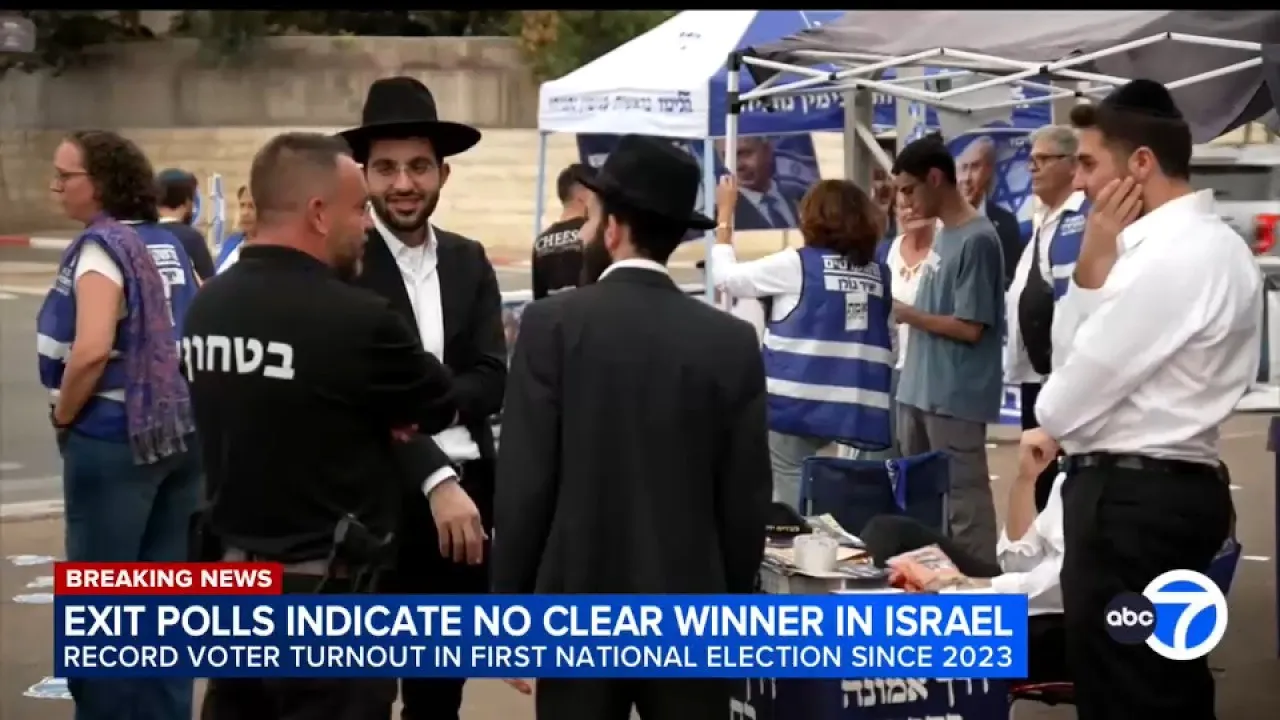
Israel's parliamentary elections concluded Tuesday with no clear winner, according to exit polls, leaving both major political blocs short of a parliamentary majority in the 120-seat Knesset.
With 2,132,650 votes counted, preliminary results showed Likud, led by Prime Minister Benjamin Netanyahu, leading with 21.70% of the vote, followed by former military chief Gadi Eisenkot’s Yashar party at 15.72%.
According to the Central Elections Committee, voter turnout reached 74.3% by 8 pm local time (1800 GMT), while the Central Elections Committee later reported a final turnout of 77.7%, the highest level since 1999.
The strong voter turnout marks a significant moment in the country’s first legislative election since the Hamas-led attacks of October 7, 2023.
If the initial projections are borne out by the official count, negotiations among political parties will be necessary to determine whether a governing coalition can be formed.
Speaking afterwards at a polling station, Eisenkot called on Israelis to vote to replace “the worst government since the state was established.” Some 7.3 million people were eligible to vote, with tens of thousands of Israelis estimated to have flown in from abroad for an election seen as crucial to deciding the future character of their country.
Eisenkot declared that the results represented a rejection of Netanyahu’s government and said he would move to form a “Zionist mobilization government.” However, Gideon Saar, Israel’s foreign minister and Netanyahu ally, said that victory declarations by the opposition were “premature.”
The election is a crucial test for Netanyahu’s political future, with the outcome determining the balance of power in Israel’s parliament.
Arab-led parties are projected to win 17 or 18 seats, a record showing for the sector.
Under Israel's parliamentary system, the president consults with party representatives after an election and assigns a lawmaker the task of forming a government, generally choosing the candidate considered most capable of securing parliamentary support.
The deadlock could allow Israel's longest-serving prime minister to remain in power as caretaker during coalition negotiations.
The election's outcome is a significant setback for Netanyahu's coalition, which entered the election with 68 seats, though the deadlock could prolong political negotiations and uncertainty.
Background
As Israel prepares for its October 27 election, Netanyahu and his rivals are locked in a fierce online battle, deploying bots, deepfakes, and sophisticated data management tools.
The upcoming Israeli election on October 27, 2026, faces uncertainty with no clear winner.
What's confirmed
- Eisenkot says Israel's response - a war that has killed more than 74,000 Palestinians, according to Gaza health authorities - was a failure because Hamas remains in charge.
- Speaking afterwards at a polling station, Eisenkot called on Israelis to vote to replace "the worst government since the state was established." Some 7.3 million people were eligible to vote, with tens of thousands of Israelis estimated to have flown in from abroad for an election seen as crucial to deciding the future character of their country.
What's still developing
- But, Amna, the bottom line is that this coalition does not appear to have a path toward forming a majority government after what many Israelis call one of the country's most consequential elections.
- The figure was eight percentage points higher than turnout recorded at the same time during the 2022 election and the highest for that point in the day in decades.
- Updated projections from Channels 11 and 13 put both camps at 51 seats each, while Channel 12 gives Netanyahu’s bloc a narrow lead with 52 seats.
- A supporter holds a banner depicting Israeli Prime Minister and Likud party leader Benjamin Netanyahu during Israel's national election, at Likud's election headquarters in Jerusalem, on Oct 27, 2026. (Photo: Reuters/Ronen Zvulun) JERUSALEM: Israel's wartime election appeared deadlocked on Tuesday (Oct 27), exit polls showed, a potential setback for veteran Prime Minister Benjamin Netanyahu if the projections hold, with neither side having a clear path to power but rival Gadi Eisenkot's larger bloc potentially giving him the first chance to form a government.
- Haaretz Podcast The Israeli Far Right's Palestinian Emigration Fantasy Haaretz Elections Podcast Has the Flydubai Midair Attack Given Netanyahu an Election Boost?
- His Rivals Must Act Fast After the Election Yossi Verter Israel to Impose General Closure for West Bank Palestinians on Election Day Matan Golan Netanyahu Fans the Flames of War Two Days Before Israel's Election Amos Harel 8 Thousands Across Israel Protest Netanyahu Gov't Three Days Before the Election Linda Dayan It's Time to Confess.
Sources
- Arab Times Kuwait Newslink
- Organiserlink
- PBSlink
- TVC Newslink
- Times Nowlink
- Vinnewslink
- The Indian Expresslink
- Channelnewsasialink
- Dailysabahlink
- AFPlink
- Haaretzlink
- Al-Monitorlink
- Ynetnewslink
- Worthynewslink
- WarpBeat — background on Israel's Election Warps Online with Bots and Deepfakes link
- WarpBeat — background on Israeli Election Uncertainty as No Clear Winner Emerges link
- Eyewitness News ABC7NY — video link