
Home · Science · Oct 19 archive
A Japanese Spacecraft Aims to Bring Back a Bit of a Martian Moon
Confirmed
In Short: The mission aims to reveal the origins of Phobos and its sibling moon, Deimos, potentially shedding light on the origins of life in the solar system.
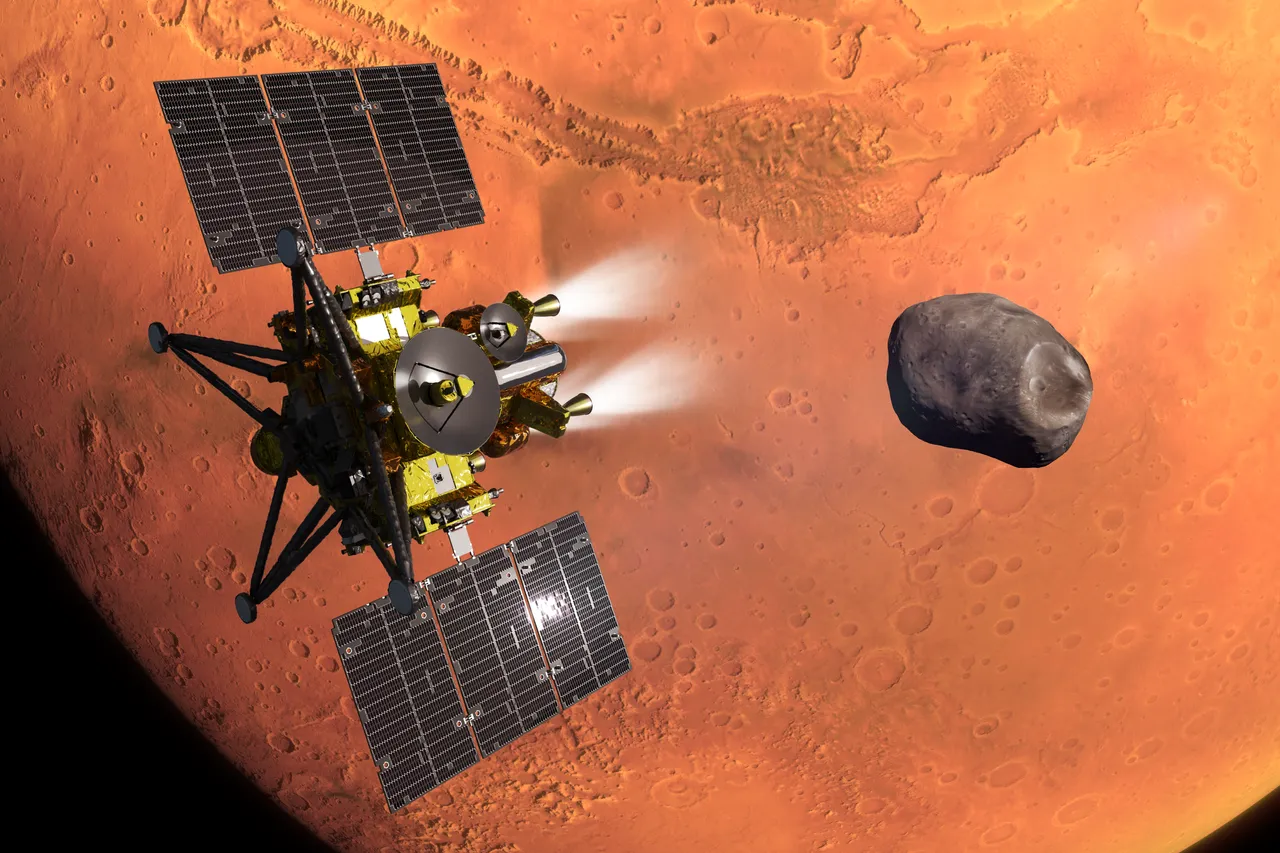
Japan launched the Martian Moons eXploration (MMX) spacecraft on October 20, 2026, from the Tanegashima Space Center, aiming to collect samples from Phobos, one of Mars' moons.
The mission, led by the Japan Aerospace Exploration Agency (JAXA), includes contributions from NASA and other international space agencies.
The MMX spacecraft will orbit Mars and explore Phobos for up to three years before landing and collecting at least 10 grams of surface material.
The spacecraft, consisting of three modules, carries sampling equipment, scientific observation instruments, and two ultra-high-definition cameras.
NASA's contributions include a P-Sampler designed to collect a ground sample from Phobos, mounted on one of the spacecraft’s landing legs.
The spacecraft is expected to arrive at Mars in August 2027 and conduct detailed observations of the two moons.
The mission's success could pave the way for future manned missions to Mars, as samples from Phobos could help determine the feasibility of using Martian moons as bases.
The MMX mission is part of a broader international effort to explore Mars and its moons, with the United States, China, and others also considering sending astronauts to Mars.
The spacecraft launched successfully to low Earth orbit but failed to fire its engines to send it toward Mars.
The mission's total cost is 55.3 billion yen (approximately $350 million).
Background
Bring Back... is a British television series comprising one-off shows where Justin Lee Collins tries to locate people from music, TV, or film backgrounds to reunite them for a one-off performance or get-together. The series was broadcast on Channel 4.
What's confirmed
- Japan is launching a spacecraft on a groundbreaking mission to bring back samples from Phobos, one of Mars' moons.
- “Despite their potential importance, Martian moons have never been fully investigated," Kawakatsu said.
- Scientists hope the five-year mission will reveal how Phobos and its sibling moon, Deimos, formed, potentially shedding light on the origins of life in the solar system.
- The Japan Aerospace Exploration Agency’s launch of the spacecraft Tuesday on a new Japanese mainstay H-3 rocket comes as the United States, China and others consider sending astronauts to Mars.
- The Japan Aerospace Exploration Agency unveils a spacecraft for its Martian Moons eXploration mission at the Tanegashima Space Center in Minamitane, southwestern Japan, Aug.
- NASA Details Contributions to Japan’s Martian Moons Mission Ahead of 19 October Launch NASA and the Japan Aerospace Exploration Agency (JAXA) are preparing to launch a mission to Mars’ two moons, Phobos and Deimos, with plans to return the first samples from a moon other than Earth’s to laboratories in 2031.
What's still developing
- “We can almost certainly come to a conclusion by analyzing (Phobos) soil samples," MMX principal investigator Kiyoshi Kuramoto said.
- Samples from Phobos will provide useful data for scientists to consider using a Martian moon as a base for a future manned mission to the planet, said MMX project manager Yasuhiro Kawakatsu.
- Samples from Phobos could also shed light on the origin of Deimos as the two moons are believed to have similar roots, Kuramoto said.
- The spacecraft then landed in the north Pacific Ocean after about three hours in flight with a fiery landing.
- It's not the first time SpaceX, which recently launched the largest IPO in history, has put a spacecraft in orbit, but it is the first time Starship has entered orbit — and the first time a spacecraft has launched into orbit from Texas.
- This will start a five-year mission, during which the spacecraft will orbit and explore Phobos, deploy a lander, touch down and collect soil and small pebbles.
- The ambitious five-year mission aims to uncover how the Martian moons formed and could also offer insights into the origins of life in the solar system, AP reported.
- Japanese scientists are readying a mission to Mars’s moons to retrieve samples that could help unlock the origins of the Solar System and life on Earth, in what aims to be the first round trip to the Martian region.
- Scientists hope the samples will provide new insights into the origins of Mars' moons and the evolution of the Martian system.
- Once the detailed map is complete, the spacecraft will land on Phobos, use its sampling devices to collect soil samples, and store them in a heat-protected capsule.