
Home · Science · Oct 18 archive
Japan Launches MMX Mission to Phobos
· Confirmed
In Short: On October 20, Japan launched the Martian Moons eXploration (MMX) spacecraft from Tanegashima Space Center, marking the start of a mission to collect samples from Phobos, one of Mars' two moons.
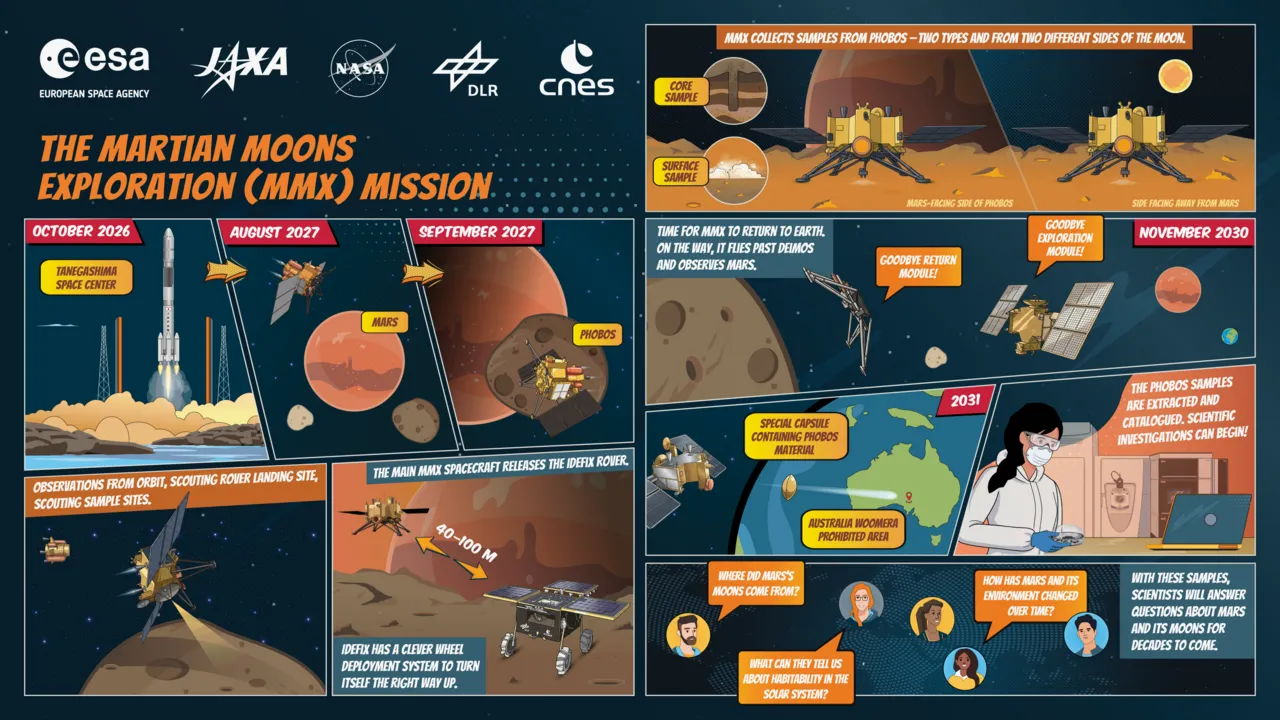
The MMX spacecraft aims to land on Phobos, deploy a small rover called IDEFIX, and collect samples that could provide insights into the moon's origins and the early history of the solar system.
According to Tom Statler, part of the NASA team collaborating on the mission, the samples could reveal how Phobos and its sibling Deimos formed, potentially shedding light on how Earth and other inner planets acquired water and organic compounds.
The MMX spacecraft will arrive at Mars in August 2027 and spend three years orbiting Phobos to map its surface and select a landing site.
Once the detailed map is complete, the spacecraft will land on Phobos, use its sampling devices to collect soil samples, and store them in a heat-protected capsule.
The mission's sampling devices include a gas puffing mechanism to collect dust and pebbles and a hollow cylinder to take samples several centimeters deep.
Scientists believe that Phobos could contain material from Mars, which could provide clues about the planet's past and the potential for life.
The collected samples will be returned to Earth in 2031, where they will be retrieved in Australia for analysis.
The mission also involves deploying a rover jointly developed by France and Germany, along with a NASA sampling device and an instrument to measure gamma rays.
JAXA officials anticipate that the mission will take five years and provide a deeper understanding of Phobos and Deimos, potentially revealing insights into the origins of life in the solar system.
What this adds
The MMX mission is the first of its kind to bring back samples from Phobos.
Scientists prefer Phobos over Deimos because it is closer to Mars and may hold deeper insights about the planet.
The mission's success could help solve the long-standing mystery of the Martian moons' origins.
Background
NASA and SpaceX launched the CRS-35 resupply mission to the International Space Station from Cape Canaveral Space Force Station on Tuesday, October 13, 2026.
What's confirmed
- MMX will launch from Tanegashima Space Center in Japan.
What's still developing
- On 20 October, the Martian Moons eXploration (MMX) spacecraft launches towards the larger of the two moons, Phobos, with the goal of bringing back a sample that may finally explain how Phobos and its sibling, Deimos, formed.
- If all goes to plan, it should arrive at Mars in August 2027, entering an orbit that keeps it alongside Phobos so it can build a detailed map of the surface.
- Check your subscription status, update your details and more.
- For more than a century, researchers have debated whether the two are captured asteroids or formed from an impact on Mars, similar to how Earth’s moon formed.
- Possible signs of ancient life on Mars are rich in complex carbon The samples, though, are the most important part of the mission.
- Impacts on the planet could have launched material into space, which would have collected on the moon’s surface and been preserved there for billions of years.
- Once the map is complete enough, the spacecraft’s operators at the Japan Aerospace Exploration Agency (JAXA) will use it to pick out a spot on Phobos for MMX to land.
- After the samples are taken, they will be stowed away inside the spacecraft, which will then head back towards Earth.
- Following launch on the H3 rocket, the spacecraft will arrive at Mars region in August 2027, to fly near Phobos for three years to retrieve Martian moon information and physical samples ahead of the 2031 return mission.
- Phobos and Deimos derived their names from the Greek mythological epitomes of fear and terror whose Roman counterpart is Mars.
- The collection of samples from multiple geographic locations optimizes the likelihood of retrieving potential evidence of past microbial life on Mars.
- In addition, the samples will be stored in a heat-protected capsule built to survive the return from orbit.