
Home · World · Oct 17 archive
Tens of Thousands Protest Labor Reforms in Lisbon
· Confirmed
In Short: Tens of thousands of protesters took to the streets of Lisbon, Portugal, on Tuesday to protest against proposed labor reforms, according to BBC (United Kingdom) and Al Jazeera (Qatar).
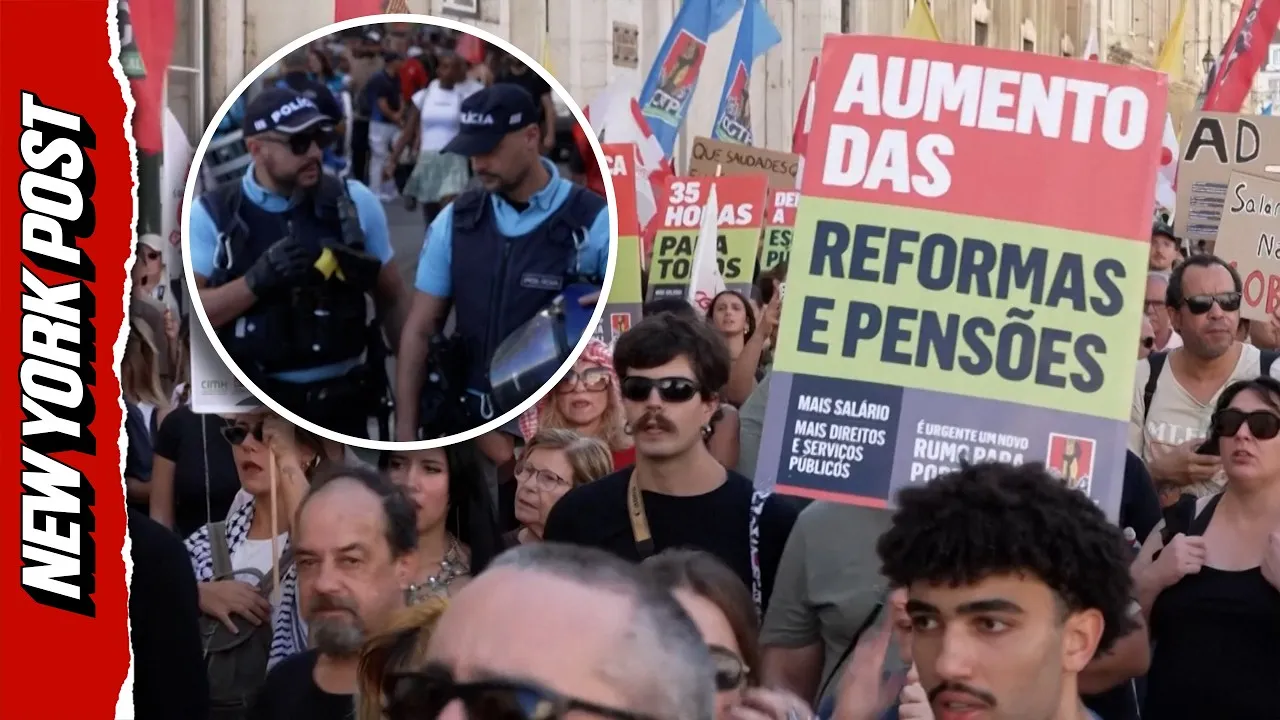
Tens of thousands of protesters took to the streets of Lisbon, Portugal, on Tuesday to protest against proposed labor reforms, according to BBC (United Kingdom) and Al Jazeera (Qatar). The demonstrations, organized by Portugal's largest union, CGTP, saw around 100,000 people gather on Lisbon's main avenue, with the union announcing a general strike for December 11.
In France, violent scenes emerged as hundreds of thousands of people protested against education reforms, reported Fox News (United States). The protests have led to the closure of more than half of the country's high schools, with the interior ministry reporting that 6,100 people have been taken into custody since the protests began in September.
Meanwhile, in Spain, tens of thousands of people rallied in Madrid and about 50 other cities to demand affordable housing measures, according to Al Jazeera (Qatar) and Theolivepress (Spain). The protests were sparked by the eviction of an 87-year-old pensioner and came a day after parliament rejected an emergency relief package for tenants.
Theolivepress (Spain) reported that the proposed reforms, which would have halted tenant evictions and introduced restrictions on 'vulture funds,' were voted down in Congress. The opposition, including the right-wing Partido Popular (PP), Vox, and Junts, voted against the reforms, while 172 MPs supported them.
In Portugal, the protests have escalated quickly, with the government attempting to rush through an anti-rioting law that could fine protesters up to 10,000 euros for participating in protests that result in property damage, reported Struggle-La-Lucha (France).
The demonstrations in France have also become a significant issue in the upcoming presidential election, with far-left presidential hopeful Jean-Luc Mélenchon criticizing the government's response as repressive, according to Fox News (United States).
In Madrid, protesters expressed frustration with the political system, with one demonstrator, Nando de Anguulo, 26, telling Reuters, 'It’s a shame,' and another stating, 'It only proves that it is us, the people, who have to adapt to the political parties, and not the politicians to what the people want, and this can’t go on like that.'
While the exact numbers and specific details may vary between reports, all outlets agree that large-scale protests are taking place in France, Portugal, and Spain, driven by concerns over labor reforms, education policies, and the housing crisis.
The protests highlight the widespread dissatisfaction with current policies and the urgent need for reforms to address workers' rights, education, and housing affordability.
What's confirmed
- Tens of thousands of protesters took to the streets of Lisbon, Portugal, on Tuesday to protest against proposed labor reforms, according to BBC (United Kingdom) and Al Jazeera (Qatar). The demonstrations, organized by Portugal's largest union, CGTP, saw around 100,000 people gather on Lisbon's main avenue, with the union announcing a general strike for December 11.
- In France, violent scenes emerged as hundreds of thousands of people protested against education reforms, reported Fox News (United States). The protests have led to the closure of more than half of the country's high schools, with the interior ministry reporting that 6,100 people have been taken into custody since the protests began in September.
- Meanwhile, in Spain, tens of thousands of people rallied in Madrid and about 50 other cities to demand affordable housing measures, according to Al Jazeera (Qatar) and Theolivepress (Spain). The protests were sparked by the eviction of an 87-year-old pensioner and came a day after parliament rejected an emergency relief package for tenants.
- Theolivepress (Spain) reported that the proposed reforms, which would have halted tenant evictions and introduced restrictions on 'vulture funds,' were voted down in Congress. The opposition, including the right-wing Partido Popular (PP), Vox, and Junts, voted against the reforms, while 172 MPs supported them.
- In Portugal, the protests have escalated quickly, with the government attempting to rush through an anti-rioting law that could fine protesters up to 10,000 euros for participating in protests that result in property damage, reported Struggle-La-Lucha (France).
- The demonstrations in France have also become a significant issue in the upcoming presidential election, with far-left presidential hopeful Jean-Luc Mélenchon criticizing the government's response as repressive, according to Fox News (United States).
- While the exact numbers and specific details may vary between reports, all outlets agree that large-scale protests are taking place in France, Portugal, and Spain, driven by concerns over labor reforms, education policies, and the housing crisis.
- The protests highlight the widespread dissatisfaction with current policies and the urgent need for reforms to address workers' rights, education, and housing affordability.
What's still developing
- The protests are quickly blowing up as a hot topic in the election campaign to replace President Emmanuel Macron next May.
- Speaking at the protest, Miriam Alves, 31, a worker at a medical device company, told Reuters that reforms are "clearly a step backward in working conditions and could lead to a complete lack of job security".
- CGTP general secretary Tiago Oliveira announced the strike for next month at the protest.
- The CJP - which is not registered as a political party in India - is seeking electoral reforms just months before crucial state elections.
- "Peaceful protests have been there for ages. We are not living in pre-independent India. We request the government to let us protest."
- Abhijeet Dipke - who began the movement in May after India's Chief Justice likened some jobless young people to "cockroaches" - and other leaders had been detained on arrival in Delhi on Saturday to lead protests seeking electoral reforms.
- The protests of the past weeks began with a handful of school pickets on Sept. 18 and 21.
- A Sept. 29 public-sector strike, in which many teachers joined their students in protest, spread the protest movement further.
- There are two questions about our welfare system that are going to become more pertinent as Labour’s forthcoming reforms unfold: what is the difference between a benefit and an entitlement?
- When it comes to childcare, parents crossing a £100,000 income threshold by just £1 can end up tens of thousands of pounds worse off because they lose their entitlement to free childcare hours at nursery.
- The protests came a day after prime minister Sanchez was dealt a hefty blow in parliament after the opposition voted down two emergency housing decrees designed to quell public anger after the high-profile eviction case of 87-year-old Maricarmen Abascal. 178 MPs from the right-wing Partido Popular (PP), Vox and Junts voted down the first of the two decrees making up the reform, while 172 MPs voted in favour.
- If passed, the reforms would have put a halt to tenant evictions, enforced mandatory extensions on residential rental contracts and introduced a swathe of restrictions on so-called ‘vulture funds’.