
Home · Science · Oct 15 archive
Chandra Reveals Origin of Cosmic Treble Clef
Confirmed
In Short: Astronomers using NASA's Chandra X-ray Observatory have discovered that a cosmic radio wave structure resembling a treble clef is caused by a black hole outburst and galaxy cluster collision.
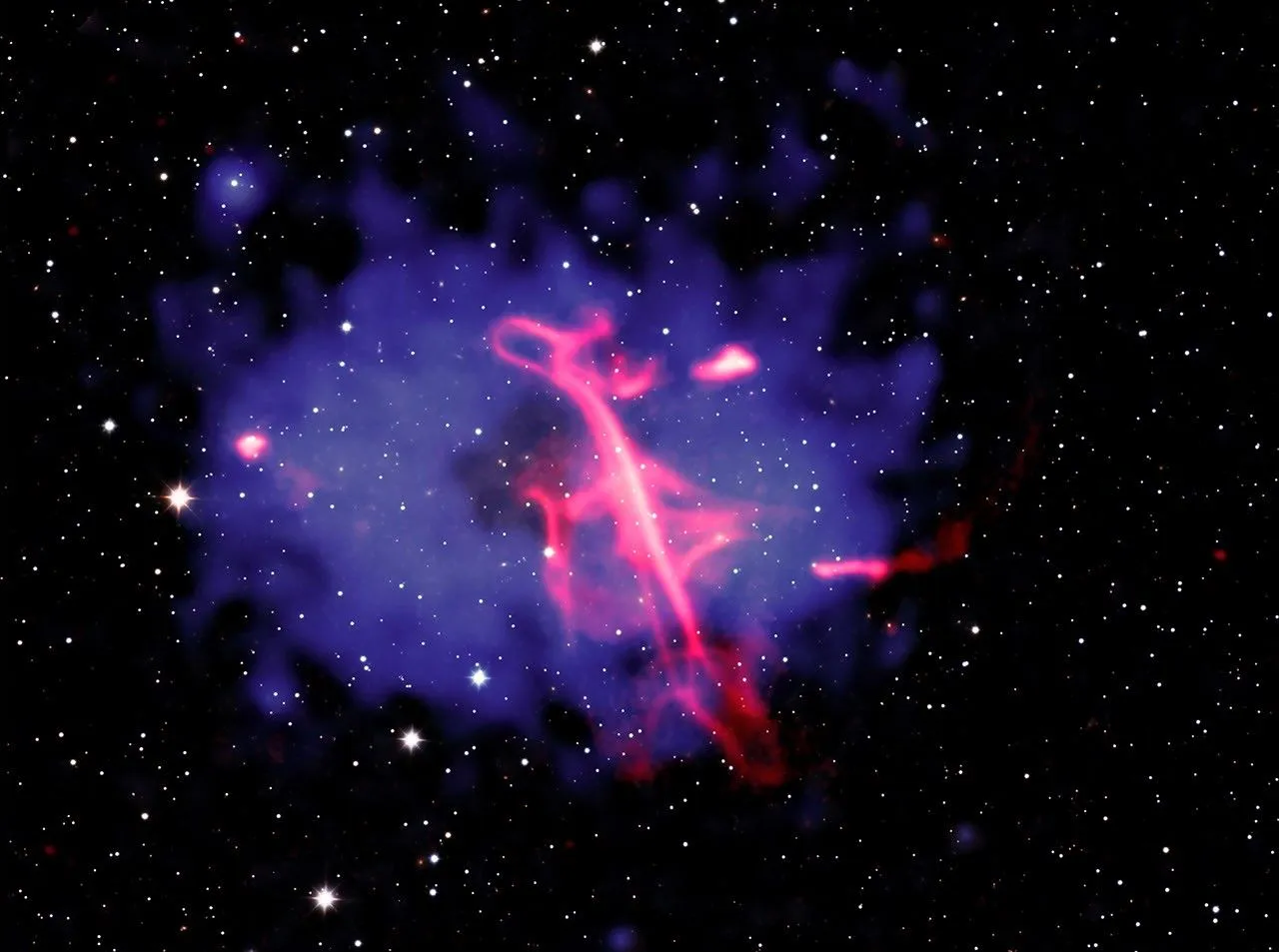
Astronomers have used NASA's Chandra X-ray Observatory to investigate the cause of a remarkable formation of radio waves they have nicknamed the 'Treble Clef' due to its distinct shape resembling the musical symbol.
The Treble Clef, located almost directly behind the plane of the Milky Way, has been a challenging subject for observation due to the obstruction caused by stars, gas, and dust from our home galaxy.
Researchers have determined that the Treble Clef is likely the result of an outburst from a supermassive black hole, followed by a collision of two galaxy clusters.
The collision of these two clusters, which occurred a few hundred million years ago, compressed or re-energised ageing particle clouds, making them brighter in radio waves.
The Treble Clef is a multimillion-degree gas cloud detected in X-rays by Chandra and the German eROSITA X-ray telescope.
The resemblance to a treble clef is a case of pareidolia, the phenomenon where people see familiar shapes in random data.
The new composite image of the Treble Clef and its cluster shows the multimillion-degree gas detected in X-rays by Chandra and eROSITA in blue, with some of the Chandra data derived from a special technique to highlight important features.
The researchers concluded that the Treble Clef likely formed in a two-stage process involving a black hole outburst and the subsequent collision of two galaxy clusters.
The Treble Clef nickname was chosen because the radio source has a distinct shape resembling the musical symbol.
In addition to the Treble Clef, some observers have noted a resemblance to a dragon viewed from the side, another example of pareidolia.
What this adds
The new findings confirm the earlier WarpBeat report on the origin of the cosmic Treble Clef, providing additional details on the process and observations.
The nickname 'Treble Clef' highlights the unique shape of the radio wave structure, which is a result of pareidolia, the tendency to recognize familiar patterns in random data.
The composite image of the Treble Clef and its cluster, showing the multimillion-degree gas detected in X-rays, provides a clearer understanding of the structure's formation and composition.
Background
Astronomers using NASA's Chandra X-ray Observatory have discovered that a cosmic radio wave structure resembling a treble clef is caused by a black hole outburst and galaxy cluster collision.
A clef is a musical symbol used to indicate which notes are represented by the lines and spaces on a musical staff. Placing a clef on a staff assigns a particular pitch to one of the five lines or four spaces, which defines the pitches on the remaining lines and spaces.
What's confirmed
- The researchers discovered the Treble Clef is likely caused by an outburst from a supermassive black hole, followed by a collision of two galaxy clusters.
- Cosmic radio waves in a shape similar to Prince's famous name symbol have been called a space "Treble Clef" by astronomers.
- NASA said: "An explanation for the Treble Clef has been particularly difficult to find because the formation lies almost directly behind the plane of the Milky Way, meaning that stars, gas, and dust from our home galaxy largely block the view from Earth."
- Researchers have used NASA's Chandra X-ray Observatory to investigate the cause of the "remarkable formation." NASA said the scientists chose the "Treble Clef" nickname because the radio source has a distinct shape resembling the musical symbol.
- Galaxy clusters are some of the largest structures in the universe, containing hundreds of individual galaxies and huge reservoirs of superheated gas.
- NASA said the resemblance to a treble clef is a case of pareidolia, the phenomenon when people see familiar shapes in random data, since there is no scientific connection to the musical notation.
- The researchers also determined the galaxy cluster is, in fact, two clusters in the process of merging.
- NASA's Chandra and the German Extended RÖntgen Survey with an Imaging Telescope Array (eROSITA) X-ray telescope found diffuse, hot gas at the location of the Treble Clef, showing that a galaxy cluster hosts the object.
- Editors have highlighted the following attributes while ensuring the content's credibility: Astronomers have used NASA's Chandra X-ray Observatory to break down the cause of a remarkable formation of radio waves they have nicknamed the "Treble Clef" because its distinct shape strongly resembles the musical symbol.
- This new composite image of the Treble Clef and its cluster shows the multimillion-degree gas detected in X-rays by Chandra and eROSITA in blue, with some of the Chandra data derived from a special technique the authors used to highlight important features in the Chandra data.
- Observations from Chandra and Germany’s eROSITA X-ray telescope revealed vast quantities of superheated gas, confirming the presence of a galaxy cluster.
- Shock waves produced by the collision could also have contributed to this process.
What's still developing
- The director was seen carrying two symbolic elements from Sinners : a blues guitar and a treble clef braided into his hair.
- Major Barrett Dill, of Operation Treble Clef — as the initiative to restore the property is called — said the site was owned by North Village Band but was abandoned decades ago as the structure began to deteriorate.
- The project has already removed “brush, trash, discarded vehicles and other paraphernalia that had accumulated over the decades,” the committee behind the Operation Treble Clef said.
- In addition to Major Dill, Kevin Grant, Willie Ferguson, Shervin Hendrickson and Darlin Young are involved in Operation Treble Clef.
- Operation Treble Clef welcomes help from all community partners.