
Home · Science · Oct 12 archive
Astronomers May Have Found a Second-Generation Planet
Confirmed
In Short: Astronomers using Hubble data from 1999 have found evidence of a second-generation planet around a white dwarf.
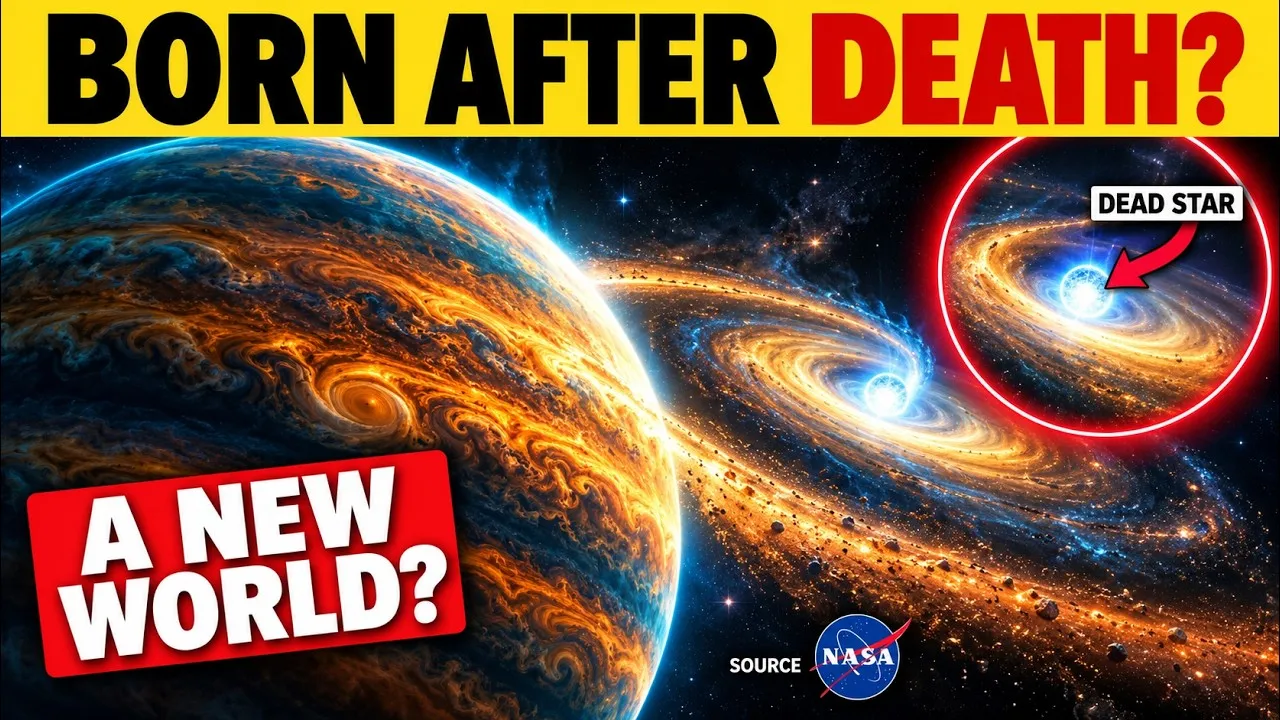
Astronomers may have discovered a second-generation planet orbiting the white dwarf HS 0209+0832, located 270 light-years away in the constellation Cetus. This finding suggests that planets can form from the debris of a dying star, a process previously theorized but never confirmed.
According to University of Warwick astronomer Jamie Williams and colleagues, the white dwarf's far-ultraviolet spectrum, obtained in 1999 with the Space Telescope Imaging Spectrograph (STIS) on the Hubble Space Telescope, revealed the presence of carbon, aluminum, silicon, calcium, titanium, nickel, and zinc in the atmosphere, along with 100 unidentified lines.
The discovery of these unusual chemical signatures, particularly the high levels of niobium, suggests that a second-generation planet may have formed from the material expelled by the white dwarf. Niobium was found at concentrations more than 1,000 times higher than those seen in the Sun.
Williams explained, 'Forming the protoplanetary disc in this situation is not easy and helps explain why these planets are so rare.' The researchers suggest that the material being absorbed by the white dwarf came from a planet formed from the star’s own expelled matter.
The planet, if confirmed, would be the first actually spotted, scientists report in a study published in Nature Astronomy. The existence of second-generation planets was predicted theoretically more than 15 years ago.
NASA’s TESS (Transiting Exoplanet Survey Satellite) observed the white dwarf for four months, detecting periodic brightness variations that indicate a planet orbits at a distance of about 3.7 million miles, much closer than Mercury orbits the Sun.
The planet, believed to be as large as Jupiter or Saturn, appears to have formed from the remains of a star that’s 270 light-years from Earth. 'In a sense, this system has given birth to a new world using the foundations of the old one,' said Dr. Nicholas Stone from the University of Warwick.
Unlike ordinary planets, which form from the disc of material surrounding a young star, the suspected planet appears to have formed much later. This means that, by extension, understanding LRDs, SMBH, and galaxies, are all related.
The researchers detected a faint, repeating change in brightness occurring approximately every 4.4 days, indicating the presence of a planet. This discovery offers a new glimpse into how planets might form after a star reaches the end of its life.
Eventually, the white dwarf will cool and then maintain a consistent temperature, with the planet in its stable habitable zone for millions of years.
The discovery of the second-generation planet, led by researchers at the University of Warwick and supported by the European Research Council, offers a new glimpse into how planets might form after a star reaches the end of its life.
This finding opens a door to the idea that even in their death throes, solar-type stars can produce planets which might potentially offer limited habitability.
What this adds
Astronomers using Hubble data from 1999 have found evidence of a second-generation planet around a white dwarf, confirming a theoretical prediction made over 15 years ago.
The discovery of high levels of niobium and other heavy elements in the white dwarf's atmosphere provides a chemical signature that distinguishes this planet from ordinary 'first-generation' planets.
This finding adds to the growing body of evidence that planetary systems can potentially rebuild themselves after stellar death, suggesting that the formation of planets is not limited to the early stages of a star's life.
Background
Astronomers using Hubble data from 1999 have found evidence of a second-generation planet around a white dwarf.
Astronomers have confirmed the existence of a Jupiter-sized planet, named Elias 2-24 b, which is less than a million years old, making it the youngest known planet ever discovered.
What's confirmed
- The body is the size of the entire solar system and glows with a brilliant red light billions of light years from Earth The body is the size of the entire solar system and glows with a brilliant red light billions of light years from Earth Astronomers claim to have discovered a new kind of cosmic object, a black hole “star”, which is the size of the entire solar system and glows with a brilliant red light.
- “This pattern of elements is a telltale sign of the ‘s-process,’ a nuclear reaction that builds heavy elements inside dying stars during their bloated red giant phase,” said Dr. Nicholas Stone from the Department of Astronomy at the University of Warwick in the release.
- “It’s a chemical signature no ordinary ‘first-generation’ planet should carry, which told us that this new planet was something different,” he continued.
- “Second-generation planets are worlds that form out of the material a star casts off as it dies,” Jamie Williams, a PhD student at the University of Warwick and the study’s first author, stated in a release.
- NASA’s TESS (Transiting Exoplanet Survey Satellite) also observed the white dwarf for four months, allowing it to detect periodic brightness variations that indicate that a planet orbits at a distance of about 3.7 million miles (6 million kilometers), much closer than Mercury orbits the Sun.
- In a study published Monday in Nature Astronomy, researchers report uncovering a surprising chemical clue that indicates the white dwarf star HS 0209+0832 may host a second-generation planet.
What's still developing
- This unusual finding appears to suggest that Chariklo’s ring system may be influenced by a broader range of processes than astronomers anticipated, and also marks a new milestone for Webb as the first stellar occultation predicted, planned, and successfully observed using NASA’s premier space observatory.
- In October 2022, a team of Spanish astronomers leveraged the powerful eye of NASA’s James Webb Space Telescope to examine one of the most unexpected discoveries in the cosmos: the rings encircling a curious asteroid in the outer Solar System.
- Using the images from the NASA/ESA/CSA James Webb Space Telescope, astronomers have discovered 24 previously shrouded outflows from newborn stars in the ‘ Cosmic Cliffs,’ a region within the stellar nursery NGC 3324.
- By analyzing Webb data from a specific wavelength of infrared light (4.7 microns), Rice University astronomer Megan Reiter and colleagues discovered 24 previously unknown outflows from extremely young stars in the ‘Cosmic Cliffs.’ The observations uncovered a gallery of objects ranging from small fountains to burbling behemoths that extend light-years from the forming stars.
- “Jets like these are signposts for the most exciting part of the star formation process. We only see them during a brief window of time when the protostar is actively accreting,” said University of Arizona astronomer Nathan Smith.
- “Jets like those discovered in the study are only visible when you embark on that deep dive — dissecting data from each of the different filters and analyzing each area alone. It’s like finding buried treasure,” said Caltech astronomer Jon Morse.
- Writing in Nature, the astronomers describe how they focused on an extremely bright red spot known as MoM-BH*-1, the reddest object in the telescope’s image archive.
- The massive globular star cluster Omega Centauri has puzzled astronomers for decades.
- Now, astronomers using archival data from the NASA/ESA Hubble Space Telescope and supportive observations from the NASA/ESA/CSA James Webb Space Telescope have finally located their first stellar-mass black hole in this cluster.
- According to the Science Daily website, the planet, called Elias 2-24 b, was identified using observations preserved in NASA-funded archives.
- The new confirmation also resolves a question astronomers have been debating for about 10 years.
- "Our planet-formation models already struggled to explain the previous record holders for the youngest known planet -- a four-way tie between two planets orbiting the star PDS 70 and two planets orbiting the star WISPIT 2 -- which are all more than 5 million years old," said Lucas Cieza, a professor at the Instituto de Estudios Astrofísicos in Chile and co-author of a paper detailing the results, as quoted by the website of Science Daily.
Sources
- Open Access Governmentlink
- Peoplelink
- Sci.Newslink
- Science Dailylink
- The Daily Galaxylink
- The Debrieflink
- Universe Todaylink
- Science Newslink
- Newswiselink
- NASAlink
- Esahubblelink
- WarpBeat — background on Hubble Reveals Second-Generation Planet in Cold Case link
- WarpBeat — background on Astronomers Confirm Youngest Known Planet link
- Vastlight — video link