
Home · Science · Oct 2 archive
Astronomers Confirm Youngest Known Planet
Confirmed
In Short: Astronomers have confirmed the existence of a Jupiter-sized planet, named Elias 2-24 b, which is less than a million years old, making it the youngest known planet ever discovered.
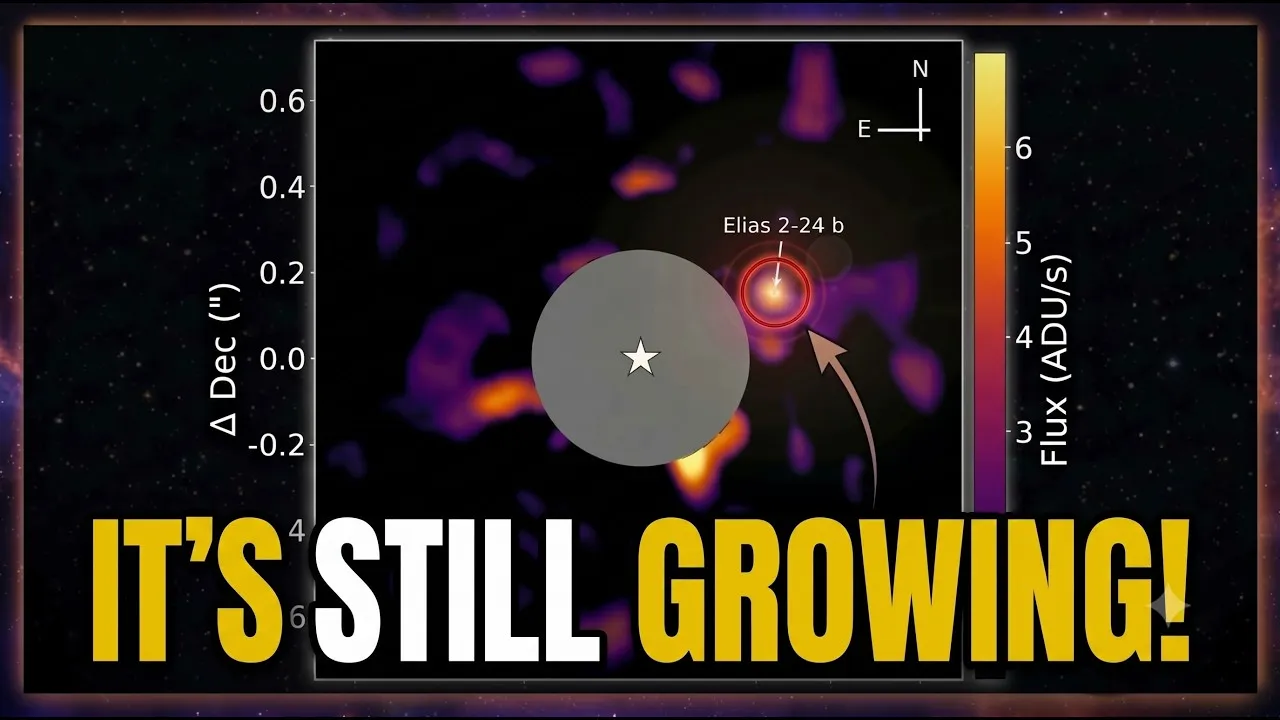
The planet, located roughly 450 light-years away from Earth, was identified using observations preserved in NASA-funded archives.
Elias 2-24 b is still orbiting within its young star's dusty disk, giving scientists a rare opportunity to study planet formation while it is still happening.
Most confirmed exoplanets have been found through transits, but baby planets like Elias 2-24 b are heavily shrouded in cosmic dust, making traditional transit hunting nearly impossible.
Instead, astronomers had to look for a world carving out a clean pathway directly through its dusty nursery.
The confirmation of Elias 2-24 b resolves a question astronomers have been debating for about 10 years.
The planet's surprisingly rapid formation challenges leading theories about how giant planets come together, especially so far from their stars.
Based on its brightness and current models of planetary evolution, they estimate the planet’s mass at between 1.9 and 4 times that of Jupiter.
The team also found that the infant planet is still incredibly hot due to the energy emitted during its creation.
What this adds
The discovery of Elias 2-24 b challenges existing theories about planet formation and offers a unique opportunity to study the early stages of planetary development.
The planet's rapid formation and location within its star's dusty disk provide new insights into the processes of planet formation.
The confirmation of Elias 2-24 b resolves a decade-long debate among astronomers about the age and formation of young planets.
The planet's mass and temperature estimates suggest it is still in the process of growing and cooling.
Background
Astronomers have confirmed the existence of a Jupiter-sized planet, named Elias 2-24 b, which is less than a million years old, making it the youngest known planet ever discovered.
Astronomers may have discovered a giant planet in the habitable zone of the hottest star yet, HD 156295.
What's confirmed
- According to the Science Daily website, the planet, called Elias 2-24 b, was identified using observations preserved in NASA-funded archives.
- "Our planet-formation models already struggled to explain the previous record holders for the youngest known planet -- a four-way tie between two planets orbiting the star PDS 70 and two planets orbiting the star WISPIT 2 -- which are all more than 5 million years old," said Lucas Cieza, a professor at the Instituto de Estudios Astrofísicos in Chile and co-author of a paper detailing the results, as quoted by the website of Science Daily.
- "Elias 2-24 b shows us that even our best planet-formation models are still missing some important processes," added Cieza.
- "The planets should be found within the gaps, since they are carving them," Bernardi said.
- Most confirmed exoplanets have instead been found through transits.
- "The galaxy churns out new stars and planets continuously, so there are many in every stage of evolution," Cieza said.
- A Decade-Old Mystery Comes Into Focus The new confirmation also resolves a question astronomers have been debating for about 10 years.
- Add ANI As A Trusted Source For Reliable Information ANI | Updated: Sep 17, 2026 21:50 IST Chennai (Tamil Nadu) [India], September 17 (ANI): Astronomers have confirmed the existence of a Jupiter-sized planet that is less than a million years old.
- Named Elias 2-24 b, it is the youngest known planet, offering scientists a rare opportunity to observe a world in the early stages of its formation.
- Its surprisingly rapid formation challenges leading theories about how giant planets come together, especially so far from their stars.
- Astronomers have confirmed the youngest known planet yet, a world less than 1 million years old that is still surrounded by the gas and dust from which it formed.
- It is still orbiting within its young star's dusty disk, giving scientists a rare opportunity to study planet formation while it is still happening.
What's still developing
- “Our planet-formation models already struggled to explain the previous record holders,” scientists noted, highlighting how Elias 2-24 b proves our existing theories are still missing important physical processes.
- A planet under a million years old isn’t just young, it’s practically a newborn still hanging out in the delivery room.
- It took astronomers a decade of cosmic sleuthing across multiple observatories: The faint glowing dot wasn’t an imaging glitch or a distant background star—it was an actual planet moving in lockstep with the gap in the disk.
- Astronomers had spotted clues there before, but a new analysis of observations from the W.
- Other observations showed a faint source near it, raising the possibility of a planet.
- The bright point in the image is evidence of a forming world, but its glow does not tell astronomers its mass without assumptions about its atmosphere and how it is growing.
- “We are mostly blind to these baby planets right now,” Dr. Cieza said.
- Dubbed Elias 2-24 b, the planet lies inside a narrow gap in a disk of gas along with dust surrounding its young star.
- Can’t-miss innovations from the bleeding edge of science and tech Astronomers have discovered the youngest planet ever observed — and they say it’s even bigger than Jupiter.
- The international team of researchers, led by the University of Hawaii, discovered the planet — dubbed 2M0437b — in a “stellar nursery” roughly 450 light-years away, according to a press release from the university about their findings in Monthly Notices of the Royal Astronomical Society.
- “This serendipitous discovery adds to an elite list of planets that we can directly observe with our telescopes,” Eric Gaidos, professor at the University of Hawaii and lead author of the study, said in the release.
- The stellar nursery where the planet was discovered is located in a molecular cloud — an area of space that’s highly conducive to the formation of stars and planets.