
Home · Science · Oct 7 archive
Nicaragua's Masaya Volcano Has Two Active Magma Reservoirs
Confirmed
In Short: Satellite data from 2018 to 2024 suggests Masaya volcano, located about 12 miles southeast of Managua, has two active magma reservoirs.
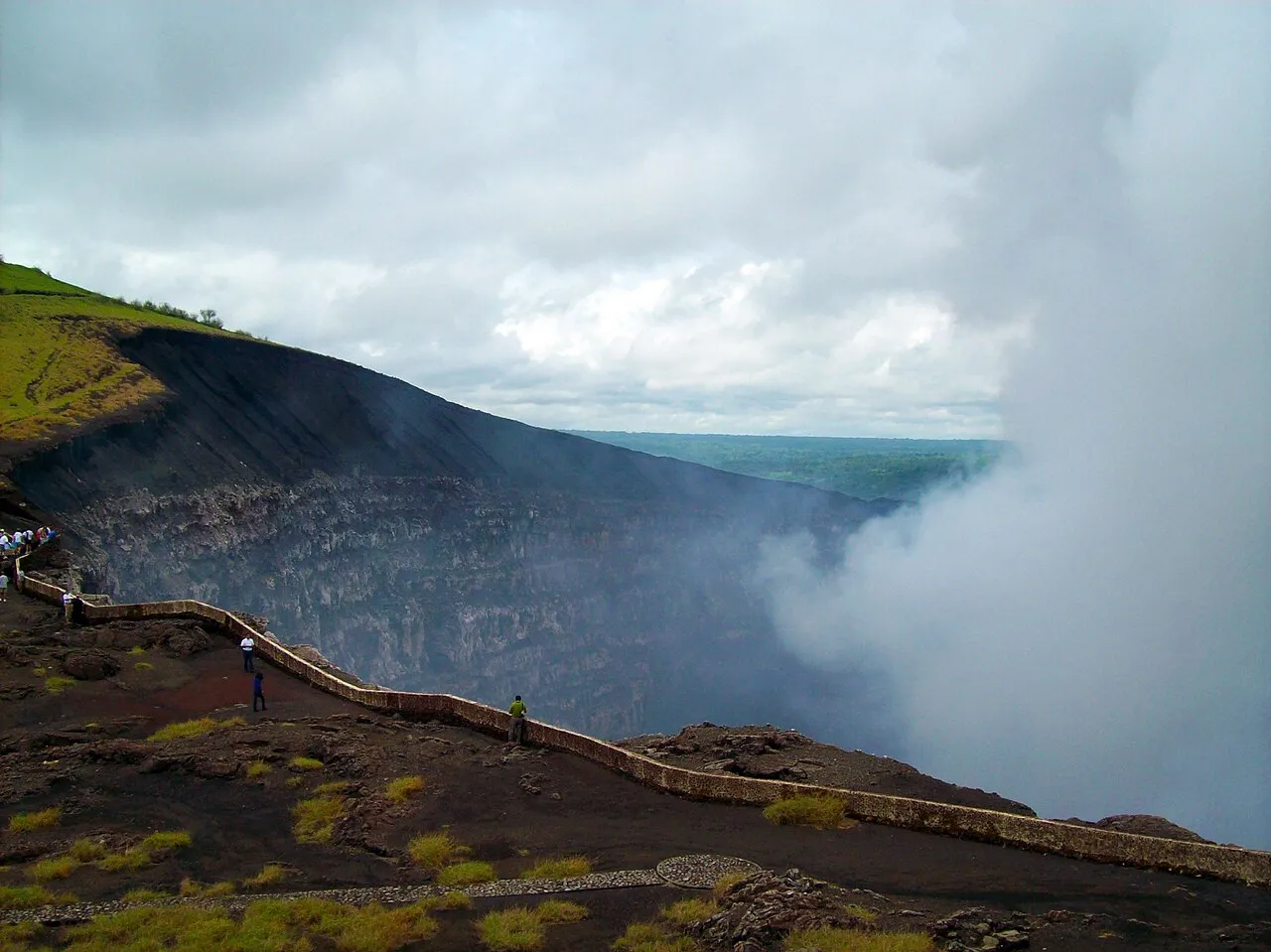
Satellite data from 2018 to 2024 suggests Masaya volcano, located about 12 miles southeast of Managua, has two active magma reservoirs, according to a study published in the journal Geophysical Research Letters.
The deeper reservoir is now refilling, while the shallower one, located just a few hundred feet below the active crater, has been slowly draining.
Lizzie Johnson, who led the research as an undergraduate at Penn State and is now pursuing her PhD in Earth sciences at the University of Hawaii at Manoa, said, “Having a thorough understanding of Masaya’s volcanic activity and its related hazards is critical, as around 2 million people live near Masaya, and the caldera is a national park and popular tourist destination.”
The researchers analyzed ground deformation at Masaya using a time series of observations from the European Space Agency’s Sentinel-1 satellite from January 2018 to February 2024.
The method, called InSAR, short for interferometric synthetic aperture radar, allowed the team to track changes in the distance between the satellite and the ground, indicating whether the ground was uplifting or subsiding.
Johnson explained, “When it’s subsiding, that means that there’s probably magma draining away from the volcano, but once the ground starts uplifting again, that can mean that there’s potentially new magma moving in.”
The volcano's famous lava lake is just a small surface feature of the much larger volcano complex, which researchers are still trying to understand.
The volcano has also produced several explosions over the past five decades, though very few people have been injured.
The volcano's complex magma systems have made it difficult for researchers to understand how they work.
The volcano's active vent is in the Santiago crater, which held a lava lake from December 2015 until a landslide covered it in March 2024.
Johnson added, “Further long-term geodetic and modeling studies will provide a more thorough understanding and allow for effective hazard monitoring and mitigation at Masaya and other lava-lake hosting basaltic volcanoes.”
What this adds
The study adds new details about the volcano's magma reservoirs and their activity, which could improve monitoring and eruption forecasting.
The volcano's complex magma systems have made it difficult for researchers to understand how they work, according to Johnson.
The volcano's famous lava lake is just a small surface feature of the much larger volcano complex, which researchers are still trying to understand.
Background
Satellite data from 2018 to 2024 indicates that Nicaragua's Masaya volcano, located about 12 miles southeast of Managua, has two active magma reservoirs, according to a study published in the journal Geophysical Research Letters.
What's confirmed
- Masaya volcano rises about 12 miles (20 kilometers) southeast of Managua, the capital of Nicaragua.
- “Although Masaya last produced a major lava flow in 1772, its persistent degassing often produces dangerously high concentrations of sulfur dioxide volcanic gas,” Johnson said.
- “When it’s subsiding, that means that there’s probably magma draining away from the volcano, but once the ground starts uplifting again, that can mean that there’s potentially new magma moving in,” Johnson said.
- “This indicates that the plumbing system is more complex and could be due to decreasing magma in a second, shallower reservoir,” Johnson said.
- Masaya is a basaltic shield volcano with a nested set of cones and craters.
- Their findings, published in the journal Geophysical Research Letters, suggest this volcano is fed by not one, but two active magma reservoirs.
- “Having a thorough understanding of Masaya’s volcanic activity and its related hazards is critical, as around 2 million people live near Masaya, and the caldera is a national park and popular tourist destination,” Lizzie Johnson, who led the research as an undergraduate in Penn State’s geosciences program and is now pursuing her PhD in Earth sciences at the University of Hawaii at Manoa, said in a statement.
What's still developing
- “These observations help scientists better understand how magma moves beneath Masaya and may improve monitoring and eruption forecasting in the future,” Johnson said.
- “Cloud penetration is important for volcanoes because many of them, like Masaya, are in tropical areas where there is often cloud cover,” Kim said.
- Johnson is now heading to Kīlauea in Hawaii, where she has started a doctorate at the University of Hawaii at Manoa, and that volcano turns out to have a similar two-level system, with lava lakes of its own and occasional explosive activity.
- Satellite measurements now suggest that two separate pools of magma are active beneath it.
- In the distant past, Masaya produced at least four large, explosive eruptions that formed calderas.
- Today, understanding what drives those transitions is critical to assessing the threat the volcano poses to millions living within 13 miles (21 kilometers) of it.
- Over the course of the entire six-year period, the area around the active Santiago crater consistently sank, hinting at a second, shallower magma reservoir located about 656 feet (200 meters) underground.
- When Spanish conquistadors first laid eyes on the Masaya volcano’s lava lake in the early 1520s, some believed it must be the entrance to hell.
- Recent activity from Nicaragua’s busiest volcano has mostly consisted of passive degassing, lava lake formation, and vent-clearing blasts, but Masaya has also produced at least four massively explosive Vesuvian eruptions throughout its history.
- These volcanoes tend to produce slow, effusive lava flows, but Masaya can transition between effusive eruptions and more dangerous explosive behavior.
- Given how many people are on and around this well-and-truly active volcano, scientists are keeping a very close eye on what it's up to.
- The researchers traced that signal to a small, separate reservoir roughly 660 feet (200 meters) below the crater, which lost a few thousand cubic meters of volume in each period.