
Home · Science · Oct 5 archive
Ancient Egyptian Skulls Show Signs of Sacrifice
Confirmed
In Short: Campbell noted that the debate over whether ancient Egyptians practiced retainer sacrifice has long been contentious, with many Egyptologists divided into two camps.
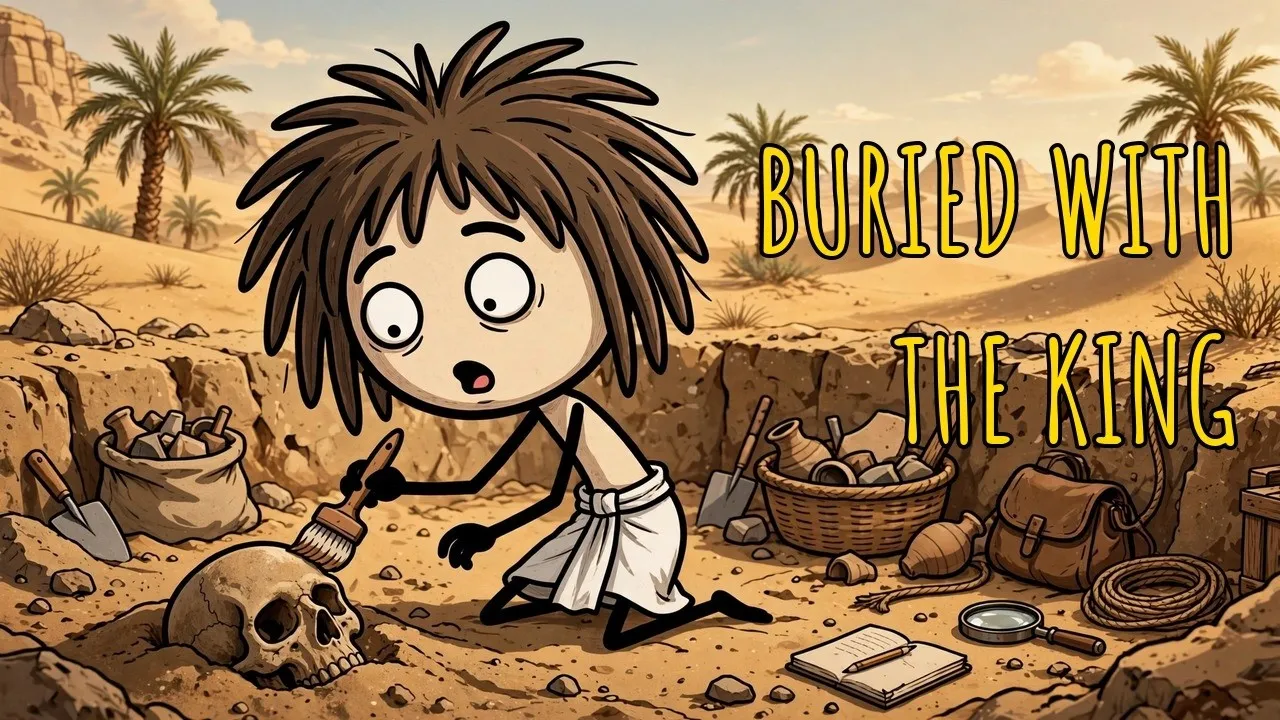
Archaeologist Roselyn Campbell has reassessed a collection of skulls excavated by Flinders Petrie in the 1920s, finding that about 39 percent of the skulls show signs of blunt force trauma.
The skulls were excavated from tombs at the Abydos site in southern Egypt, a royal necropolis where early pharaohs were buried.
Campbell's analysis, published in the journal Frontiers in Environmental Archaeology, suggests that these individuals may have been victims of retainer sacrifice, a practice where servants and officials were killed to accompany their rulers in the afterlife.
Campbell noted that the debate over whether ancient Egyptians practiced retainer sacrifice has long been contentious, with many Egyptologists divided into two camps.
The presence of linear fractures in 18 of the 46 skulls Campbell examined indicates that the trauma occurred around the time of death, supporting the hypothesis of retainer sacrifice.
Campbell emphasized the importance of context in interpreting archaeological evidence, noting that previous excavations were influenced by colonial and racist ideas.
"At the time, it was very common to focus most of the attention on the skull, and part of that was because phrenology and similar ideas held sway," Campbell told Ars Technica.
"Petrie was, in many ways, ahead of his time as far as taking notes, but he was also a product of his time," Campbell added.
"For the crania without trauma, we cannot be certain they were sacrificed," Campbell told The Guardian.
"It's quite possible that some of the retainers were sacrificed, while others were not," she noted.
Campbell's work highlights the ongoing self-correction in scientific methods and the importance of preserving as much knowledge as possible for future researchers.
"I’m interested in how we as human beings decide which types of violence are okay and which are not, and how we even define violence," Campbell told Ars Technica.
What this adds
The debate over retainer sacrifice has long been contentious, with many Egyptologists divided into two camps.
The 46 skulls represent only about 5 to 15 percent of those originally buried around the monuments, and most of the rest of their skeletons were reburied and are missing.
Background
According to the study, the debate over whether ancient Egyptians practiced retainer sacrifice has long been contentious, with many Egyptologists divided into two camps: those who believe it occurred and those who do not.
The debate over whether ancient Egyptians practiced retainer sacrifice, where servants and officials were killed to accompany their rulers in the afterlife, has long been contentious.
The civilization's history is divided into periods of stability—the Old Kingdom (c. 2686–2181 BCE), Middle Kingdom (c. 2055–1650 BCE), and New Kingdom (c.
What's confirmed
- Archaeologist Flinders Petrie suspected a century ago that the people buried around Egypt's first kings were retainers, killed when the kings died, but he found no wounds to prove it.
- Most of the bodies from Petrie's digs at Abydos in Egypt went back into the ground, but he kept the skulls and sent some of them to the U.K. When Campbell looked again with current forensic techniques, 18 of the 46 showed fractures from around the time of death.
- The tombs date to about 5,000 years ago, when Egypt's first kings ruled the newly united country.
- Some of the skulls also showed injuries from something sharp, and one person had a chopping wound to the eye.
- Learn how modern forensics uncovered evidence that Egypt’s royal retainers may have been killed to serve their rulers in the afterlife.
- Roselyn Campbell wanted to see what modern forensics could make of the skulls he kept.
- Modern forensic methods revealed breaks from around the time of death in 18 of the 46 skulls he kept.
- “Retainer sacrifice is a type of human sacrifice where those close to a ruler are killed when the ruler dies,” Campbell explained.
- Campbell found that 18 of those 46 skulls, about 39%, carry breaks that happened around the time of death.
What's still developing
- The excavation revealed a primary burial accompanied by a deposit of bones and skulls without any anatomical relationship.
- The excavation team’s analysis suggests that the burial may have been part of funeral rites performed in the domestic units of the region, potentially involving the sacrifice of male members of the same family to celebrate the founding of a settlement.
- Archaeologists from the National Institute of Anthropology and History (INAH) have uncovered an offering of human sacrifices dating back to the pre-Hispanic era in the Mexican town of Pozo de Ibarra.
- The discovery occurred during the construction of a sewage network, revealing a burial site with a complex arrangement of human bones and skulls.
- Among the findings were femurs, tibias, ulnas, and at least seven complete skulls, all deliberately positioned or stacked atop one another.
- Some of the skulls displayed evidence of cranial modification, a practice common among Mesoamerican cultures for aesthetic and possibly social distinction purposes.
- Newly-completed research examining cranial injuries found in these burial grounds indicates significant evidence for the concept of 'sacrificed' individuals, with nearly 40% of the individuals in these burial sites having sustained head trauma near the time of their death in order to serve their deceased rulers in the afterlife.
- The extent of burial grounds can be found at Umm el-Qaab, the royal burial ground adjacent to Abydos, in southern Egypt, where rulers of the First Dynasty built tombs and constructed ceremonial structures in what can be estimated to be between 3078 and 2900 BC.
- However, Petrie found no signs of trauma on the skulls that was a significant drawback in his explanation of the discovery.
- The 46 skulls represent only about 5 to 15 percent of those originally buried around the monuments, and most of the rest of their skeletons were reburied and are missing.
- "would likely cause rapid unconsciousness, internal bleeding, and death."
- As for dumping the rest of the bones in a mass grave, “They had found so many remains, so the bones were treated fairly casually,” said Campbell.
Sources
- Ancient Originslink
- Ars Technicalink
- Discover Magazinelink
- Earth.comlink
- Gizmodolink
- Nationalgeographiclink
- SciTechDailylink
- The Debrieflink
- Thenationalnewslink
- Dailynewsegyptlink
- Archaeologymaglink
- ScienceAlertlink
- WarpBeat — background on New Evidence Suggests Ancient Egyptian Retainer Sacrifice link
- WarpBeat — background on Ancient Egyptian Skulls Show Signs of Sacrifice link
- Grokipedia — background on Ancient Egypt link
- ORIGROX — video link