
Home · Science · Oct 3 archive
Physicists Uncover Hidden Topology in Quantum Entanglement
Confirmed
In Short: A team of physicists has uncovered a hidden topological structure within quantum entanglement, revealing complex spatial patterns that could revolutionize quantum information encoding.
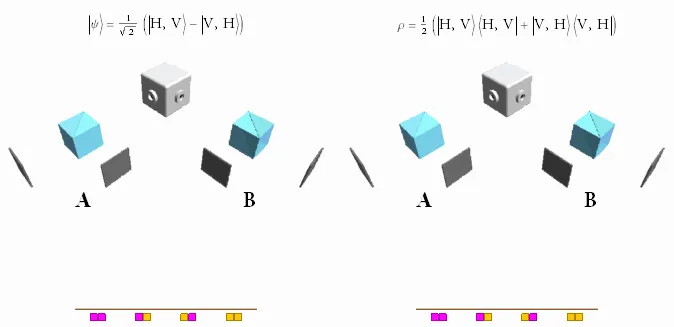
The researchers observed the highest level of topology ever reported in any physical system, spanning 48 dimensions and more than 17,000 distinct topological signatures.
By examining the spatial degrees of freedom, the team discovered that the structure of entangled light contains previously unnoticed high-dimensional topologies.
This method naturally generates entanglement in the spatial properties of light, using the orbital angular momentum (OAM) of light, which can exist in two-dimensional states as well as in far higher-dimensional configurations.
The consequence is that since OAM is high-dimensional, so too is the topology, and this let us report the highest topologies ever observed, according to the researchers.
In high dimensions, it is not so obvious where to look for the topology. We used abstract notions from quantum field theory to predict where to look and what to look for – and found it in the experiment!
The researchers also found that once the topology extends beyond two dimensions, it can no longer be described with a single number.
This vast set of patterns could function as a powerful new framework for encoding quantum information in ways that remain stable even in the presence of noise.
The team demonstrated these features using the orbital angular momentum (OAM) of light, which can exist in two-dimensional states as well as in far higher-dimensional configurations.
The researchers noted that the spatial topology of an optical field at the fundamental frequency is directly transferred to the generated harmonic radiation, offering a new way for generating structured light while overcoming material and nanofabrication constraints.
What this adds
This discovery builds on prior WarpBeat reporting that highlighted the potential of hidden topological structures within quantum entanglement.
Background
A team of physicists has uncovered a hidden topological structure within quantum entanglement, revealing complex spatial patterns that could revolutionize quantum information encoding.
What's confirmed
- The team reports the highest level of topology observed in any physical system so far: structures spanning 48 dimensions and more than 17,000 distinct topological signatures.
- By examining these spatial degrees of freedom, the researchers discovered that the structure of entangled light contains previously unnoticed high-dimensional topologies.
- The researchers also found that once the topology extends beyond two dimensions, it can no longer be described with a single number.
- A team of physicists has uncovered a hidden topological structure within one of the most widely used sources of quantum entanglement.
- Experiments that routinely generate entangled photons in laboratories appear to contain hidden topological structures.
- This vast set of patterns could function as a powerful new framework for encoding quantum information in ways that remain stable even in the presence of noise.
- This method naturally generates entanglement in the spatial properties of light.
- The team demonstrated these features using the orbital angular momentum (OAM) of light, which can exist in two-dimensional states as well as in far higher-dimensional configurations.
What's still developing
- When asked if the iPhone Duo's crease would be more visible over time, as that's what tends to happen on other foldables, Marieb said the nano-texture display would help.
- When you look at glossy displays, their specularity makes it very easy to pick up topology differences.
- We really worked on the torque profile very heavily, and that means changing a lot of the mechanical properties of the hinge to have it feel solid, like a high-end automobile's car door, when you shut it.
- In some cases, there is an actual physical and straight path that can take you back to where you started, but not to when you started, Andrew Jaffe, professor of cosmology and astrophysics at Imperial College London, told me via email.
- Cosmologists have been observing the CMB since the 1960s, but only since the early 2000s have they had enough sensitivity to detect the patterns that would enable them to see topology.
- The modern era of cosmic topology started in the late 1990s when we realized we could use patterns in the CMB to look for topology, Jaffe, author of the 2025 book “The Random Universe: How Models and Probability Help Us Make Sense of the Cosmos,” told me.
- But in the last few years, Jaffe and colleagues have created a group called COMPACT (Collaboration for Observations, Models and Predictions of Anomalies and Cosmic Topology), now comprising about twenty international scientists dedicated to thinking about this topological problem.
- The existence of paths like this indicates the kind of topology we are looking for, he says.
- Because we know that the scale of the topology, if it is something like a torus, must be large enough that we can’t observe those twins, says Jaffe.
- If some aspects of cosmic topology turn out to be true, the idea that starships might voyage the cosmos over hundreds of thousands of light years without ever returning to the same neck of space-time could be problematic.
- That’s because some aspects of cosmic topology (the global shape and connectivity of our cosmos) could dictate a closed loop universe — at least on the largest scales.
- But global topology may ultimately invalidate part, or all of that axiom.