
Home · Science · Oct 2 archive
Black Holes May Quietly Grow Alongside Galaxies
Confirmed
In Short: According to Zhu's research, the black holes at the centers of these galaxies are not just consuming material but are actively reshaping their surroundings.
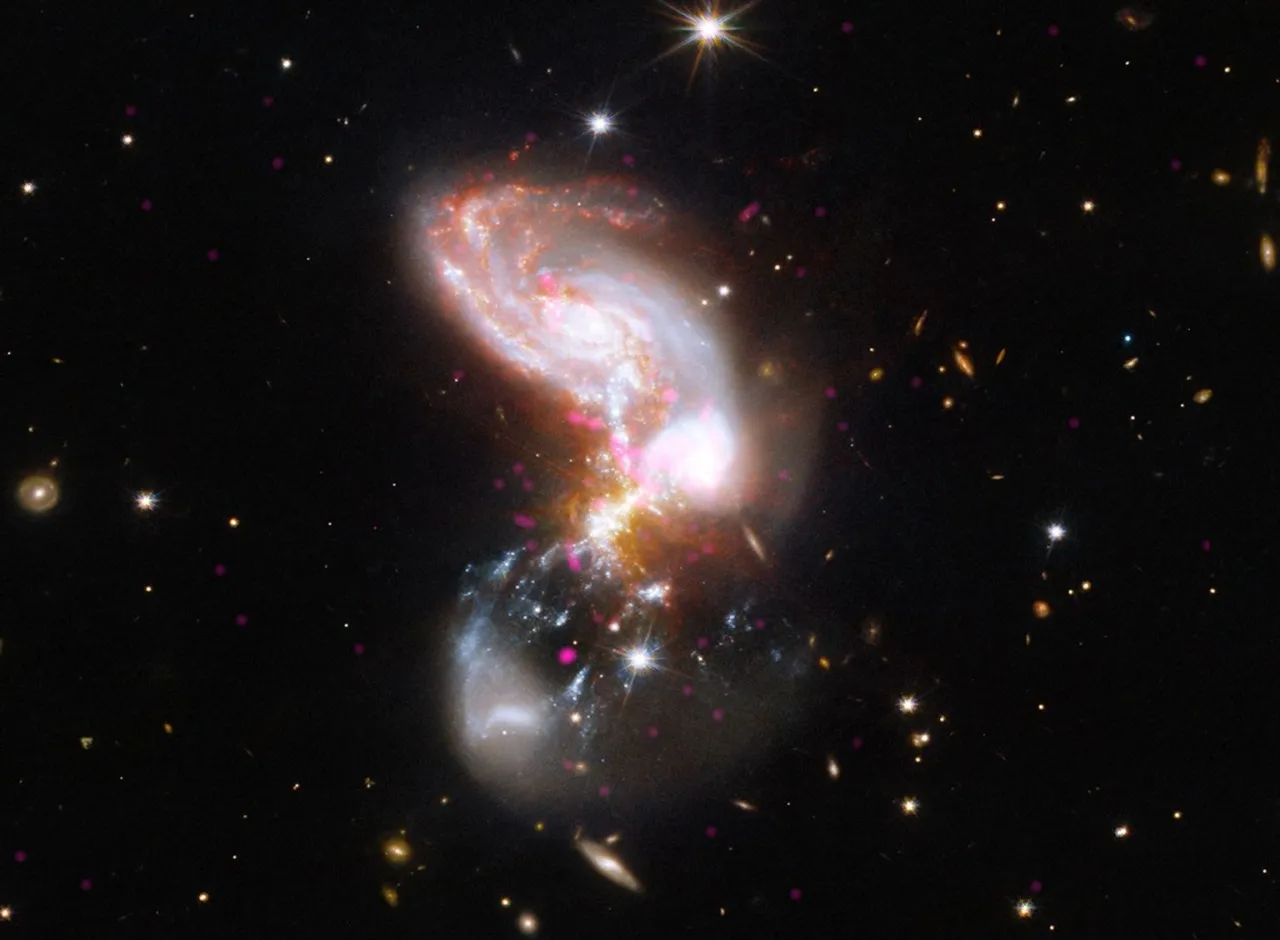
A study by Harvard Center for Astrophysics graduate student Peixin Zhu, using the Very Large Telescope in Chile, reveals that active galactic nuclei (AGN) in nine nearby Seyfert galaxies are associated with star formation.
The team differentiated sites of star formation from black hole radiation and excitation by shock fronts moving through the galaxy from the black hole through the interstellar medium.
They also found ionized cones of black-hole radiation extending away from the galactic cores, with fast shocks radiating out perpendicular to the cones.
These galaxies contain star-forming rings or arcs, as well as regions of energized gas and fast shock fronts associated with energetic outflows interacting with neighboring gas clouds.
The AGN-related activity could well be playing a role in the growth and evolution of galaxies.
The study focused on galaxies that have central supermassive black holes busily accreting material from nearby regions.
The colors represent star formation in red, black-hole radiation in blue, and shocks in yellow.
The nine galaxies studied lie within about 360 million light-years, and each has an active nucleus powered by the action of a supermassive black hole.
These galaxies are Type 2 Seyfert galaxies, which means they can appear bright in infrared light, their emission lines are often narrow, and the velocities of their gas outflows are not as fast as in other Seyfert galaxies.
What this adds
These findings suggest that massive clouds of cold gas coalesced at the center of early galaxies and collapsed to form black holes, known as the Direct-Collapse Black Hole (DCBH) scenario.
This research challenges existing models of black hole formation and suggests that black holes may grow quietly alongside galaxies even without violent mergers.
Background
A new study of nine nearby galaxies has revealed that actively growing supermassive black holes may contribute to star formation, contrary to previous assumptions.
A new study published in the Astrophysical Journal reveals that actively growing supermassive black holes may promote star formation in their host galaxies, contrary to previous assumptions.
What's confirmed
- A study by Harvard Center for Astrophysics graduate student Peixin Zhu, using the Very Large Telescope in Chile, reveals that active galactic nuclei (AGN) in nine nearby Seyfert galaxies are associated with star formation.
- The team differentiated sites of star formation from black hole radiation and excitation by shock fronts moving through the galaxy from the black hole through the interstellar medium.
- They also found ionized cones of black-hole radiation extending away from the galactic cores, with fast shocks radiating out perpendicular to the cones.
- These galaxies contain star-forming rings or arcs, as well as regions of energized gas and fast shock fronts associated with energetic outflows interacting with neighboring gas clouds.
- The AGN-related activity could well be playing a role in the growth and evolution of galaxies.
- The study focused on galaxies that have central supermassive black holes busily accreting material from nearby regions.
- The colors represent star formation in red, black-hole radiation in blue, and shocks in yellow.
- The nine galaxies studied lie within about 360 million light-years, and each has an active nucleus powered by the action of a supermassive black hole.
- These galaxies are Type 2 Seyfert galaxies, which means they can appear bright in infrared light, their emission lines are often narrow, and the velocities of their gas outflows are not as fast as in other Seyfert galaxies.
What's still developing
- “We’re seeing that black holes are not just consuming material at the centers of galaxies, but they’re actively reshaping their surroundings,” said Lisa Kewley, an astrophysicist at the Center for Astrophysics | Harvard & Smithsonian, director of the Center, and Zhu’s advisor.
- The black holes at the hearts of galaxies get the credit and/or blame for a lot of things in their hosts.
- For example, they take the blame for gobbling up star-forming material, effectively "quenching" starbirth in some areas of galaxies.
- Anderson, who will again serve as showrunner, executive produces alongside Swisher and Kate Gordon under their Rolling Clover banner as well as Black Label Media.
- For the occasion—where Hawke’s upcoming film The Weight was listed as one of the movies set to premiere at the event—the 55-year-old looked dapper in a jet-black suit and matching dress shoes.
- Indeed, Ryan—who wed Ethan in 2008—coordinated with her husband as she donned a black long-sleeve dress and matching heels.
- Kyrie Irving says he will cover a $11,492 fine that Texans linebacker Azeez Al-Shaair incurred for writing the name of a young Palestinian girl killed by Israel’s military on his eye black. pic.twitter.com/ljGY61LAhF The Houston Texans linebacker wrote “Hind Rajab” across his eye black strips during the team’s 36-31 loss to the Buffalo Bills.
- The Magazine of Hip Hop Music, Culture and Politics Azeez Al-Shaair used two words on his eye black to honor a child whose death became a global symbol of the human toll in Gaza.
- Rajab was a 5-year-old Palestinian girl killed alongside members of her family in Gaza City in January 2024.
- Wednesday, September 23, 2026 · 2:10 PM ET In Short: These findings, published in The Astrophysical Journal Letters, suggest that massive clouds of cold gas coalesced at the center of early galaxies and collapsed to form black holes, known as the Direct-Collapse Black Hole (DCBH) scenario.
- Astronomers using the Cosmic Archaeology Tool (CAT) have detected massive black hole seeds forming as early as 500 million years after the Big Bang, challenging existing models of black hole formation.
- The CAT, a semi-analytic model used to interpret high-redshift sources, revealed that massive black hole seeds could form via direct collapse as early as 13.64 billion years ago.
Sources
- Universe Todaylink
- Deadlinelink
- Eonlinelink
- Thesourcelink
- Warpbeatlink
- Quanta Magazinelink
- NASAlink
- Contactmusiclink
- Cosmicbooklink
- T2Onlinelink
- Universe Todaylink
- Darkhorizonslink
- Al Jazeeralink
- WarpBeat — background on Study Reveals Black Holes May Promote Star Formation link
- WarpBeat — background on Black Holes May Promote Star Formation, Study Shows link
- wealth path — video link