
Home · Science · Sep 29 archive
Theoretical Physicists Propose Black Hole Decay Into Boson Star
Confirmed
In Short: Theoretical physicists have proposed a novel method of black hole decay that could result in the formation of a boson star, according to a study published in ScienceAlert.
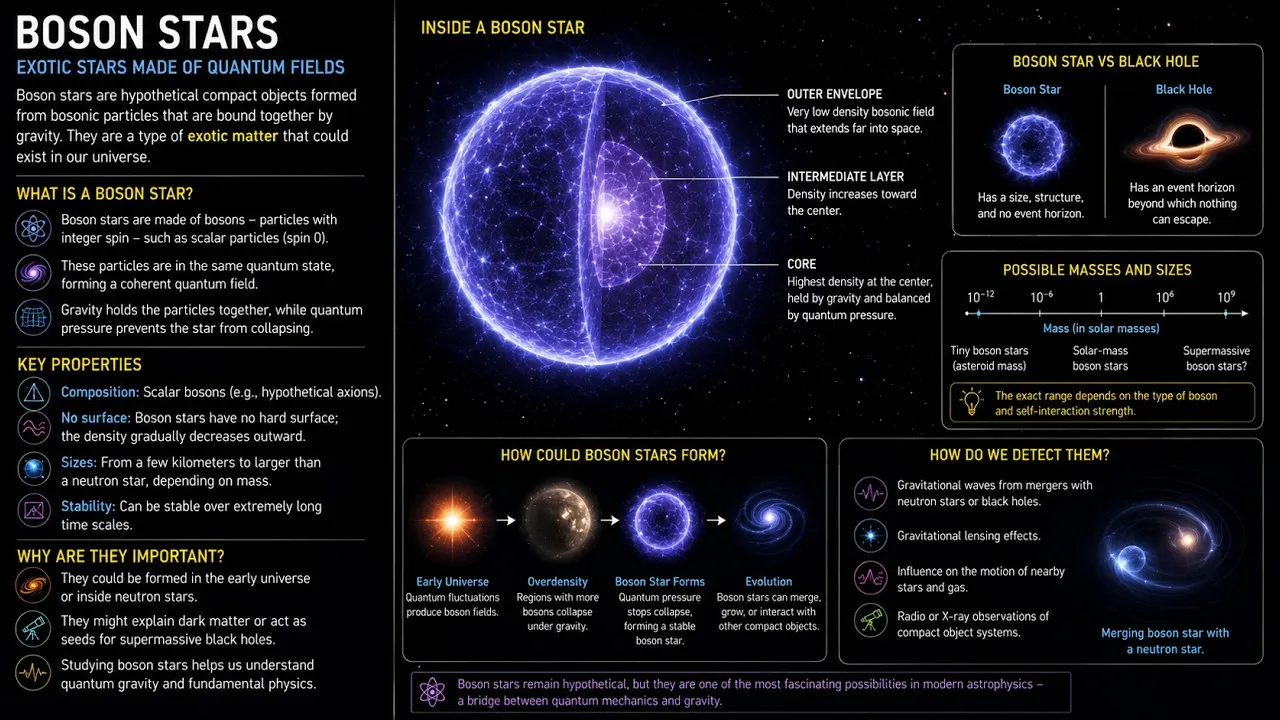
Theoretical physicists have proposed a novel method of black hole decay that could result in the formation of a boson star, according to a study published in ScienceAlert.
Black holes, typically considered eternal under standard general relativity, could potentially decay through a mechanism that ejects their 'hair'—a term used to describe the scalar field surrounding them—leaving behind a fully functional boson star.
The research team, including José Ferreira, Carlos Herdeiro, Eugen Radu, and Miguel Zilhão from the University of Aveiro in Portugal, found that this decay process is possible due to a resonance mechanism that allows the scalar field and the black hole's horizon to remain in equilibrium.
The study reveals that in this decay process, the black hole exists in a three-dimensional space but must behave identically in all directions.
This research opens up new possibilities for understanding black holes, as it suggests that there may be other parameters and behaviors that have yet to be discovered.
Black holes, known for their extreme conditions, offer unique opportunities for physicists to explore forms of matter and fields that are otherwise difficult to detect.
The team's findings could have implications for understanding the behavior of black holes and their influence on star formation in galaxies.
The research also highlights the complexity of black hole dynamics and the potential for new discoveries in the field of astrophysics.
What this adds
The study adds to the ongoing exploration of black hole behavior and their impact on galactic environments.
The research team's findings suggest that black holes may play a more active role in star formation than previously thought.
What's confirmed
- Theoretical physicists have proposed a novel method of black hole decay that could result in the formation of a boson star, according to a study published in ScienceAlert.
- Black holes, typically considered eternal under standard general relativity, could potentially decay through a mechanism that ejects their 'hair'—a term used to describe the scalar field surrounding them—leaving behind a fully functional boson star.
- The research team, including José Ferreira, Carlos Herdeiro, Eugen Radu, and Miguel Zilhão from the University of Aveiro in Portugal, found that this decay process is possible due to a resonance mechanism that allows the scalar field and the black hole's horizon to remain in equilibrium.
- The study reveals that in this decay process, the black hole exists in a three-dimensional space but must behave identically in all directions.
- This research opens up new possibilities for understanding black holes, as it suggests that there may be other parameters and behaviors that have yet to be discovered.
- Black holes, known for their extreme conditions, offer unique opportunities for physicists to explore forms of matter and fields that are otherwise difficult to detect.
- The team's findings could have implications for understanding the behavior of black holes and their influence on star formation in galaxies.
- The research also highlights the complexity of black hole dynamics and the potential for new discoveries in the field of astrophysics.
What's still developing
- If anything is forever in this Universe, it's black holes – or so their physics suggests.
- Although they're some of the most extreme objects in physics, under standard general relativity, black holes are actually fairly straightforward – once they're settled and doing their thing, remarkably few parameters are required to describe their behavior – spin and mass, for example.
- In these solutions, however, there is a particular resonance mechanism that allows the scalar field and the black-hole horizon to remain in equilibrium," the researchers said. "The important open question was whether that equilibrium was actually stable once general perturbations were allowed.
- Although the black hole existed in three dimensions, anything that happened in one direction was required to happen identically in every other direction.
- In the fission regime, the symmetric configuration in which the black hole sits exactly at the center of the boson star is an unstable equilibrium," the researchers explained. "A useful analogy is a ball balanced at the very top of a mountain.
- Actually, we don't know what other parameters might be lurking in black-hole space – but math allows physicists to explore some really weird possibilities.
- Europe's misfiring star pair were beaten in both of Saturday's sessions and have contributed just half a point from four matches to the scoreline of 8-8 as the contest heads into Sunday's decisive 12 singles matches.
- "We didn't hole many putts in the morning and all afternoon, and that's the difference, really," Woad said.
- Yes, they’re going to New York while Guillermo is still competing on Dancing With The Stars.
- Even if the studio is Guillermo-less next week (no confirmation yet), Jimmy Kimmel will have plenty of guests to fill our funny, sidekick-shaped hole in our hearts.
- There is a physical speed limit to how fast gas can fall into a black hole, known as the Eddington limit, which, in theory at least, limits the size they should have been able to grow to by the time the JWST observed them.
- Observatories like LIGO and Virgo have found collisions between black holes whose masses sit inside an “upper mass gap” - essentially black holes of sizes where stellar evolution says stars can’t create black holes.