
Home · Business · Sep 23 archive
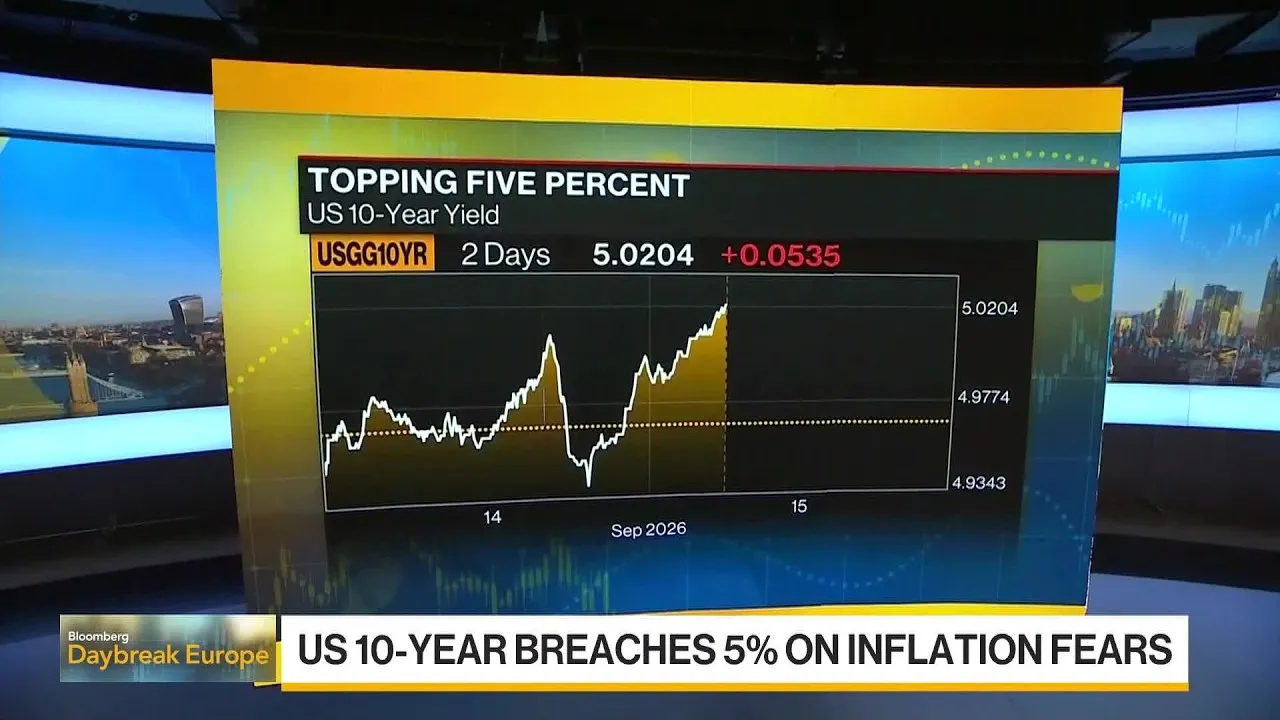
US 10-Year Treasury Yield Hits 2007 High Amid Inflation Worries
Confirmed
In Short: The 10-year Treasury yield spiked to its highest level since 2007, surpassing 5%, driven by rising oil prices and concerns about inflation. The yield reached 5.13% on Wednesday, its highest level since 2007, according to NBC News.
Stocks fell in response to the rise in yields and oil prices, with the S&P 500 down nearly 1%. The yield on the 10-year Treasury note closed at 4.8%, a level not seen in nearly three years, and more than 60 basis points above estimates from the Congressional Budget Office (CBO).
Angelo Kourkafas, senior global strategist at Edward Jones, noted, “The double headwinds of rising bond yields and oil prices are now testing the market's resilience, but stocks have not lost their key pillar of support, which is fast-rising earnings.”
The Federal Reserve is expected to raise the benchmark interest rate by 25 basis points, signaling a more challenging period ahead for the economy. The European Central Bank raised its key interest rates by 25 basis points on September 10, citing inflationary pressures from the ongoing conflict.
The 2-year Treasury yield spiked by 13 basis points to 4.91%, the highest since May 2024, according to Wolf Street. The 2-year yield is a strong signal for the Fed about its next policy moves, indicating the need for multiple rate hikes.
The 30-year Treasury yield also hit a 19-year record, reaching 5.39%, its highest since July 2004. The Treasury Department’s announcement to increase the size of its buyback program did not significantly impact yields.
The US Dollar strengthened, supported by rising US yields and rate-hike expectations, leading to a slide in growth-sensitive currencies like the New Zealand Dollar.
The 10-year Treasury yield’s rise was its sharpest one-day jump since April 9, 2025, a week after Trump’s tariffs began roiling global markets, according to Dow Jones data.
The Treasury buyback announcement, aimed at pushing down long-term Treasury yields, fell flat, with yields spiking further after the announcement.
The 10-year Treasury yield’s climb to 5.10% broke through the 5% ceiling it had been stuck on for two weeks, according to Wolf Street.
What this adds
The 10-year Treasury yield's climb to 5% is its highest level since 2007, driven by rising oil prices and concerns about inflation. This contrasts with the previous peak in 2023, which was driven by different economic factors.
The current spike in yields is testing market resilience, but stocks have not lost their key support from fast-rising earnings, according to Edward Jones.
The Treasury buyback program aimed at pushing down long-term Treasury yields did not achieve its intended effect, with yields spiking further after the announcement.
Background
The 10-year Treasury yield reached 5%, its highest level since 2023, driven by rising oil prices and concerns about inflation, while the US Dollar strengthened against other currencies.
What's confirmed
- The 10-year Treasury note closed at a high yield of 4.8%, a level not seen in nearly three years and more than 60 basis points above estimates from the Congressional Budget Office (CBO), while the 2-year Treasury yield is at a near 2-year high of 4.4%.
What's still developing
- Investors are watching if the calm lasts. The last time the 10-year Treasury yield touched 5% was October 2023.
- Treasury and overseas government bond yields over the past few weeks, the S&P 500 (.SPX), opens new tab sits just less than 3% below its August 13 record high, as the promise of AI-driven profit growth and economic resilience prompts investors to buy the dips — and perhaps limits the impulse to rotate into bonds.
- Rising yields typically pressure high-growth stocks because much of their appeal lies in expectations for future profits whose value diminishes as discount rates climb.
- If rates remain this high above projections, it would add an additional $2.3 trillion to the debt over the next decade.
- Rising rates, in addition to being caused by high debt, feed into it.
- Higher debt can also slow economic growth, which would boost debt further.
- One of the primary drivers of Wednesday’s rise in bond yields was the release of new economic data that revealed rising inflation.
- Treasury bonds jumped Wednesday and oil prices rose, sending stocks tumbling as investors braced for the prospect of future Fed rate hikes.
- Rising oil prices often translate into higher bond yields due to the effect that higher energy costs can have on inflation more broadly.
- Rising yields intensified pressure on equities, particularly growth and technology stocks.
- Without intervention, Dickens said, higher prices could be here to stay.
- PROVIDENCE, Rhode Island, May 18 - Investors are warning that lofty U.S. stock markets have not yet priced in the risk of rocketing inflation and are vulnerable to a sharp spike in bond yields.