
Home · Science · Sep 23 archive
Mysterious 'Little Red Dots' May Be Forming Supermassive Black Holes
Confirmed
In Short: Astronomers are rethinking the origins of supermassive black holes after observing mysterious 'little red dots' in the early universe.
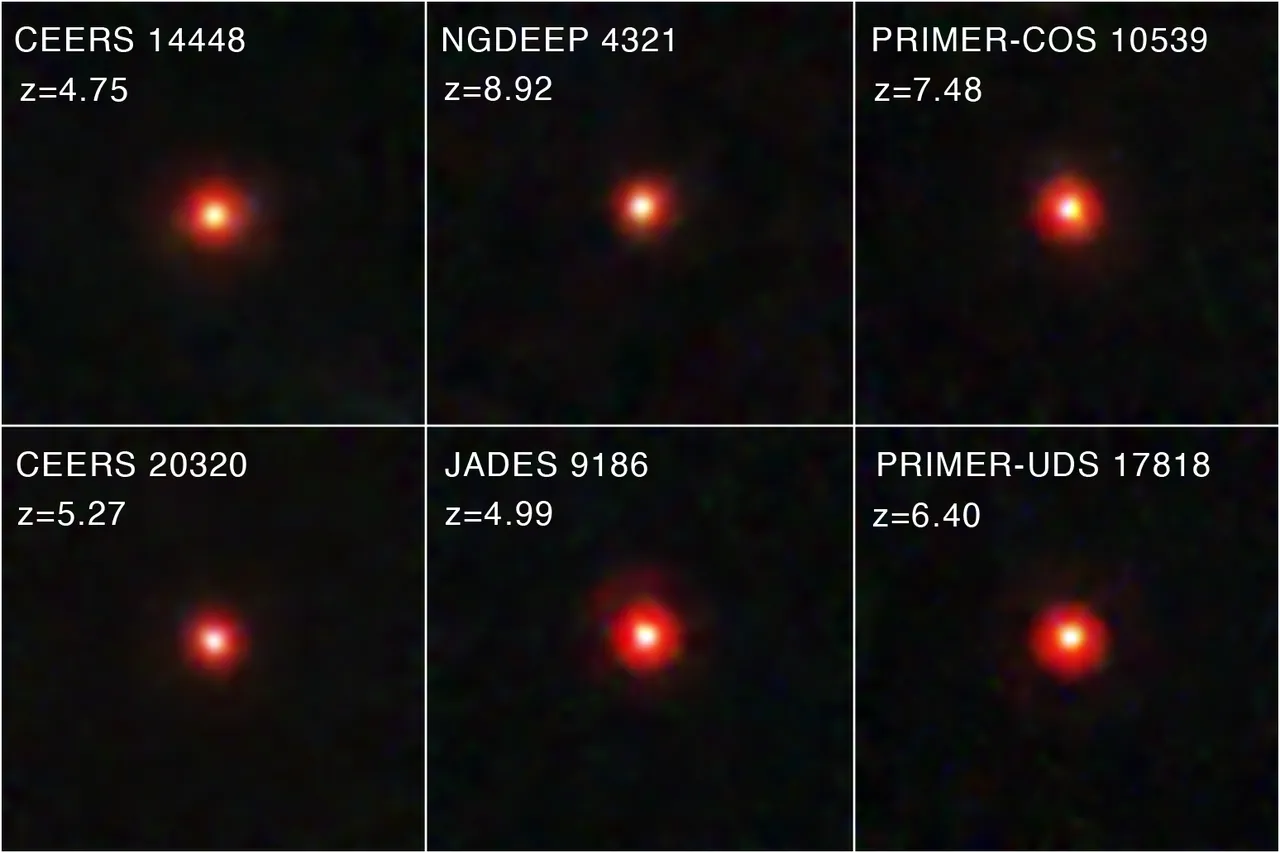
Astronomers are rethinking the origins of supermassive black holes after observing mysterious 'little red dots' in the early universe.
These dots, first noticed by the James Webb Space Telescope (JWST), are challenging existing theories about how supermassive black holes (SMBH) form.
According to new research published in The Astrophysical Journal Letters, these dots could be the visible parts of a population of super-Eddington black holes, indicating there could be many more waiting to be discovered.
The study, led by researchers at the Center for Astrophysics (CfA), suggests that these dots are early black holes, and their mergers could lead to the formation of SMBH.
Researchers at the CfA found that the spectrum of light from these dots shows hydrogen in ways that current models of young galaxies or ordinary active galactic nuclei can't explain.
The existence of such massive black holes so early in the universe challenges existing models of black hole formation, where stars collapse at the end of their lives to form black holes that gradually come together to create SMBH.
This led astronomers to consider a different pathway where massive clouds of cold gas coalesced at the center of early galaxies and collapsed to form black holes, known as the Direct-Collapse Black Hole (DCBH) scenario.
Understanding the growth of these black holes is crucial, as they challenge the conventional limits set by the Eddington limit, which theoretically restricts the size black holes can grow to.
The findings advance a technique called hydrogen intensity mapping, which uses the collective radio emissions of many galaxies to map large volumes of space.
MeerKAT’s direct detection of distant hydrogen emissions offers a way to study the universe’s structure during an earlier chapter of its history.
The signal traveled for roughly four to five billion years before reaching Earth, providing insights into the development of galaxies and the distribution of matter across the universe.
What this adds
Thursday, September 17, 2026 · 3:20 PM ET In Short: New research suggests the mysterious Little Red Dots observed by the JWST could be forming supermassive black holes.
Some researchers believe these dots are the visible parts of a population of super-Eddington black holes, indicating that there could be many more waiting to be discovered.
New research published in the Publications of the Astronomical Society of Japan presents evidence that LRDs are early black holes, and their mergers could lead to the formation of SMBH.
Understanding the growth of these black holes is crucial, as they challenge the conventional limits set by the Eddington limit, which theoretically restricts the size black holes can grow to by the time the JWST observed them.
Background
In the spring of 2025, astronomers announced the discovery of 'little red dots' that could be the early stages of supermassive black holes, challenging previous theories.
New research suggests the mysterious Little Red Dots observed by the JWST could be forming supermassive black holes.
What's confirmed
- Astronomers are rethinking the origins of supermassive black holes after observing mysterious 'little red dots' in the early universe.
- These dots, first noticed by the James Webb Space Telescope (JWST), are challenging existing theories about how supermassive black holes (SMBH) form.
- According to new research published in The Astrophysical Journal Letters, these dots could be the visible parts of a population of super-Eddington black holes, indicating there could be many more waiting to be discovered.
- The study, led by researchers at the Center for Astrophysics (CfA), suggests that these dots are early black holes, and their mergers could lead to the formation of SMBH.
- Researchers at the CfA found that the spectrum of light from these dots shows hydrogen in ways that current models of young galaxies or ordinary active galactic nuclei can't explain.
- The existence of such massive black holes so early in the universe challenges existing models of black hole formation, where stars collapse at the end of their lives to form black holes that gradually come together to create SMBH.
- This led astronomers to consider a different pathway where massive clouds of cold gas coalesced at the center of early galaxies and collapsed to form black holes, known as the Direct-Collapse Black Hole (DCBH) scenario.
- Understanding the growth of these black holes is crucial, as they challenge the conventional limits set by the Eddington limit, which theoretically restricts the size black holes can grow to.
- The findings advance a technique called hydrogen intensity mapping, which uses the collective radio emissions of many galaxies to map large volumes of space.
- MeerKAT’s direct detection of distant hydrogen emissions offers a way to study the universe’s structure during an earlier chapter of its history.
- The signal traveled for roughly four to five billion years before reaching Earth, providing insights into the development of galaxies and the distribution of matter across the universe.
What's still developing
- "visible" matter) component in all the progenitor halos using the Cosmic Archaeology Tool (CAT), a semi-analytic model used to interpret the properties of observed high-redshift sources and test different black hole evolution scenarios against observations.
- At high-redshift (z) values, corresponding to less than one billion years after the Big Bang, astronomers witnessed an abundance of galaxies that hosted what appeared to be the "seeds" of supermassive black holes (SMBHs).
- They detected hydrogen emissions from two periods in cosmic history using radio observations alone.
- Reliable detections at these distances have typically required combining radio data with optical surveys of galaxies.
- “Neutral hydrogen is one of the key ingredients for understanding how galaxies form and evolve,” said study co-author Dr. Zhaoting Chen.
- Measuring that stretching lets astronomers distinguish emissions from different stages of cosmic history.
- Because intensity mapping collects emissions from galaxies that are not individually resolved, it offers an efficient way to survey enormous regions of the universe.
- The two teams of astronomers propose that they are looking at a new astronomical object: a topsy-turvy lump of hydrogen that shines with the light of billions of suns while hiding a black hole deep in its core.
- When all you can see is a speck, it’s hard to tell what you’re looking at.
- As black holes, the little red dots would appear red because dust — grainy stuff much more complicated than gas — was blocking their blue light.
- Initially, researchers thought the dots looked kind of like galaxies.
- Anna de Graaff of the Max Planck Institute for Astronomy in Heidelberg, Germany, suspects that many of the little red dots are giant stars with black holes hidden inside them.
Sources
- Cfalink
- Quanta Magazinelink
- Universe Todaylink
- Warpbeatlink
- Scitechdailylink
- NASAlink
- Universe Todaylink
- Scilink
- CBS Newslink
- Laserfocusworldlink
- NASAlink
- Symmetrymagazinelink
- WarpBeat — background on New Observations Suggest Little Red Dots May Be Forming Supermassive Black Holes link
- Leveraging You — video link