
Home · Science · Sep 21 archive
Astronomers Debate Nature of 'Little Red Dots
Confirmed
In Short: Two teams of astronomers have sparked a debate over the nature of 'little red dots' observed by the James Webb Space Telescope, suggesting these dots could be witnessing the birth of supermassive black holes inside colossal stars.
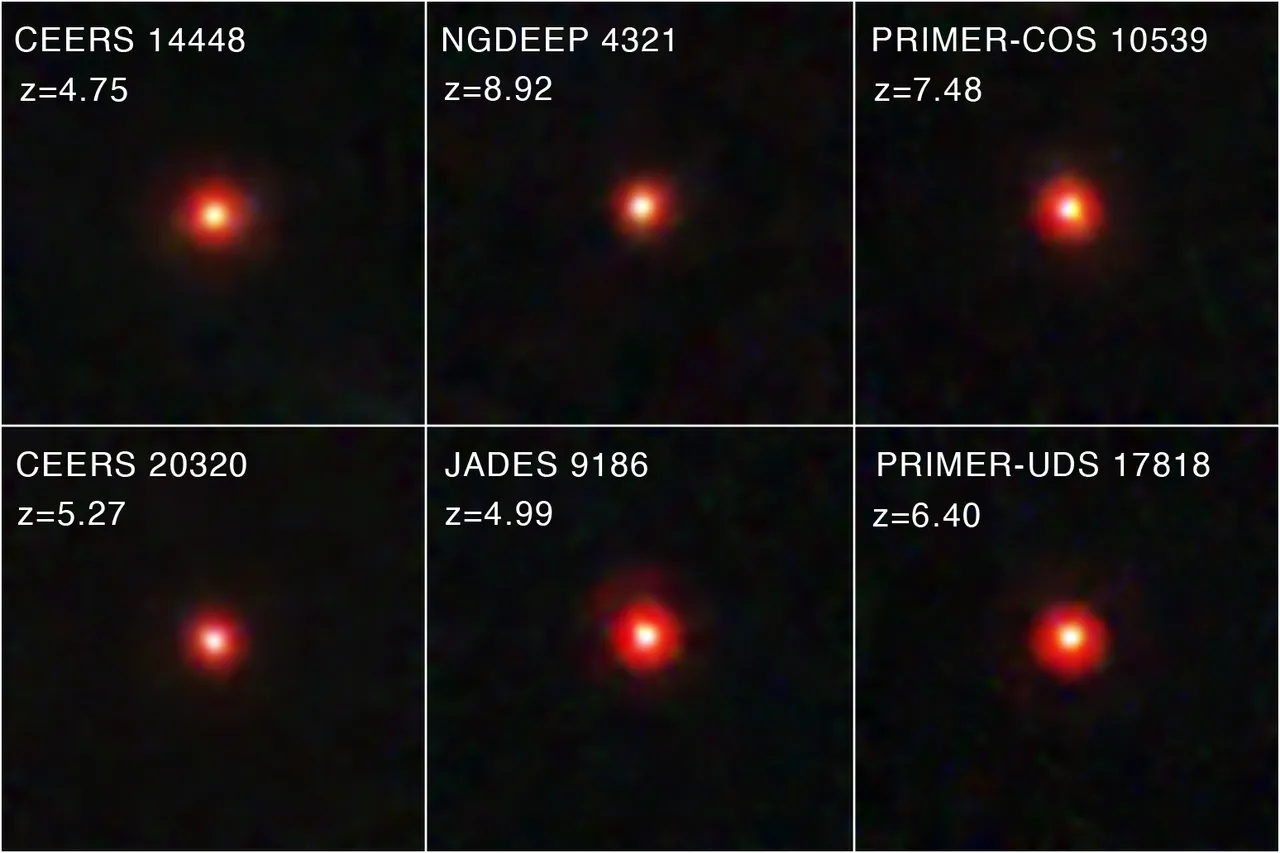
The Webb telescope first spotted these dots in 2023, and they glowed blindingly bright, emitting red light with long wavelengths and shining as brilliantly as a whole galaxy.
Initially, researchers thought the dots looked like distant galaxies, but later concluded they resembled supermassive black holes at the heart of galaxies.
Astronomers argue that the dots could be giant stars with black holes hidden inside them, based on the detailed color breakdown, known as a spectrum, which tells a more detailed story than initial observations.
The dots appear red because dust blocks their blue light, and the wider the range of this red light, the faster the hydrogen clouds are flying, indicating a more massive black hole.
Simulations of these overmassive black holes predict a spectrum that strongly matches the observed spectra of little red dots, but the dots also show a strong rotational Doppler shift, suggesting they rotate incredibly fast.
A new study in Nature argues that the dots are young, overmassive black holes, while others suspect they are giant stars with hidden black holes.
These findings could provide new insights into the early cosmos and the formation of supermassive black holes.
The debate continues as astronomers wring precious new information from these pixels of light, hoping to resolve the mystery of the little red dots.
What this adds
The debate over the nature of 'little red dots' continues to evolve, with new studies and observations providing conflicting evidence.
The rotational Doppler shift observed in the dots adds complexity to the theories, as it is unusual for the first stars.
Background
Two teams of astronomers have sparked a debate over the nature of 'little red dots' observed by the James Webb Space Telescope, suggesting these dots could be witnessing the birth of supermassive black holes inside colossal stars.
Astronomers are exploring the possibility that missing stars around the Milky Way's black hole could be a sign of 'black hole hair,' exotic structures that could alter gravitational waves.
What's confirmed
- The Webb telescope first spotted these dots in 2023, and they glowed blindingly bright, emitting red light with long wavelengths and shining as brilliantly as a whole galaxy.
- Initially, researchers thought the dots looked like distant galaxies, but later concluded they resembled supermassive black holes at the heart of galaxies.
- Astronomers argue that the dots could be giant stars with black holes hidden inside them, based on the detailed color breakdown, known as a spectrum, which tells a more detailed story than initial observations.
- The dots appear red because dust blocks their blue light, and the wider the range of this red light, the faster the hydrogen clouds are flying, indicating a more massive black hole.
- Simulations of these overmassive black holes predict a spectrum that strongly matches the observed spectra of little red dots, but the dots also show a strong rotational Doppler shift, suggesting they rotate incredibly fast.
- A new study in Nature argues that the dots are young, overmassive black holes, while others suspect they are giant stars with hidden black holes.
- These findings could provide new insights into the early cosmos and the formation of supermassive black holes.
- The debate continues as astronomers wring precious new information from these pixels of light, hoping to resolve the mystery of the little red dots.
What's still developing
- Then, in the spring of 2025, two teams of astronomers simultaneously announced observations of a pair of little red dots that were unlike all the rest.
- The two teams of astronomers propose that they are looking at a new astronomical object: a topsy-turvy lump of hydrogen that shines with the light of billions of suns while hiding a black hole deep in its core.
- “The field has gotten very polarized,” said Anna-Christina Eilers, an astrophysicist at the Massachusetts Institute of Technology who studies little red dots.
- Astronomers built the James Webb Space Telescope to pick up faint light from the first billion years after the Big Bang, a chaotic era when vast swaths of hydrogen and helium gas gathered into the chains of galaxies we see today.
- These monstrous masses are themselves dark, but their formidable gravity violently vacuums up gas and other nearby matter, generating rings of hot, swirling detritus that completely outshine the stars around them.
- When the James Webb Space Telescope (JWST) first looked at the darkest regions of the sky, it was able to see objects fainter and more distant than ever before.
- The obvious idea is that they must be young and powerful active black holes.
- But active black holes generate powerful radio and X-ray light, like quasars, while LRDs do not.
- Another idea is that they are tremendously large progenitor stars.
- Powerfully bright stars made only of hydrogen and helium.