
Home · Science · Sep 20 archive
Study Suggests Venus Once Had a Moon That It Swallowed
Confirmed
In Short: A new study from the University of California, Riverside, published in The Astrophysical Journal, suggests that Venus may have once had a moon that spiraled inward and crashed into the planet due to its slow rotation and powerful gravity.
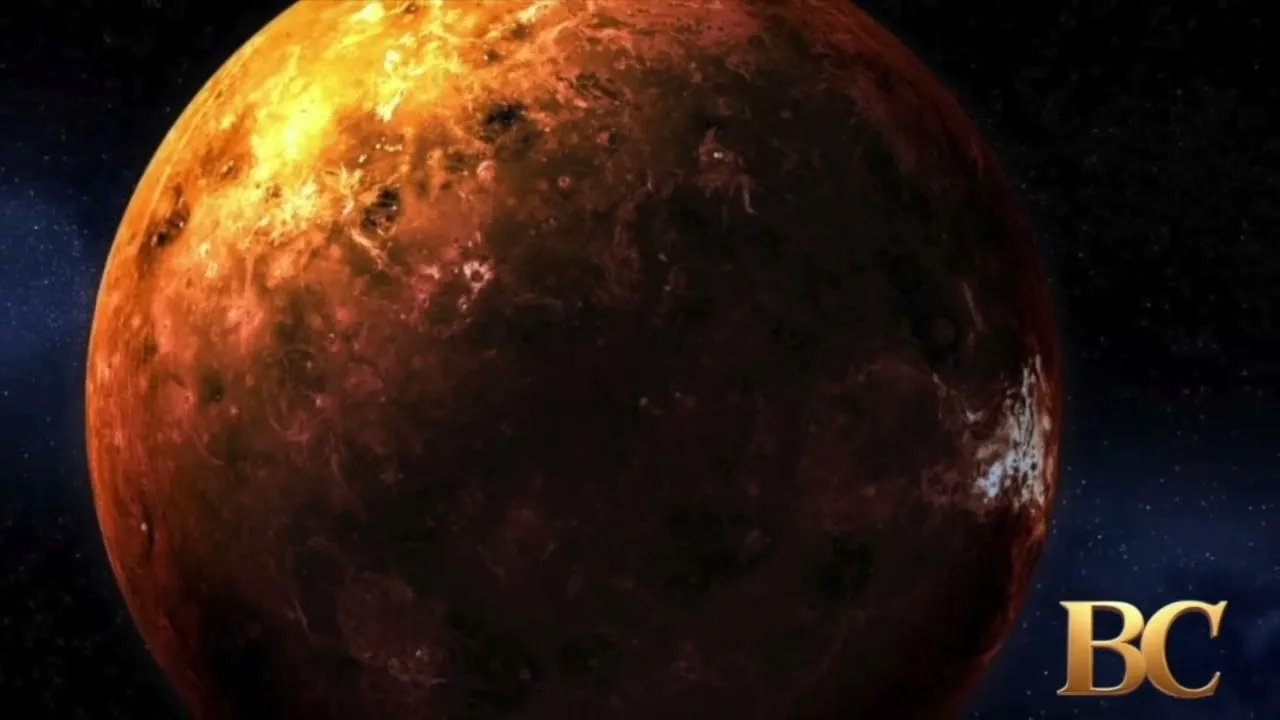
A new study from the University of California, Riverside, published in The Astrophysical Journal, suggests that Venus may have once had a moon that spiraled inward and crashed into the planet due to its slow rotation and powerful gravity.
Stephen Kane, the lead researcher from UC Riverside, explains that Venus’s slow rotation, taking 243 Earth days to complete one rotation, has the opposite effect of Earth’s faster rotation, which pushes its moon outward.
Kane’s study recreated the evolutionary history of Earth’s Moon and simulated Venus with hypothetical moons ranging from half to ten times the mass of our Moon. In almost all cases, the moon spiraled inward and collided with Venus.
The study does not establish that Venus ever possessed a moon, but it does suggest that Venus’s missing moon cannot be explained by slow rotation alone without knowing how fast the young planet spun and what kind of satellite it might have formed.
Kane’s research shows that Venus didn’t require a catastrophic collision to lose a satellite. Instead, ordinary tidal interactions between the planet and a hypothetical moon could have driven the moon back toward Venus under many plausible conditions.
The results reveal a competition between the moon moving outward and Venus slowing its spin. In nearly every simulation, the moon inevitably spiraled inward and crashed into the planet, with larger moons falling even faster.
Kane notes that the gravity of the planet itself combined with the rate at which it spins naturally caused the moon to collapse on top of it. This process could also help explain Venus’s strange rotation, hostile climate, and whether it ever had conditions suitable for life.
The study challenges assumptions about how moons form, evolve, and disappear. It offers a possible explanation for why Venus is moonless today and provides insights into the planet’s mysterious past.
Kane also commented on the implications for Earth-like planets around other stars, stating, “My feeling is there are benefits to having a moon, but it isn’t required for habitability.”
What this adds
This study adds to the understanding of Venus's geological history and challenges previous theories that Venus either never had a moon-forming impact or lost its moon to a subsequent asteroid collision.
The research does not definitively prove that Venus had a moon, but it provides a plausible explanation for the planet's current moonless state.
The study also highlights the importance of considering a planet's rotation and gravitational forces when modeling the evolution of its satellite system.
Background
In a groundbreaking study, researchers at the University of California, Riverside, have shown that a moon around Venus would have faced certain doom from the start due to the planet's gravitational pull.
NASA has shelved plans for a Venus mission, redirecting resources to the European Space Agency's Envision orbiter, which will map the planet's surface with radar.
What's confirmed
- Venus and Earth are often called twins because they’re similar in size, mass, and composition.
- “My study shows Venus didn’t require a catastrophe to arrive at what we can see today,” Kane said.
What's still developing
- Any traces of a moon impact may lie hidden deep inside the planet, similar to unusual structures found beneath Earth that may be remnants of our own moon-forming collision.
- Yet one striking difference has puzzled scientists for decades: Earth has a large moon, while Venus has none.
- On Earth, the Moon is gradually moving away at a rate of about 4 cm each year since the planet’s relatively quick 24-hour rotation transfers energy outwards.
- A constant-time-lag model sometimes allowed massive moons to settle into long-lived near-synchronous states rather than fall back into Venus.
- (CREDIT: Shutterstock) Earth and Venus are remarkably similar in size and mass, yet one obvious feature separates the neighboring worlds.
- Our planet rotates once roughly every 24 hours, while the Moon orbits much more slowly.
- Tidal interactions transfer rotational angular momentum from Earth into the Moon’s orbit, pushing the Moon outward by about four centimeters each year.
- A new study now suggests that the planet could have once been accompanied by a moon, only for its sluggish rotation to gradually pull the lunar body closer until Venus ultimately swallowed it.
- On Earth, seismic instruments have detected massive, unusual mantle structures believed to be remnants of the giant impact that created our Moon.
- Previous theories suggested Venus either never had a moon-forming impact or lost its moon to a subsequent asteroid collision.
- Roughly 80% of Venus’s surface was overwritten by a massive volcanic resurfacing event about a billion years ago, likely erasing surface craters.