
Home · Technology
SpaceX Launches Northrop Grumman Cygnus to ISS with Supplies and Experiments
· Confirmed
In Short: SpaceX launched a Northrop Grumman Cygnus spacecraft to the International Space Station, carrying supplies and experiments.
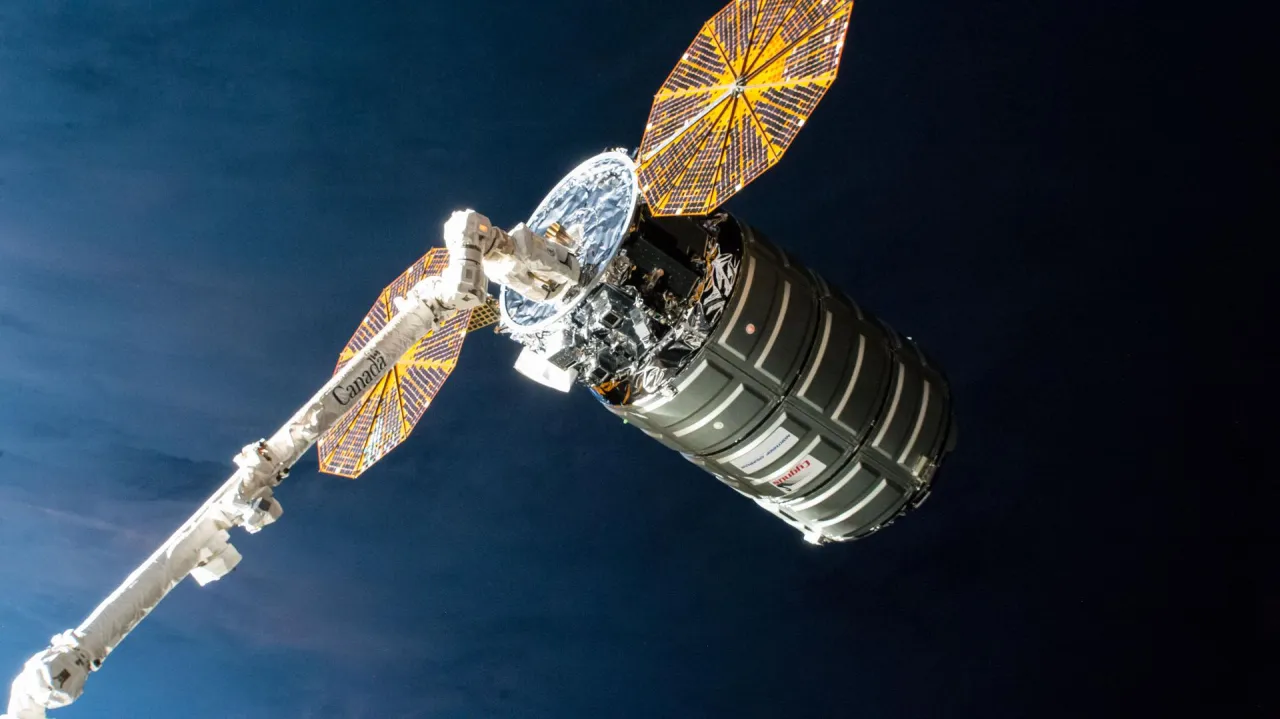
The Cygnus cargo craft from Northrop Grumman, NASA.
LIVE: SpaceX Launches Cygnus Spacecraft with 11,000 Pounds of Cargo for Astronauts aboard ISS | AC1E. DWS News
SpaceX launched a Northrop Grumman Cygnus spacecraft to the International Space Station on December 1, 2026, marking the start of a roughly two-day flight to deliver supplies and experiments.
The launch, which took place at 12:07 p.m. EST from Space Launch Complex 40 at Cape Canaveral Space Force Station, Florida, was the first Cygnus mission for SpaceX’s Falcon 9 booster B1077, which previously launched a Cargo Dragon to the ISS in June 2023.
The Cygnus spacecraft, known as NG-20, carried more than 8,200 pounds (3,700 kilograms) of equipment, payloads, and supplies for the station’s incumbent Expedition 70 crew, according to AmericaSpace.
SpaceX confirmed the deployment of the Cygnus XL spacecraft at 16:41 UTC, about 15 minutes after liftoff.
The spacecraft is loaded with approximately 3,500 pounds of crew supplies, more than 4,000 pounds of research equipment, and more than 2,500 pounds of spare parts, spacewalk gear, and computer equipment, as reported by CBS News.
NASA astronaut Jasmin Moghbeli will capture the Cygnus spacecraft using the station’s Canadarm2 robotic arm, with Loral O’Hara as a backup, scheduled to arrive at the space station around 4:15 a.m. EST on December 2.
The mission, known as NASA’s Northrop Grumman Commercial Resupply Services 25 (NG-25), includes experiments aimed at improving drug delivery for cancer and osteoarthritis, predicting cancer spread, and advancing treatments for muscle loss.
Gaurang Patel, NASA's ISS operations integration manager, noted that the Cygnus XL has fresh food items for the crew to enjoy, especially ahead of the holiday season.
Northrop Grumman’s CRS-25 resupply flight, also called NG-25, is on track for its target launch, with preparations remaining on track as reported by NASA on November 27–28, 2026.
Since 2013, Northrop Grumman has delivered more than 169,000 pounds of supplies, experiments, and equipment to the station, with this being the company’s 25th cargo mission to the station and the third flight of the larger Cygnus XL design.
SpaceX’s Falcon 9 booster B1077 became the first to launch cargo missions for both of NASA’s in-service Commercial Resupply Services (CRS) partners, having also launched a Cargo Dragon to the ISS in June 2023.
The Cygnus spacecraft will eventually be released to burn up in the atmosphere, usually filled with trash, unlike SpaceX’s Dragon, which returns to Earth.
What's confirmed
- In flying SpaceX’s first Cygnus, B1077 becomes the first Falcon 9 booster to launch cargo missions for both of NASA’s in-service Commercial Resupply Services (CRS) partners, having also launched a Cargo Dragon to the space station in June 2023.
- In comments provided at last week’s NG-20 Prelaunch Media Teleconference, Bill Gerstenmaier—a former senior NASA leader who now serves as SpaceX’s vice president of build and flight reliability—noted that a small, environmentally-controlled “door” had to be added to the fairing to permit technicians to access Cygnus for the late-loading of time-critical cargo items on Monday afternoon/evening.
- In readiness for the mission, the Pressurized Cargo Module (PCM) was transported overland from Northrop Grumman’s Dulles, Va., facility to the Space Coast last summer, followed by the Service Module (SM) from Thales Alenia Space’s site in Turin, Italy, in mid-December; the pair were subsequently mated and loading of Cygnus with early cargo commenced on 14 January.
- On Monday, the two astronauts practiced their responsibilities on laptop computers, with Moghbeli expected to grapple Cygnus using the station’s 57.7-foot-long (17.6-meter) Canadarm2 at about 4:15 a.m.
- The mission is known as NASA’s Northrop Grumman Commercial Resupply Services 25, or Northrop Grumman CRS-25.
What's still developing
- Her Cygnus duty came about in the months preceding last August’s retirement of Northrop Grumman’s home-grown Antares 230+ rocket, leaving a gap in capability of up to two years before the next-generation 300-series iteration comes online with Firefly Aerospace-furnished Miranda engines sometime after mid-2025.
- Once secured, flight controllers at Johnson Space Center in Houston, Texas, will take over from the station crew, remotely operating the arm to pull the Cygnus spacecraft in for berthing at the Earth-facing port of the station's central Unity module.
- After arriving at the International Space Station, NASA astronauts Jessica Watkins and Luke Delaney, who are living and working aboard the space station, will use the Canadarm2 robotic arm to capture the Cygnus XL on Tuesday, Dec. 1.
- This will be its ninth flight following the launches of Kuiper Falcon 1, NASA’s IMAP, NROL-77, GPS III-9, NASA’s SpaceX CRS-34, CRS-35, NROL-95, and Starlink 6-87.
- This analysis covers all three, then goes further into the hardware, the experiments, the money behind commercial cargo, and what stays unconfirmed until NASA says otherwise.
- SpaceX has one more Falcon 9 set aside to support Cygnus, as the new Antares 330 rocket, which Northrop Grumman has been developing with partner Firefly Aerospace, likely won’t be available until later in 2027.
- Adjacent to that pad is SpaceX’s nearly complete Starship and Super Heavy launch tower, which the company is pushing to get ready for what would be the location’s first launch of the world’s most powerful rocket in the coming months.