
Home · World
Netanyahu, Eisenkot Meet to Discuss Unity Government
· Confirmed
In Short: Israeli Prime Minister Benjamin Netanyahu and opposition leader Gadi Eisenkot met on Sunday to discuss forming a unity government following inconclusive October polls.
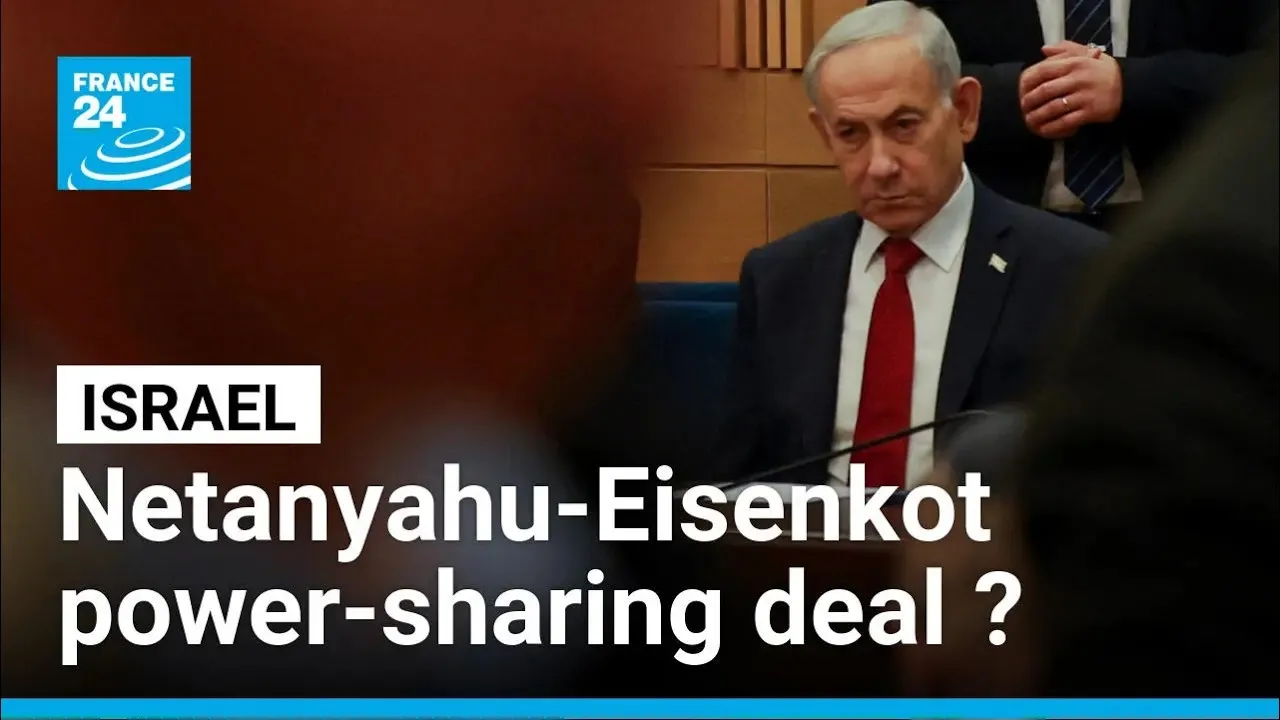
Israel's Netanyahu and Eisenkot meet to discuss forming unity government • FRANCE 24 English. FRANCE 24 English
The meeting came after President Isaac Herzog tasked Eisenkot with forming a government, as neither Netanyahu's right-wing coalition nor Eisenkot's opposition alliance secured the 61 seats needed for a parliamentary majority.
Netanyahu's Likud party won 27 seats, while Eisenkot's Yashar party secured 21 seats in the 120-member Knesset.
Eisenkot welcomed the possibility of negotiations but questioned Netanyahu's willingness to compromise.
Netanyahu offered to have Eisenkot serve as prime minister first in a rotating arrangement, a significant concession.
Eisenkot stated, 'If Likud is ready for genuine unity, I am prepared to see how serious it is over the next 24 hours.'
The blocs led by Netanyahu and Eisenkot have refused to take help from Arab parties, which won a record 19 seats in the Knesset.
Youssef Jabareen, leader of the Arab-majority Joint List, said, 'This bloodstained, neglectful government must go,' referring to the outgoing Netanyahu-led administration.
Eisenkot's parliamentary strategy faces a significant obstacle: the four parties in the anti-Netanyahu bloc hold 48 seats, with Ra’am and the Joint List accounting for another 19.
Eisenkot has 28 days to assemble a coalition, with the possibility of a two-week extension.
Alon Pinkas, a former Israeli consul general in New York, said Eisenkot had little choice but to meet Netanyahu to demonstrate that he had made a genuine effort to form a unity government.
Netanyahu faces significant pressure from multiple fronts, including potential unity government leadership offers and allegations of ignoring warnings.
Netanyahu remains in power as a caretaker leader, while the Israeli parliament elected Eisenkot-aligned Matan Kahana as the new speaker on November 17.
What this adds
The meeting took place after Netanyahu announced he was willing to have Eisenkot become prime minister first in a rotating arrangement under a possible unity deal.
Netanyahu's political future has come under growing pressure following the October 7, 2023, Hamas attacks on Israel and the wars that followed in Gaza and Lebanon, as well as the conflict with Iran that began on February 28.
Eisenkot, a hawkish former military chief who lost a son and two nephews in the Gaza war, emerged as Netanyahu's strongest challenger, stressing his security credentials while positioning himself as a centrist domestically.
Netanyahu urged Eisenkot to join a unity government, arguing that Israel needs a broad political alliance to confront the threat from Iran.
Background
Israeli opposition leader Gadi Eisenkot and Prime Minister Benjamin Netanyahu met on Sunday to discuss forming a unity government following inconclusive October polls.
Despite the conflicting reports, both Al Jazeera and Timesofisrael agree that Netanyahu faces significant pressure from multiple fronts, including potential unity government leadership offers and allegations of ignoring warnings.
What's confirmed
- Benjamin Netanyahu has met his main political rival, Gadi Eisenkot, after the Israeli caretaker prime minister offered to form a unity government under a rotating premiership.
- “The discussion was businesslike, with both sides seeking to bridge the substantial differences between them,” a joint statement said after the meeting.
What's still developing
- Netanyahu remains in power as a caretaker leader, while the Israeli parliament elected Eisenkot-aligned Matan Kahana as the new speaker on November 17.
- Israel appears to be on the brink of a political deadlock, with neither Prime Minister Benjamin Netanyahu nor his main rival, former Israel Defense Forces chief of staff Gadi Eisenkot, projected to gain a parliamentary majority.
- Eisenkot announces 'marathon talks' in bid to form new Israeli government. i24NEWS English Israeli opposition leader Gadi Eisenkot is making progress in his efforts to form a government after the October elections.
- Thursday, November 26, 2026 · 9:55 AM ET In Short: Eisenkot's bloc includes potential allies from Israel’s Palestinian minority, which holds 19 seats.
- Humanitarian catastrophe largely ignored as rivals Gadi Eisenkot and Benjamin Netanyahu vow to end Hamas rule Humanitarian catastrophe largely ignored as rivals Gadi Eisenkot and Benjamin Netanyahu vow to end Hamas rule As Israel prepares to go to the polls, Palestinians in Gaza are bracing for an outcome that could shape their future, knowing their fate rests with the country that has reduced much of the territory to rubble and killed nearly 75,000 people.
- A senior commander during Israel’s 2006 war with Hezbollah, Eisenkot, whose son and two nephews were killed fighting in Gaza, later championed the “Dahiya doctrine”, which advocated overwhelming force against civilian areas where militants operated.
- "It is entirely legitimate to disagree with representatives of the Arab parties, even to strongly disapprove of some of them. But it is neither legitimate nor acceptable to malign an entire community, and I will not allow it," Eisenkot said.
- "The attempt to marginalize them and vilify them collectively is a profound violation of the principles of civic responsibility." Netanyahu and his allies have repeatedly criticized leaders of Arab parties for refusing to describe Hamas as a "terror group" following its unprecedented October 7, 2023 attack on Israel.
- On the campaign trail during the country’s recent elections, Netanyahu had stoked fears of a nuclear-armed Iran and called for toppling its government, with Eisenkot warning his rival against using military action as a means to ensure his political survival.
- Knesset moves to appoint new speaker. i24NEWS English The Eisenkot bloc, commanding a majority in the Knesset with the support of Arab parties, began its push to reverse legislation passed under Prime Minister Benjamin Netanyahu on Wednesday.
- He entered politics only four years ago and joined Netanyahu's war cabinet after the Hamas attack, but quit eight months later, criticising the prime minister's leadership.
- Eisenkot, 66, a hawkish former military chief who lost a son and two nephews in the Gaza war, emerged as Netanyahu's strongest challenger, stressing his security credentials while positioning himself as a centrist domestically.
Sources
- Reuterslink
- Al Jazeeralink
- Fox Newslink
- NBC Newslink
- NPRlink
- Newsweeklink
- The Indian Expresslink
- The Times of Israellink
- The Guardianlink
- CBS Newslink
- Lemondelink
- Middleeasteyelink
- Timelink
- Arabnewslink
- Warpbeatlink
- Businessdaylink
- FRANCE 24 English — video link
- Middle East Eye — video link
- India Today Global — video link
- NewsX Live — video link
- Viral Desk — video link