
Home · Science
Scientists Discover Quasar Formed Just 630 Million Years After Big Bang
Confirmed
In Short: A German-led team of scientists has discovered a quasar that formed within 630 million years of the Big Bang, marking a significant milestone in the study of early universe formations.
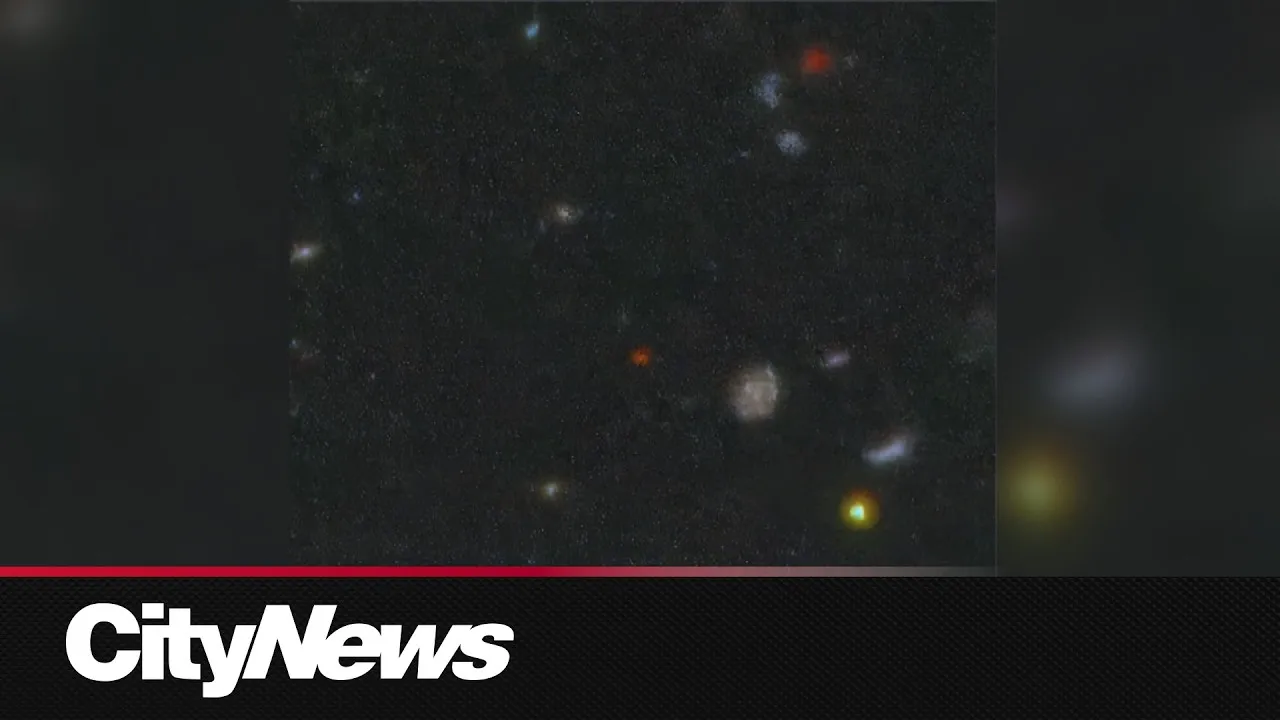
Most distant quasar that formed 630 million years after the Big Bang discovered. CityNews
The quasar, named Dun Aonghasa after a prehistoric stone fort in Ireland’s Aran Islands, was spotted by the team while analyzing data from the European Space Agency’s Euclid telescope.
According to the team, the previous two records each took researchers back by about 15 million years or less, whereas this new quasar takes them back by nearly 40 million years, the biggest advance in nearly a decade.
Scientists are seeing this quasar as it was 13.1 billion years ago, when the universe was less than 5% of its current age.
The black hole at the center of the quasar had already grown to about 360 million times the mass of the sun by 630 million years after the Big Bang, raising questions about its rapid formation.
Wolf, the lead scientist, explained, “Dun Aonghasa gives us a new deadline for the early universe.” He added, “About 630 million years after the Big Bang, its black hole had already grown to about 360 million times the mass of the sun. But how?”
Finding a quasar so early in the universe is rare, according to Wolf, and it provides valuable insights into the early stages of galaxy and black hole formation.
Wolf’s wife and daughter are Irish, and he was inspired to name the quasar after a visit to the Dun Aonghasa fort, which he described as a frontier holding “the promise of a vast horizon still to explore,” much like this quasar.
This discovery is part of ongoing efforts to understand the events immediately following the Big Bang, including the formation of the first stars and galaxies.
Scientists are optimistic about the possibility of detecting primordial black holes, which may have formed just after the Big Bang and could explain dark matter.
Quantum simulators are also being used to explore particle formation and the conditions that followed the Big Bang, providing new pathways for experimental investigations into the behavior of matter at its most fundamental level.
The quasar formed within 630 million years of the universe-forming Big Bang, a German-led team reported Tuesday.
Wolf and his team spotted the quasar while digging through millions of observations made by the European Space Agency’s Euclid telescope.
What this adds
The quasar's black hole mass is estimated at 360 million times the mass of the sun, according to observations from the James Webb Space Telescope.
The Euclid telescope image showing the farthest known quasar was released on Tuesday, Nov. 24, 2026.
What's confirmed
- The quasar formed within 630 million years of the universe-forming Big Bang, a German-led team reported Tuesday.
- Scientists are seeing it as it was 13.1 billion years ago — when the universe was less than 5% of its current age.
- Wolf nicknamed the quasar Dun Aonghasa after the prehistoric stone fort in Ireland’s Aran Islands.
- Wolf and his team spotted the quasar while digging through millions of observations made by the European Space Agency’s Euclid telescope.
- His wife and daughter are Irish, and he was awestruck when they visited the fort — a frontier holding “the promise of a vast horizon still to explore,” just like this quasar.
- Finding a quasar so early in the universe is rare, according to Wolf.
- (AP) — Scientists have discovered the most distant quasar yet, the core of a galaxy with a slow-chomping black hole at its center dating back to nearly the dawn of the universe.
- Thanks to Webb, scientists learned that the black hole powering this quasar is equivalent in mass to 360 million of our suns, an astounding amount so early in time.
What's still developing
- This European Space Agency's Euclid telescope image, released Tuesday, Nov. 24, 2026, shows the farthest known quasar, visible as the red dot at the center.
- That year, scientists reported that gravitational waves, ripples in spacetime predicted by Einstein’s general theory of relativity, had been detected from a pair of merging black holes.
- While the Big Bang has yet to be directly observed, scientists have worked tirelessly to piece together the events that happened immediately after the Big Bang, specifically the first billion years or less, with the goal of gaining insight into the how the first stars, and potentially planets, formed and evolved.
- Now, an international team of scientists might be one step closer to unraveling the post-Big bang events as they used the Atacama Large Millimeter/submillimeter Array (ALMA) in Northern Chile to observe a star-forming gas known as neutral gas.
- A credit line must be used when reproducing images; if one is not provided below, credit the images to "MIT." Scientists have hypothesized that, in the fraction of a second following the Big Bang, minute black holes may have been forged within tiny, dense pockets that collapsed under their own gravity.
- But it gives scientists useful information about where to look next, and which particles might be found when the LHC's successor starts work in the second half of this century.
- Scientists hope new particles may live in this tiny world.
- Here, scientists could be able to find the answers to dark matter and the origins of matter after the Big Bang.
- Scientists knew these elements, including carbon, later became incorporated into new stars, solid planets, and eventually life itself, yet exactly how they spread throughout the early universe remained unclear.