
Home · Science · Nov 24 archive
A new reason for magic numbers: Scientists discover the secret behind an unusually stable molecular cluster
Confirmed
In Short: A Martian meteorite discovered in Algeria has been dated to 1.27 billion years ago, providing scientists with rare evidence from a largely unexplored period in the Red Planet’s geological history, as reported by Muslimnetwork.
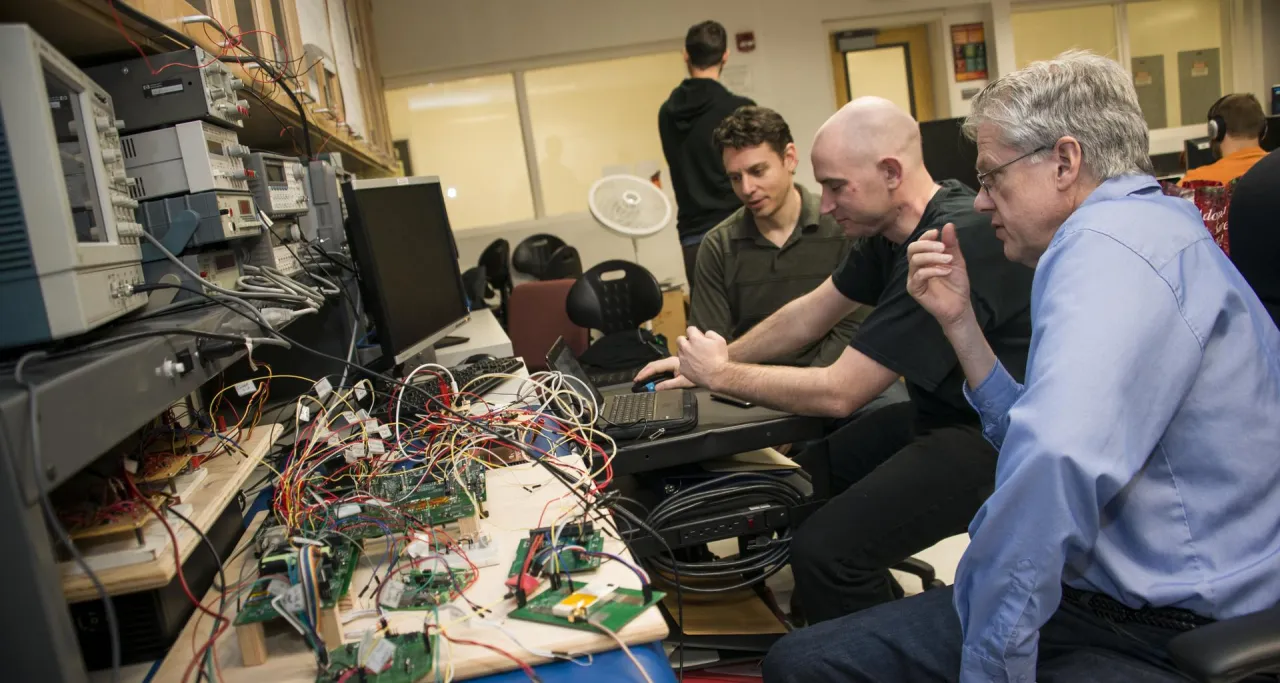
CSUNSat 1 Team working on their CubeSat at California State University Northridge, NASA.
Dark matter, which does not emit, absorb, or reflect light, is thought to account for approximately 85% of all matter in the universe. Scientists must search for other evidence of its interactions with ordinary matter.
Scientists determine the age of such rocks by examining when their minerals crystallized from molten material. NWA 13441 therefore provides evidence from a period that has remained largely inaccessible to scientists.
NASA-funded scientists have discovered an organism that lives at extreme temperatures previously thought impossible for complex life. In the heated waters of California’s Lassen Volcanic National Park, a team observed an amoeba that can reproduce by division at an astonishing 145 degrees Fahrenheit (63 degrees Celsius), setting a record for the upper temperature limit for all known eukaryotes.
A remarkably preserved fossil from northeastern Spain is giving scientists a rare look at the skin, soft tissues, and possible coloration of an ancient crocodile relative that lived about 125 million years ago, according to Sciencedaily.
Not until NASA-funded scientists age-dated its minerals did they realize the nearly 2-pound (800-gram) rock was a piece of Mars that formed more than 4.1 billion years ago, making it one of the oldest Martian meteorites ever found.
Scientists identified 13 locations on Mars that match the mineralogy and chemistry of Teghaza 001, one of the most ancient Martian meteorites ever found on Earth, as reported by NASA.
Two new studies are giving planetary scientists hope that conditions for extraterrestrial life exist, even in our own solar system.
A nearly complete fossil skull, a jawbone, and three partial shells have helped scientists identify a previously unknown species of softshell turtle that lived in North America millions of years ago, according to The Indian Express.
When weird fungal epidemics crop up in far-flung places, scientists work together to unravel how the microscopic murderers show up and turn deadly, as reported by Nationalgeographic.
The scientists’ suspicions that they were looking at red blood cells were bolstered when chemical tests came back positive for heme and its breakdown products, according to The Guardian.
If confirmed, it would open up entirely new avenues for scientists, allowing them to investigate dinosaur blood, metabolism, and even their activity levels.
Studying these organisms helps scientists understand what life as we know it is capable of.
What's confirmed
- Dark matter, which does not emit, absorb, or reflect light, is thought to account for approximately 85% of all matter in the universe. Scientists must search for other evidence of its interactions with ordinary matter.
- Scientists determine the age of such rocks by examining when their minerals crystallized from molten material. NWA 13441 therefore provides evidence from a period that has remained largely inaccessible to scientists.
- NASA-funded scientists have discovered an organism that lives at extreme temperatures previously thought impossible for complex life. In the heated waters of California’s Lassen Volcanic National Park, a team observed an amoeba that can reproduce by division at an astonishing 145 degrees Fahrenheit (63 degrees Celsius), setting a record for the upper temperature limit for all known eukaryotes.
- A remarkably preserved fossil from northeastern Spain is giving scientists a rare look at the skin, soft tissues, and possible coloration of an ancient crocodile relative that lived about 125 million years ago, according to Sciencedaily.
- Not until NASA-funded scientists age-dated its minerals did they realize the nearly 2-pound (800-gram) rock was a piece of Mars that formed more than 4.1 billion years ago, making it one of the oldest Martian meteorites ever found.
- Scientists identified 13 locations on Mars that match the mineralogy and chemistry of Teghaza 001, one of the most ancient Martian meteorites ever found on Earth, as reported by NASA.
- Two new studies are giving planetary scientists hope that conditions for extraterrestrial life exist, even in our own solar system.
- A nearly complete fossil skull, a jawbone, and three partial shells have helped scientists identify a previously unknown species of softshell turtle that lived in North America millions of years ago, according to The Indian Express.
- When weird fungal epidemics crop up in far-flung places, scientists work together to unravel how the microscopic murderers show up and turn deadly, as reported by Nationalgeographic.
- The scientists’ suspicions that they were looking at red blood cells were bolstered when chemical tests came back positive for heme and its breakdown products, according to The Guardian.
- If confirmed, it would open up entirely new avenues for scientists, allowing them to investigate dinosaur blood, metabolism, and even their activity levels.
- Studying these organisms helps scientists understand what life as we know it is capable of.
What's still developing
- But in the early 1930s, scientists discovered that some atomic nuclei – the center part of atoms, which make up all matter – were more stable than others.
- In the U.S., physicist Maria Goeppert Mayer published an explanation, at the same time as a group of scientists led by J.
- Scientists with Novo Nordisk and Eli Lilly, the two biggest current GLP-1 makers, revealed intriguing data this past week at an anti-aging conference.
- Meanwhile, Eli Lilly scientists conducted a similar analysis with their blockbuster drug tirzepatide, which combines GLP-1 with another gut hormone called GIP.