
Home · Science · Nov 21 archive
Scientists discover twist-tunable interlayer excitons in atomically thin anisotropic semiconductors
Confirmed
In Short: In another study, NASA-supported scientists discovered an organism that can reproduce at an astonishing 145 degrees Fahrenheit (63 degrees Celsius) in the heated waters of California’s Lassen Volcanic National Park, setting a record for the upper temperature limit for all known eukaryotes.
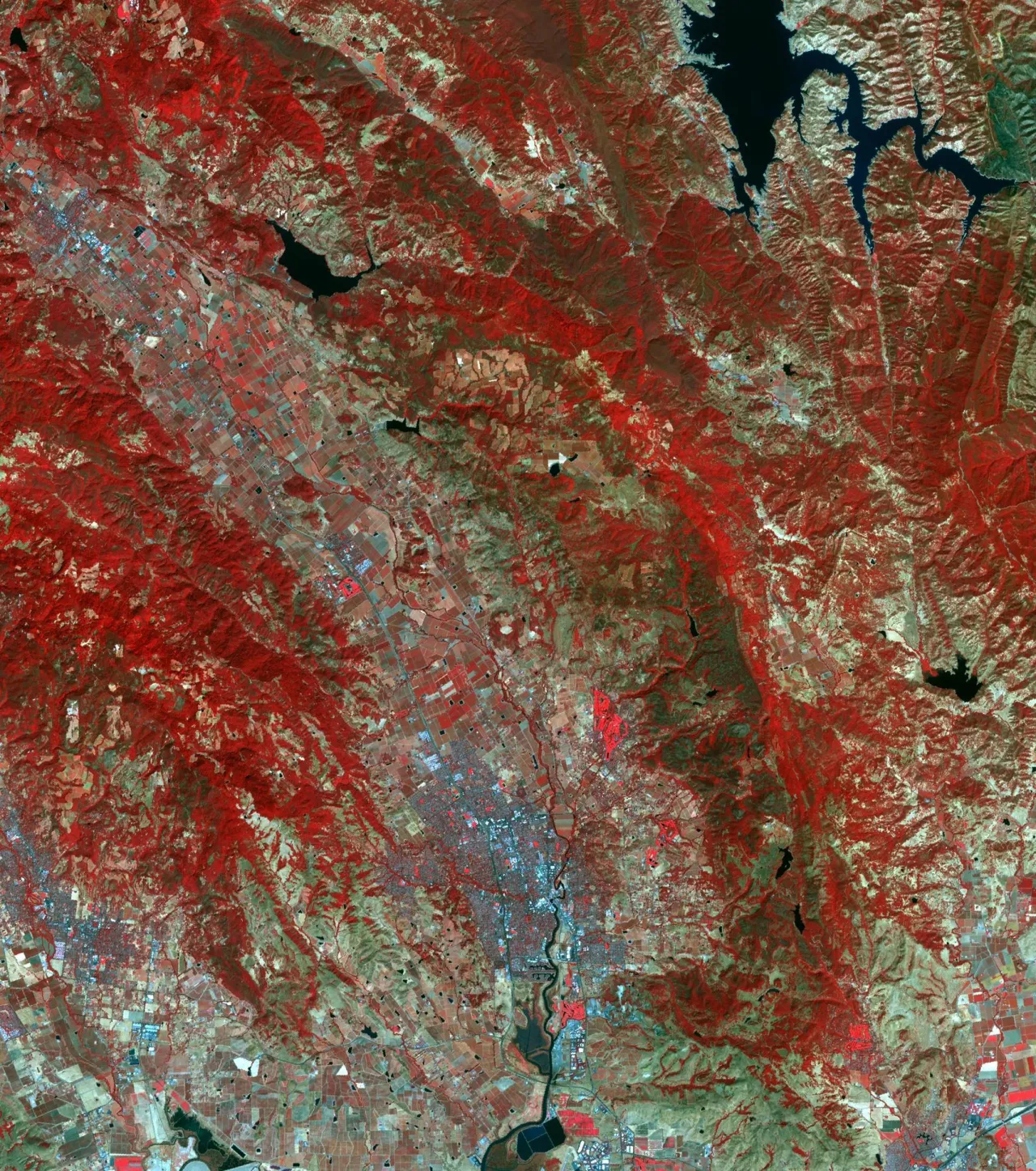
Northern California Fires, NASA.
Scientists have made groundbreaking discoveries in diverse fields, including ancient fossils, Martian meteorites, and extreme life forms, according to recent studies.
NASA-funded scientists determined that the nearly 2-pound (800-gram) rock is one of the oldest Martian meteorites ever found, dating back more than 4.1 billion years.
Scientists identified 13 locations on Mars that match the mineralogy and chemistry of Teghaza 001, one of the most ancient Martian meteorites ever found on Earth.
In a remarkable find, a fossil from northeastern Spain is offering scientists a rare glimpse into the skin, soft tissues, and possible coloration of an ancient crocodile relative that lived about 125 million years ago.
Scientists have also discovered a huge tectonic boundary under Africa, running from Mozambique to Tanzania, which could help shape the movement of continents.
In the field of medicine, scientists have identified a 'slurred downstroke' in the waveform data of high-risk patients that could be a sign of impending heart trouble, possibly stemming from fibrosis in heart muscle.
What's confirmed
- Scientists have made groundbreaking discoveries in diverse fields, including ancient fossils, Martian meteorites, and extreme life forms, according to recent studies.
- NASA-funded scientists determined that the nearly 2-pound (800-gram) rock is one of the oldest Martian meteorites ever found, dating back more than 4.1 billion years.
- Scientists identified 13 locations on Mars that match the mineralogy and chemistry of Teghaza 001, one of the most ancient Martian meteorites ever found on Earth.
- In a remarkable find, a fossil from northeastern Spain is offering scientists a rare glimpse into the skin, soft tissues, and possible coloration of an ancient crocodile relative that lived about 125 million years ago.
- Scientists have also discovered a huge tectonic boundary under Africa, running from Mozambique to Tanzania, which could help shape the movement of continents.
- In the field of medicine, scientists have identified a 'slurred downstroke' in the waveform data of high-risk patients that could be a sign of impending heart trouble, possibly stemming from fibrosis in heart muscle.
What's still developing
- Scientists determine the age of such rocks by examining when their minerals crystallized from molten material.
- Two new studies are giving planetary scientists hope While we still don’t know if there’s extraterrestrial life out there, we do know the conditions for it exist, even in our own solar system.
- Although the Mars meteorites found on Earth differ from one another, they share a common history, having been blasted off the Red Planet’s surface by an impact, followed by a trajectory that eventually placed them on Earth and into the hands of scientists.
- The scientists’ suspicions that they were looking at red blood cells were bolstered when chemical tests came back positive for heme and its breakdown products.
- In the heated waters of California’s Lassen Volcanic National Park, a team of scientists observed an amoeba that can reproduce by division at an astonishing 145 degrees Fahrenheit (63 degree Celsius), setting a record for the upper temperature limit for all known eukaryotes.
- Studying them helps scientists understand what life as we know it is capable of.
- Scientists discovered the fault by using seismic reflection data (pictured), which works like a giant ultrasound scan of the Earth They found a rapid transition between the continent and the ocean, with the crust becoming up to 18 miles thinner over a distance of just 10 miles This activation will help to shape the movement of the continents, as the UK drifts down towards the equator and the current continent of Antarctica makes its way towards the North Pole.