
Home · Science · Nov 19 archive
Euclid Telescope Reveals 15,000 Strong Gravitational Lens Candidates
Confirmed
In Short: The European Space Agency's Euclid space telescope has made a significant discovery, revealing 15,000 new strong gravitational lens candidates in its first data release on November 12th.
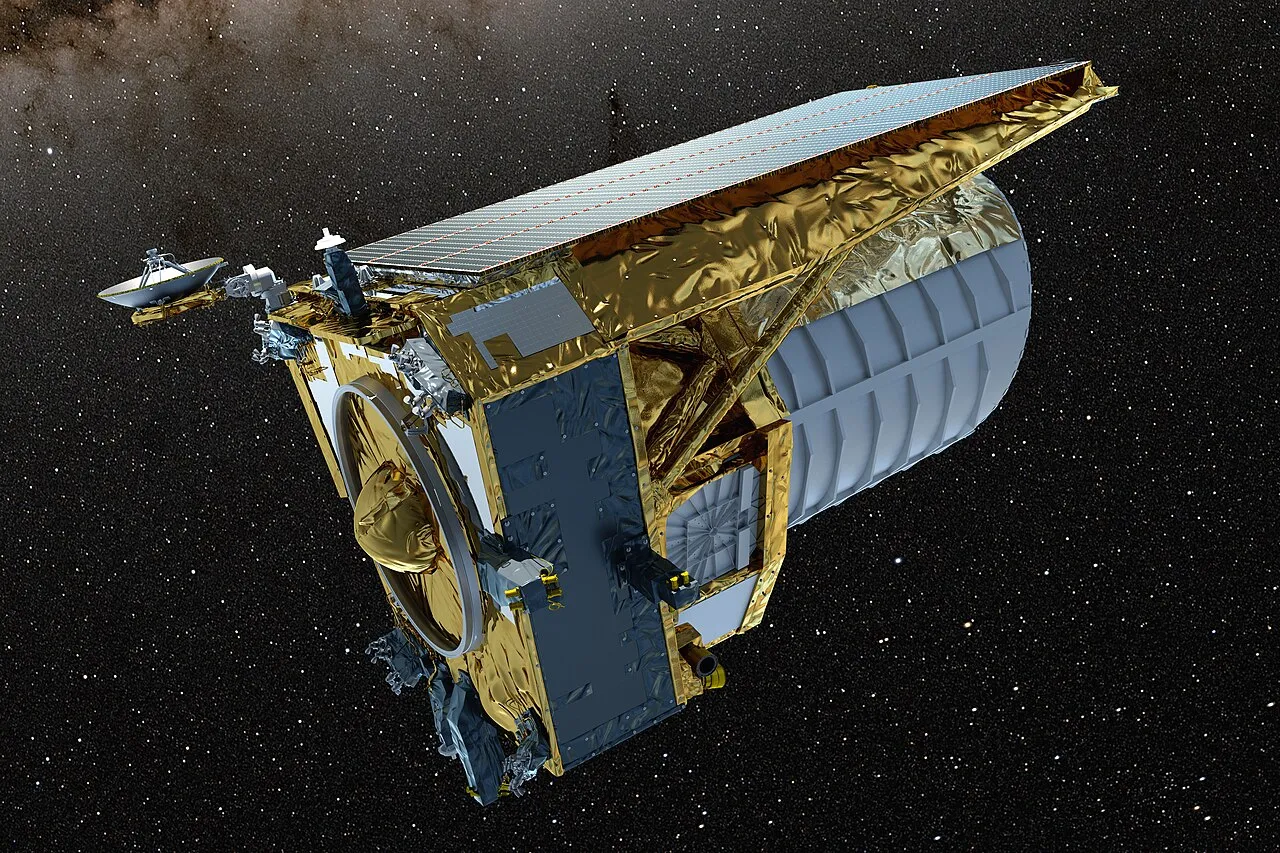
The European Space Agency's Euclid space telescope has made a significant discovery, revealing 15,000 new strong gravitational lens candidates in its first data release on November 12th.
Euclid, launched in July 2023, orbits the Sun-Earth Lagrange point 2, approximately 1.5 million kilometers from Earth.
The telescope's mission is to study dark matter and dark energy, which together account for about 95% of the universe.
Before Euclid, there were fewer than a thousand confirmed strong lenses. Now, the telescope has found 15,000 new candidates, a massive increase.
The data release covers about 1,900 square degrees, around 14% of the area planned for Euclid's six-year survey.
In addition to the gravitational lens candidates, Euclid's data includes around 60 million quasar candidates and spectra from over 160 million sources.
The vast amount of data collected by Euclid makes it impossible for the human eye alone to view all of it, highlighting the telescope's unprecedented capabilities.
Euclid's findings are expected to lead to the discovery of many objects and phenomena never seen before, opening up new avenues for understanding the universe.
What this adds
Euclid's data release marks a significant advancement in the study of dark matter and dark energy, providing a wealth of new information.
What's confirmed
- The European Space Agency's Euclid space telescope has made a significant discovery, revealing 15,000 new strong gravitational lens candidates in its first data release on November 12th.
- Euclid, launched in July 2023, orbits the Sun-Earth Lagrange point 2, approximately 1.5 million kilometers from Earth.
- The telescope's mission is to study dark matter and dark energy, which together account for about 95% of the universe.
- Before Euclid, there were fewer than a thousand confirmed strong lenses. Now, the telescope has found 15,000 new candidates, a massive increase.
- The data release covers about 1,900 square degrees, around 14% of the area planned for Euclid's six-year survey.
- In addition to the gravitational lens candidates, Euclid's data includes around 60 million quasar candidates and spectra from over 160 million sources.
- The vast amount of data collected by Euclid makes it impossible for the human eye alone to view all of it, highlighting the telescope's unprecedented capabilities.
- Euclid's findings are expected to lead to the discovery of many objects and phenomena never seen before, opening up new avenues for understanding the universe.
What's still developing
- The data revealed almost 5% of the night sky in 13 months of observations.
- It would be impossible to make sense of our surroundings.
- Strong-lensing candidates are also candidates requiring follow-up and confirmation, not all confirmed lenses.
- Euclid's main objective is to discover the secrets of 'dark energy', which accounts for about 70 percent of the universe, and 'dark matter', which accounts for 25 percent.
- Comparing it to the Hubble telescope, which provided high-quality images but covered only a limited area of the sky, Taylor explained Euclid's capability.