
Home · Science · Nov 18 archive
Strange radio signals from space could come from a dead star
Confirmed
In Short: A team of researchers has identified the origin of strange, repeating radio signals coming from a distant star system.
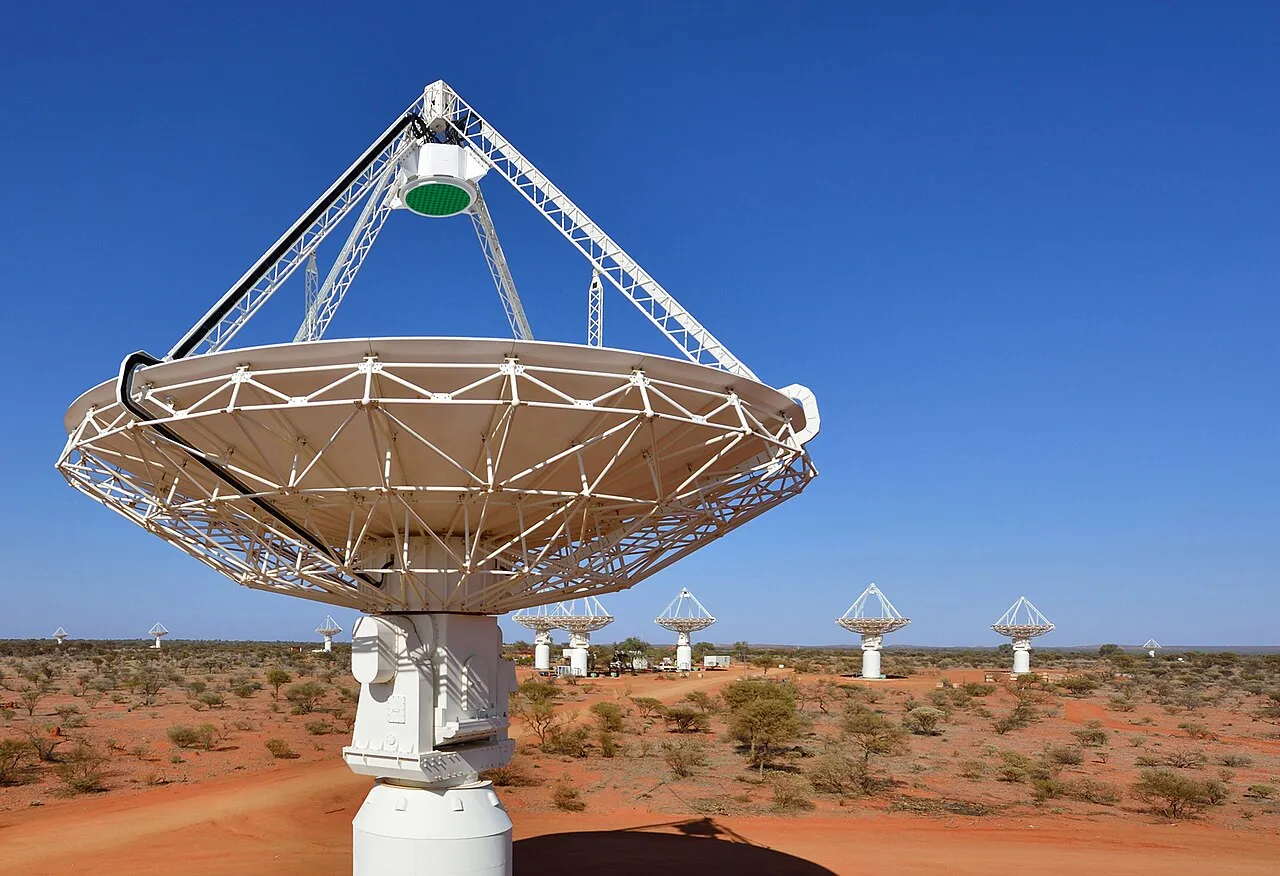
CSIRO ScienceImage 2161 Close up of a radio astronomy telescope with several more in the background.
Dead Star Sends Mysterious Signals Every 8 Minutes: A Cosmic Mystery Deepens | GRAVITAS. WION
In research published March 12 in Nature Astronomy, a group of astrophysicists finally found the source of strange, minute-long radio bursts.
The team discovered a mysterious star system more than 5,000 light-years away that emits radio signals every eight minutes.
The researchers analyzed over 100 hours of radio data to better understand the movement of the white dwarf.
Since 2022, astronomers have been tracking highly unusual bursts of radio emissions that repeat at precise intervals, ranging from a few minutes to several hours.
Even with just a dozen of these strange sources discovered so far, they seem to come in a few different shapes and sizes.
Researchers observed the identified object using 15 telescopes around the world, determining that it must be spinning and is a fairly small, high-energy object, like a black hole or neutron star.
Background
Astronomers have identified the source of mysterious radio waves from deep space, tracing the signals back to an unusual stellar pair in the Boötes constellation, located about 8,000 light-years away.
What's confirmed
- In research published March 12 in Nature Astronomy, a group of astrophysicists finally found the source of strange, minute-long radio bursts.
- The team discovered a mysterious star system more than 5,000 light-years away that emits radio signals every eight minutes.
- The researchers analyzed over 100 hours of radio data to better understand the movement of the white dwarf.
- Since 2022, astronomers have been tracking highly unusual bursts of radio emissions that repeat at precise intervals, ranging from a few minutes to several hours.
- Even with just a dozen of these strange sources discovered so far, they seem to come in a few different shapes and sizes.
- Researchers observed the identified object using 15 telescopes around the world, determining that it must be spinning and is a fairly small, high-energy object, like a black hole or neutron star.
What's still developing
- They called this phenomenon a “luminous fast blue optical transient,” or LFBOT.
- “Achieving this required knowing with extraordinary precision the orbit of Chariklo, the position of the star—thanks to ESA’s Gaia mission—and the trajectory of JWST,” said study co-author Yücel Kilic, a postdoctoral researcher at the IAA-CSIC, noting the telescope’s position approximately 1.5 million kilometers from Earth at the L2 Lagrange point, close to where NASA’s newly-launched Nancy Grace Roman Space Telescope is not also positioned in orbit.
- Countless bands have come unglued thanks to the rigorous of touring, that seemingly unending cycle of late nights, strange towns, faceless hotels.
- Sánchez-Lavega/University of the Basque Country-EHU Scientists watching the weather on Saturn have spotted a strange polygon surrounding the planet’s south pole — a feature that would have surprised them less had it appeared years ago, when the planet was under constant surveillance.
- He specializes in history, space, strange science, and anything out of the ordinary.
- A recent study examining a strange ripple in spacetime suggests that unusual gravitational-wave signals could carry evidence of invisible matter surrounding black holes.
- A feature published by Space.com noted that gravitational-wave astronomy may eventually help scientists "hear" the influence of dark matter rather than directly observe it.
- Gravitational waves are ripples in spacetime caused by violent events such as black hole collisions or neutron star mergers.
- He played Professor Charles Xavier in Fox's X-Men films, as well as in Doctor Strange in the Multiverse of Madness in the Marvel Cinematic Universe.
- Since 2007, astronomers have been working to unravel the mystery of brief, intense flashes of radio waves called fast radio bursts, or FRBs.
- Like Ortegas’s trauma over her brush with death at the hands of the Gorn in season three culminated in the season highlight “Terrarium,” La’an’s turbulent emotional state and doubts about her sanity and inherent goodness come to a head here in the penultimate episode of Season 4 should make for fertile ground for good storytelling.
- There's been countless hours, days, weeks and months trying to make sense of how the College Football Playoff committee would analyze this crazy season that has seen consistent inconsistency and strange results that have left just three teams unbeaten and six others among the Power Four with one defeat.