
Home · Technology · Nov 15 archive
Startup Drogue Raises $20M to Harness Ocean Heat for Data Centers
· Confirmed
In Short: TechCrunch reports that startup Drogue has raised $20 million to develop a prototype that uses ocean heat to power data centers.
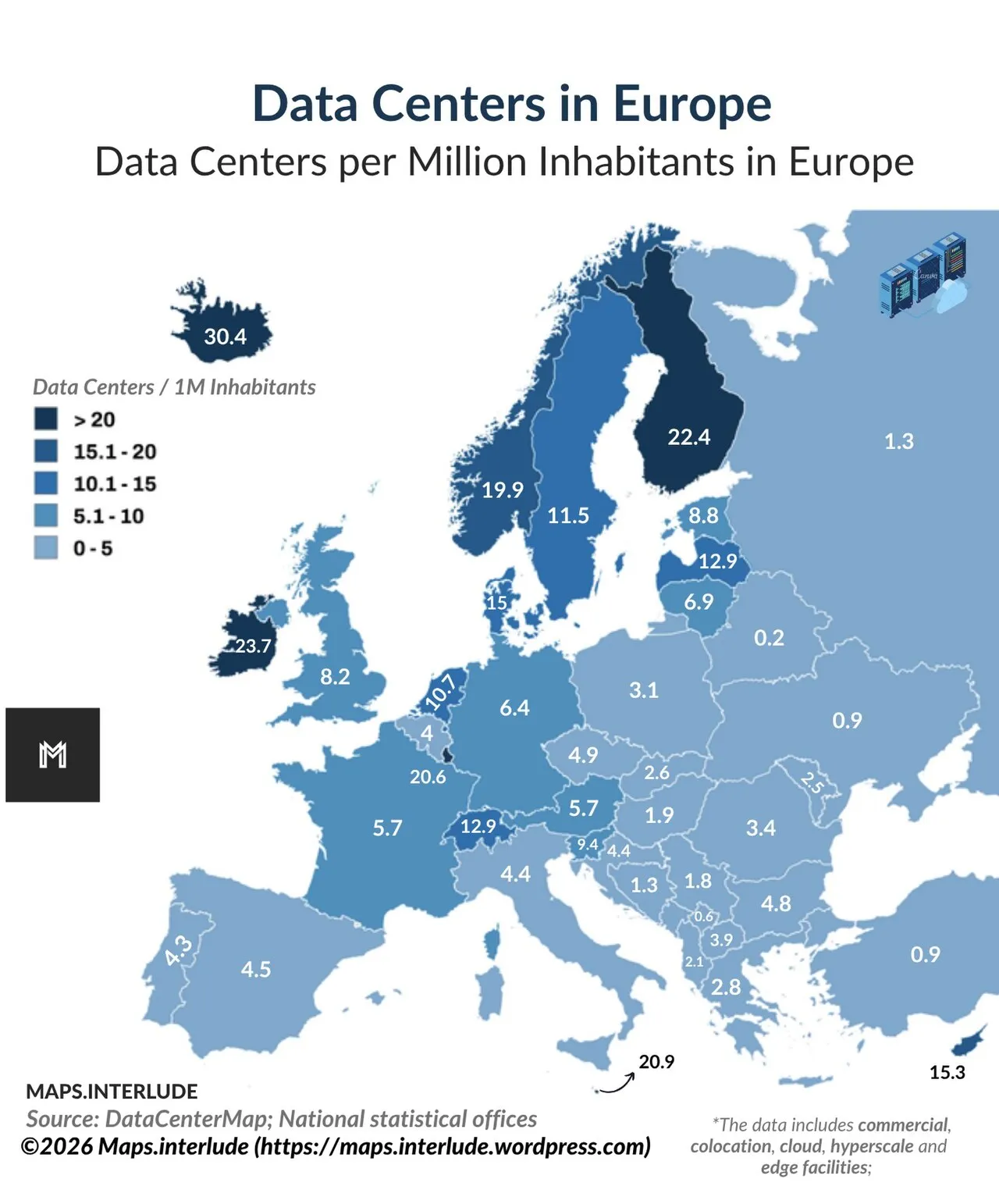
Data Centers in Europe.
TechCrunch reports that Drogue, founded just six months ago in Washington, D.C., has raised $20 million from a variety of investors, including XYZ Venture Capital, Toyota Ventures, and Tamarack Global, among others. The startup plans to install a multi-megawatt prototype on a traditional oceangoing ship and send it out to sea in early 2028.
WIRED notes that the data center industry has faced public backlash this year, with concerns about the environmental impact of these facilities. The publication highlights that data centers need significant amounts of water to stay cool and functional, often consuming as much water as a town of 50,000 people.
TechCrunch explains that Drogue's prototype will use cold water drawn from 1,000 meters deep to pass over the condenser’s fins, absorbing the heat. This process is designed to harness the ocean's energy, which has been absorbing an additional 5.8 million terawatt-hours of energy annually due to global warming.
Theaiinsider reports that the data center industry has seen opposition from both Republican and Democratic officials, with New York recently halting permits for large projects. The publication also mentions that SpaceX investors are seeing huge windfalls, but the community hosting xAI data centers is demanding accountability for the company’s use of polluting gas turbines.
News adds that data center operators are struggling in the market, with Core Scientific declining by 3.5% and Iren by 3.6%. The publication also notes that clean power developer NextEra Energy experienced a modest rise of 2.3%, indicating a shift in investor sentiment.
WIRED and TechCrunch both highlight the environmental challenges faced by data centers, with WIRED noting that 25 percent of data centers are in areas where there's a water gap during at least one month of the year, and TechCrunch detailing the prototype's innovative use of ocean heat.
Despite differing focuses, both TechCrunch and WIRED agree that the data center industry is facing significant environmental and regulatory challenges. TechCrunch emphasizes the innovative approach of using ocean heat, while WIRED highlights the broader environmental impact and the need for accountability.
The reports from TechCrunch and WIRED converge on the critical need for sustainable solutions in the data center industry, with TechCrunch focusing on the technological innovation of harnessing ocean heat, and WIRED on the broader environmental and regulatory challenges.
Background
Anthropic secured a $3.4 billion deal with OnePWR Solutions for 1.7 GW of gas-fired generators to power its AI data centers.
What's confirmed
- In a new study published in Environmental Science & Technology, researchers led by a team from the Carnegie Institution for Science in the US mapped the location of the 9,347 currently identified data centers worldwide.
- Data centers need water to stay cool and functional, and lots of it: The larger facilities can consume as much water a day as a town of 50,000 people, and because much of the cooling involves evaporation, freshwater is often preferred.
What's still developing
- Anyone who has weathered a hurricane can tell you that the oceans — which fuel the storms — contain a tremendous amount of energy.
- The data center industry has faced public backlash this year, leading to concerns that tighter oversight from a Democratic Congress might hinder investments just as investors begin to express caution regarding escalating AI expenditures and the uncertainty of returns.
- The company has been steering heavy sums into chips and data centers as it squares off against OpenAI and Anthropic, a buildout that has eaten into the free cash flow that was long a hallmark of its business.
- Blackstone Digital Infrastructure Trust is targeting the acquisition of newly built data centers occupied by hyperscalers and valued between $250M and $1.5B, Bloomberg reported.
- Private equity pumped more than $45B in 2025 into U.S. data centers, the highest total in five years, and more than 70% of the overall $63.35B invested in the space, S&P Global Market Intelligence reported.
- The U.S. tallied nearly 4,000 data centers as of Q3 2025, according to S&P, with more than 2,600 operational, 265 under construction and 1,100 planned.
- Public Citizen said the Texas Commission on Environmental Quality hadn’t stopped issuing data center permits as required.
- About $4.9 million of the haul came from donors who develop, own or operate data centers, a Tribune analysis found.
- "Water scarcity is measured locally, inconsistently, and often not at all." "So, we built the map because it did not exist." The map showed that 41 percent of global data centers are competing directly with cities and municipalities for their water, while for another 28 percent of sites the primary water use is for agriculture.
- A Memphis City Council meeting descended into chaos Tuesday night after lawmakers postponed a vote on a proposed yearlong moratorium on new data centers, as protesters chanted inside City Hall, police cleared the chamber and a fight broke out in the lobby.
- An Iceland-based startup, Treble, is positioning itself to be at the center of the voice AI industry by creating a simulation platform that can cater to model makers, robotics companies, and consumer hardware makers.
- Anthropic said on Monday that small AI models could be months away from self-replicating across internet-connected devices, raising the possibility of AI botnets spreading quickly, fighting takedown attempts, and even breaking into data centers to turbocharge their growth.