
Home · Science · Nov 14 archive
Voyager 1 Reaches One Light-Day Milestone in Deep Space
Confirmed
In Short: NASA's Voyager 1 spacecraft, launched in 1977, has reached a distance of one light-day from Earth, marking a significant milestone in its journey through interstellar space.
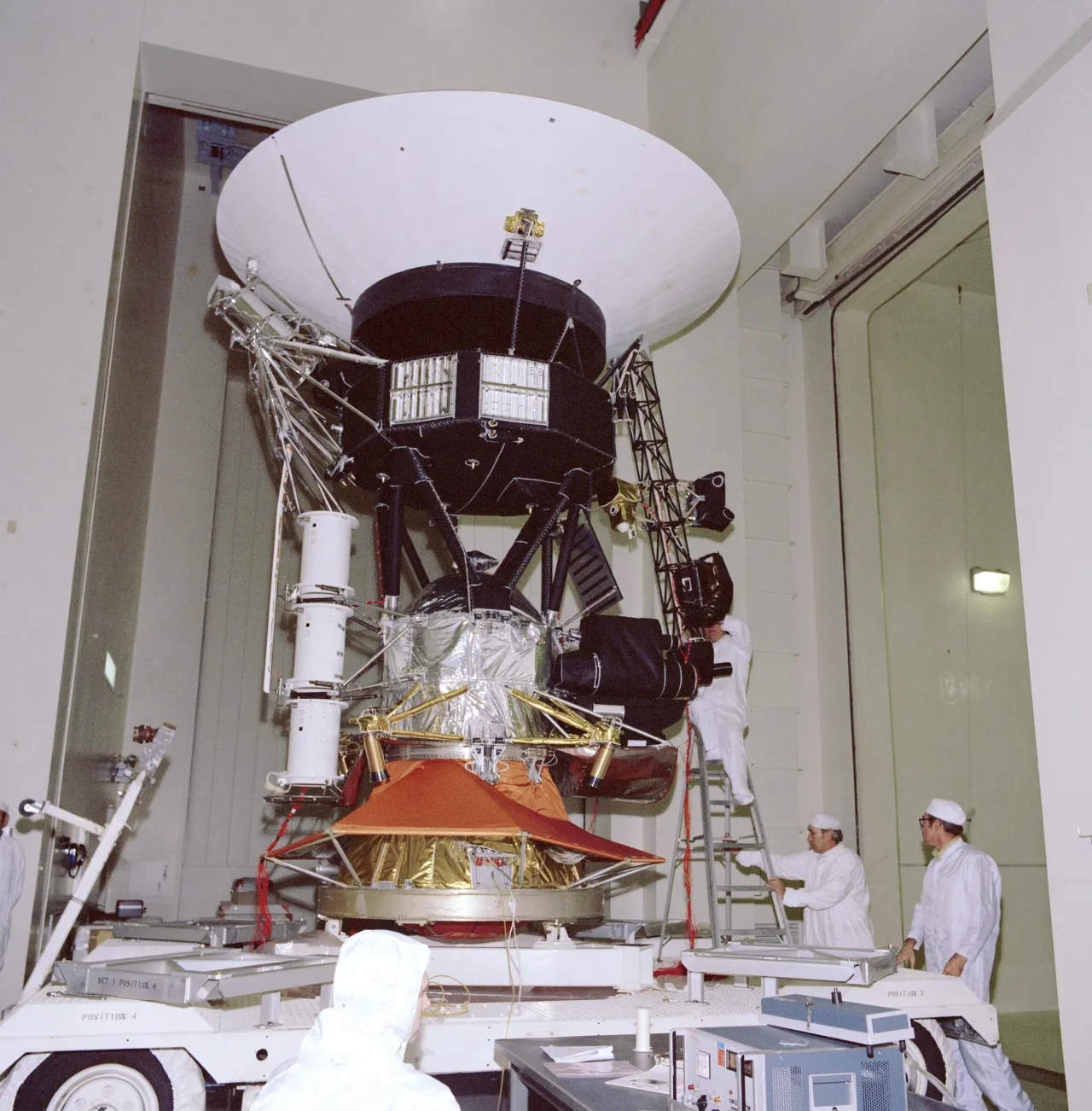
Voyager 1 is currently traveling at a speed of 38,000 mph (61,000 kph) and is expected to achieve a full light-year in another 18,000 years.
The spacecraft's twin, Voyager 2, won't reach the one light-day mark until 2035.
Voyager 1's journey has been marked by several significant milestones, including flybys of Jupiter and Saturn in 1979 and 1980, respectively.
In 1989, Voyager 2 discovered six previously unknown moons around Neptune, adding to its list of achievements.
Voyager 1's power comes from radioisotope thermoelectric generators, which convert heat from decaying plutonium into electricity.
The spacecraft's journey is a testament to the enduring legacy of the Voyager mission, which has provided invaluable insights into the outer reaches of our solar system and beyond.
What this adds
NASA engineers successfully revived Voyager 1 using an innovative 'Big Bang' fix, pushing the spacecraft past a significant milestone.
Voyager 1's sister spacecraft, Voyager 2, is also traveling through interstellar space but at a slower pace.
Background
NASA engineers successfully revived Voyager 1 using an innovative 'Big Bang' fix, pushing the spacecraft past a significant milestone.
What's confirmed
- Despite sporadic problems typical of old age, Voyager 1 and its twin Voyager 2 continue to send back science and engineering data as they zoom toward different points in space at 38,000 mph (61,000 kph).
- Although launched two weeks before its sibling in 1977, Voyager 2 won’t reach the one light-day mark until 2035.
- They’re a bit like weather satellites, according to Dodd, who’s worked with the Voyagers since 1984.
- When Voyager 1 reaches that remarkable milestone on Wednesday, its radio signals will take precisely 24 hours traveling at the speed of light to reach Earth — in other words, one light-day.
- This undated handout image provided by NASA shows the Voyager Golden Record Album.
What's still developing
- The probe was launched in 1977 but it continues to relay space-related data back to a team of NASA scientists daily.
- Launched in 1977, it is one of two Voyager spacecraft sent to explore beyond the solar system, with both probes now travelling through interstellar space.
- The agency’s longest-running mission is approaching a historic distance milestone as its team members implement creative engineering solutions to keep it going.
- “It’s a national treasure,” she told The Associated Press.
- This summer, a Voyager had to join two Typhoons assigned to monitor a Russian warship in the English Channel when it began firing live rounds from its main cannon.
- Rob Hastings joins a Voyager tanker crew refuelling Nato fighters in 'Cobra Warrior' war games over the North Sea For a second or two, they look like birds: four tiny black dots in the distance.
- I’m onboard an RAF Voyager air-to-air refuelling tanker.
- In October 2026, NASA temporarily lost contact with Voyager 1 for approximately 48 hours before its signal unexpectedly returned.
- Voyager 1 is trekking across the cosmos and headed toward a star called AC +79 3888, also known as Gliese 445, according to NASA.