
Home · Health · Nov 13 archive
American Cancer Society Updates Prostate Cancer Screening Guidelines
· Confirmed
In Short: The American Cancer Society (ACS) has updated its guidelines for prostate cancer screening, recommending that men aged 50 to 69 undergo regular screening using a blood test every two years.
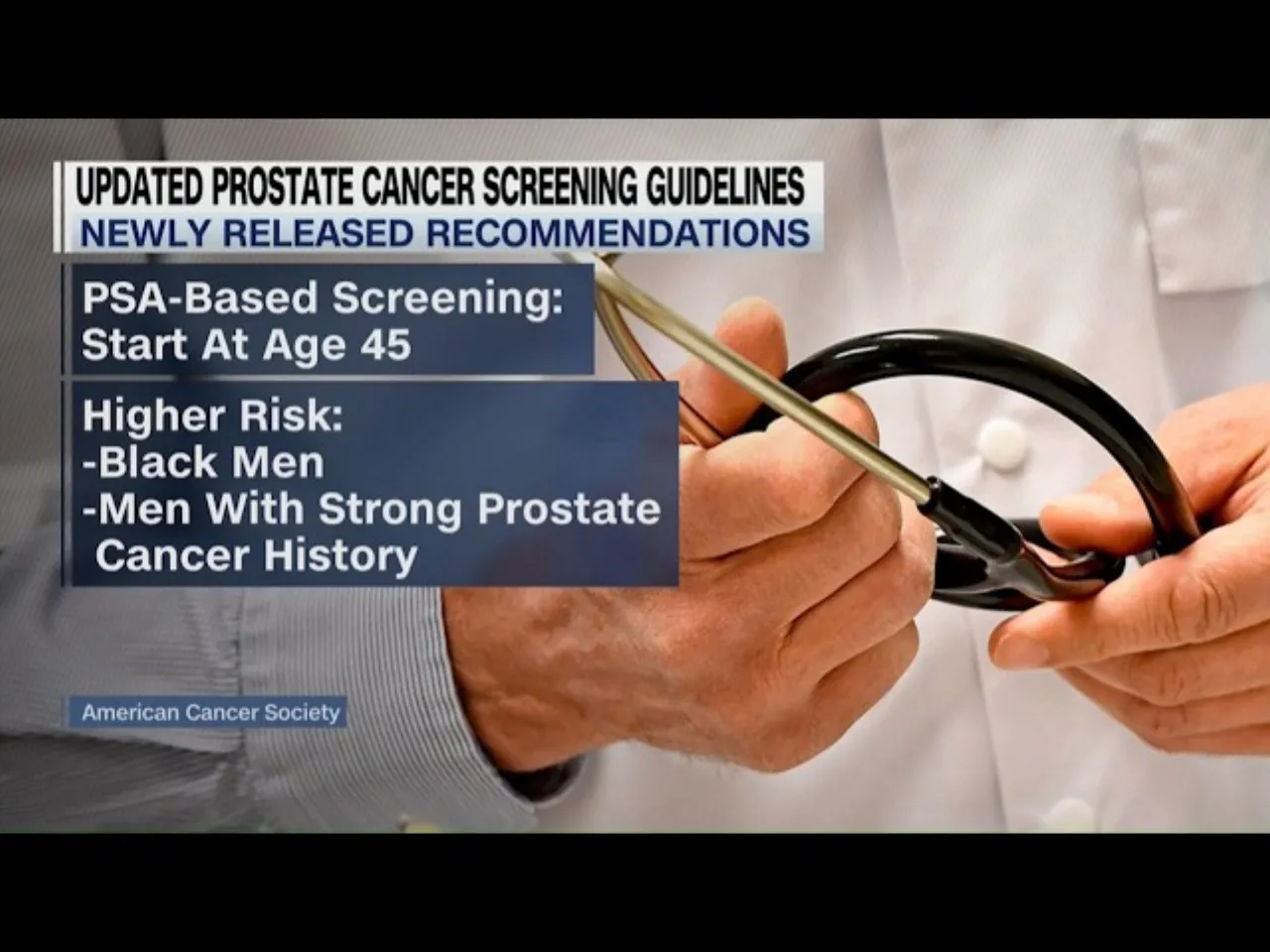
American Cancer Society updates prostate cancer screening guidelines. CBS19
The American Cancer Society (ACS) has updated its guidelines for prostate cancer screening, recommending that men aged 50 to 69 undergo regular screening using a blood test every two years. This change reflects new evidence showing that screening can reduce the risk of dying from prostate cancer, according to the ACS's new recommendations released Thursday.
The updated guidelines diverge from earlier recommendations that left the decision about screening to patients and physicians based on careful consideration of risks and benefits. The ACS now strongly recommends that most men aged 50 and older should take a prostate-specific antigen (PSA) blood test every two years until age 70, while higher-risk men should start as early as age 45.
The new guidelines also advise that men with a higher risk, such as Black men and those with a significant family history of prostate cancer, should get tested annually starting at age 45. This is a significant shift from the previous guidelines, which made no universal recommendations for routine screening.
The ACS's updated guidelines are based on new evidence since 2010 that shows screening saves lives and that advances in case management can avoid the concerning harms from overdiagnosis and overtreatment. The organization emphasizes the importance of a doctor-patient conversation about the pros and cons of screening, especially for men aged 70 to 74, who should consult their doctor on continuing screening.
The National Screening Committee in the UK, which advises governments across the UK, has taken a different stance, stating that a screening program for all men is not justified. The committee advises that screening could cause more harm than good for most men, as many prostate cancers grow so slowly that they pose no threat until a person reaches 120-150 years old, according to the committee.
In the US, the U.S. Preventative Services Task Force has also updated its controversial 2012 recommendation to abandon routine screening of all men using the PSA test. A urologist who has treated prostate cancer patients for 17 years noted that the 2012 controversies led to significant confusion among both physicians and patients, and 65 percent of physicians stopped performing digital prostate examinations, abandoning any form of prostate cancer screening.
The ACS's new guidelines also address the issue of early diagnosis and treatment for prostate cancer, which is the most common cancer in men and kills approximately 12,000 people across the UK each year. The organization hopes that increased surveillance will reduce the number of Black patients presenting with cancers at advanced stages, as this demographic is disproportionately represented in prostate cancer mortality.
The new guidelines recommend that men discuss their individual risk factors, the potential benefits and limitations of screening, and the appropriate screening schedule with their physician. This includes secondary testing, such as MRI and biomarker testing, for men with an elevated PSA to help determine whether a prostate biopsy is necessary.
What this adds
The updated guidelines aim to provide clearer and more consistent advice for men regarding prostate cancer screening, addressing the complexities and controversies surrounding the issue.
What's confirmed
- Many prostate cancers grow so slowly you would have to live to 120-150 years old before they were a threat - so they do not need treating, the National Screening Committee said.
- The U.S. Preventative Services Task Force has recently updated and modified its controversial 2012 recommendation to abandon routine screening of all men using the prostate cancer screening blood test called the prostate specific antigen or PSA test.
- As a urologist who treats and has cared for prostate cancer patients for 17 years, I witnessed firsthand how the controversies of PSA testing in 2012 led to significant confusion in both physicians and patients alike.
- More concerning, 65 percent of these physicians also stopped performing digital prostate examinations, therefore abandoning any form of prostate cancer screening.
- Men in high-risk groups, like Black men and men with a significant history of prostate cancer in the family, are urged to get tested annually starting at 45.
- We’ve got a great lineup for you today, including an inside look at shuffles within the Senate’s health committee, and what it might mean for “Medicare for All.” The American Cancer Society released a major update to its guidelines today, recommending testing for prostate-specific antigen blood levels every two years starting at age 50 for men with an average risk of prostate cancer.
- “Since the ACS last issued a prostate cancer screening guideline, accumulating evidence has confirmed that screening reduces prostate cancer mortality and distant-stage disease,” wrote the expert advisors who developed the guidelines in a report published Thursday in CA: A Cancer Journal for Clinicians, the flagship journal of ACS.
- The UK's National Screening Committee – which advises governments across the UK – has said no to screening in all but one rare circumstance.
- On the other hand, if only one close relative was diagnosed with prostate cancer and it was diagnosed at age 65 or older, non-Black men in this case should start PSA screening at 45, but are recommended to get testing only every two years.
- Newswise — NEW YORK, NY (November 12, 2026) — – New recommendations from the American Cancer Society call for more regular prostate cancer screening, with earlier and more frequent testing for men at higher risk of the disease.
- In a significant update to its guidelines for prostate cancer screening, the American Cancer Society is now recommending that men get routinely screened for prostate cancer with a PSA (prostate-specific antigen) test.
What's still developing
- The Prostate Cancer Foundation This website uses cookies to ensure you get the best experience on our website.
- Chang, MD, MBA Testicular, Penile & Rare GU Malignances Testicular Cancer Science in GU Oncology Bishoy M.
- Joyce, MD, MS Bladder Cancer Non-Muscle Invasive Bladder Cancer Ashish Kamat, MD Muscle-Invasive Bladder Cancer Advanced & Metastatic Bladder Cancer (mUC) Trimodality Therapy Leslie Ballas, MD Kidney Cancer Advanced Kidney Cancer Pedro Barata, MD, MSc Endourology Endourology Jaime Landman, MD Prostate Cancer Localized Prostate Cancer Matthew R.
- Cooperberg, MD, MPH Biochemical Recurrence in Prostate Cancer Decipher® Genomic Classifier Imaging Center Phillip Koo, MD mHSPC Neeraj Agarwal, FASCO, MD nmCRPC Zachary Klaassen, MD, MSc mCRPC Treatment A.
- Experts looking at UK, US and Dutch data found ‘significant increases’ in early onset cases of seven cancers, prompting warnings about lifestyle choices Experts looking at UK, US and Dutch data found ‘significant increases’ in early onset cases of seven cancers, prompting warnings about lifestyle choices Cases of seven types of cancer have risen sharply among younger people in England, major new research has found, prompting warnings that lifestyle choices are costing thousands of lives each year.
- Experts said the figures reflected the growing global obesity epidemic, poor diets and insufficient exercise, as well as growing awareness of cancer and earlier diagnosis.
- Studies since the 2010 guidelines—including the long-term follow-up of earlier trials—have largely found a consistent benefit, however.
- Colorectal cancers in people 20 and under are often aggressive and delayed in diagnosis, new research shows.
- In these earlier guidelines, the ACS cited mixed studies on the effectiveness of PSA testing.
- A high level of PSA can indicate prostate cancer but doesn’t necessarily mean that a man has it.
- If you’re a man reaching middle age, the American Cancer Society (ACS) has an important message for you: It’s probably time to keep a watchful eye on your prostate.
- Today is the start of a three-month consultation before the committee meets again and gives its final advice to ministers in England, Wales, Northern Ireland and Scotland who will each have to make their own decision on prostate screening.