
Home · Science · Nov 10 archive
NASA's Twin ESCAPADE Spacecraft Complete Earth Flyby Maneuvers
· Confirmed
In Short: NASA's twin ESCAPADE spacecraft, Blue and Gold, have successfully completed their powered Earth flyby maneuvers, propelling them toward Mars.
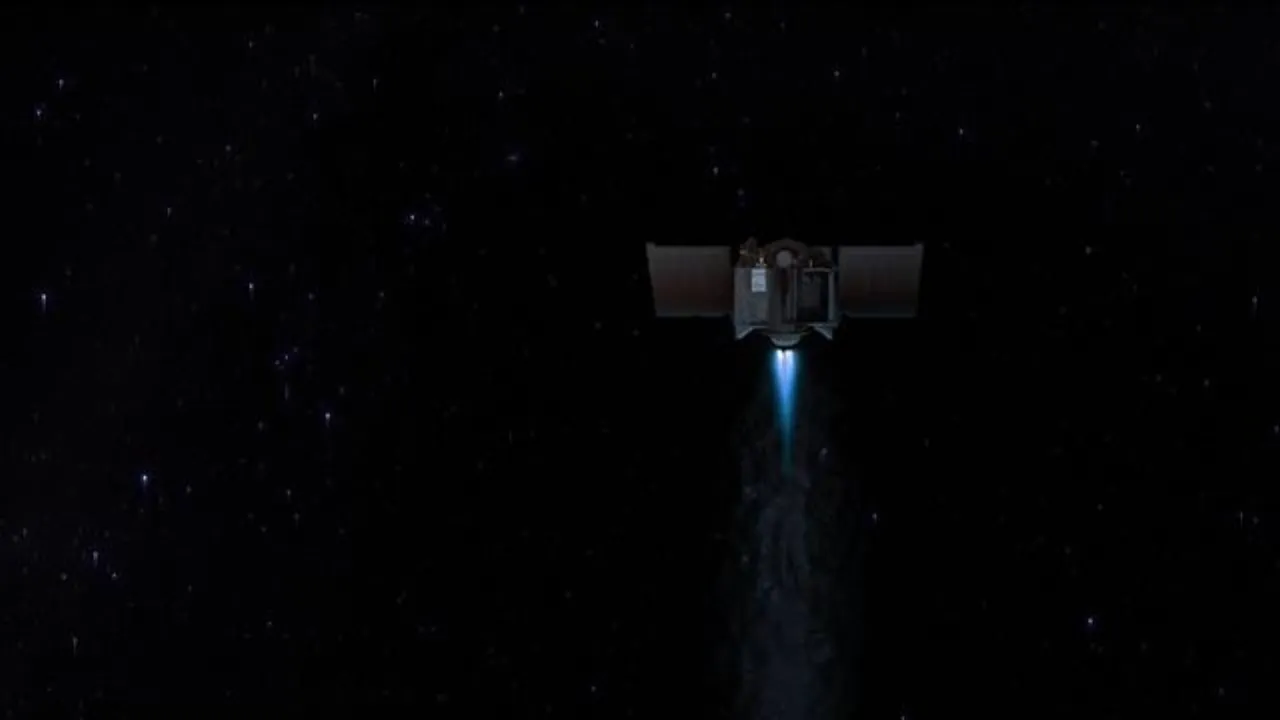
ESCAPADE Earth flybys Mars: Both spacecraft complete powered departures. HeyDay News
NASA's twin ESCAPADE spacecraft, Blue and Gold, have successfully completed their powered Earth flyby maneuvers, propelling them toward Mars. The maneuvers, executed on November 7 and 9, 2026, respectively, increased their speed by over 1,000 miles per hour.
The spacecraft are expected to arrive at Mars in September 2027.
Asal Naseri, acting associate flight director for the Heliophysics Division at NASA Headquarters, praised the mission's success, stating, "This is the first time NASA has used a powered Earth flyby to propel a spacecraft toward Mars, and we’ve now executed this maneuver twice, flawlessly, in just two days."
Rob Lillis, ESCAPADE’s principal investigator and associate director for planetary science at the Space Sciences Laboratory, expressed excitement about the upcoming journey. "Our fantastic operations team put 110% into this critical maneuver, getting the spacecraft ready and watching like hawks for potential issues. We’re excited to now focus on our interplanetary journey. Onward, to Mars!"
The ESCAPADE mission initially aimed to launch in October 2024 but faced delays, leading to a reevaluation and the development of a "loitering" orbit. This path allowed the spacecraft to orbit back to Earth by early November 2026, setting the stage for the recent maneuvers.
The powered Earth flyby maneuvers combined gravitational interaction with engine thrust, providing a significant velocity boost. Michele Cash, ESCAPADE program scientist at NASA headquarters, noted, "By better understanding how the solar wind affects the Martian environment, ESCAPADE’s findings could help us plan and prepare for future human exploration of the Red Planet."
During the flybys, the spacecraft observed Earth's magnetotail, capturing data that could provide insights into Earth's magnetic field and its interactions with the solar wind. This data is considered unprecedented and could shed light on the search for life and Earth's own dynamics.
The ESCAPADE spacecraft will be the first to fly in formation around Mars, providing a more comprehensive understanding of the planet's dynamics. The mission's findings could help uncover more about how Mars lost its ancient atmosphere.
The ESCAPADE mission's success marks a significant step in NASA's exploration of Mars and the solar system. The spacecraft's journey to Mars is expected to begin in earnest in June 2028, with science operations commencing shortly thereafter.
What this adds
The ESCAPADE mission's powered Earth flyby maneuvers are a first for NASA, demonstrating a new approach to interplanetary travel.
The spacecraft's formation flying will enable scientists to study the Martian environment from multiple vantage points simultaneously, providing a more comprehensive understanding of the planet's dynamics.
Background
NASA's twin ESCAPADE spacecraft have completed powered Earth flyby maneuvers, setting them on course for Mars in 2027.
What's confirmed
- “This is the first time NASA has used a powered Earth flyby to propel a spacecraft toward Mars, and we’ve now executed this maneuver twice, flawlessly, in just two days,” said Asal Naseri, acting associate flight director for the Heliophysics Division at NASA Headquarters in Washington.
- Science operations are expected to begin in June 2028.
- To view this video please enable JavaScript, and consider upgrading to a web browser that supports HTML5 video The two ESCAPADE spacecraft launched from Cape Canaveral Space Force Station in Florida on Nov. 13, 2025, when Earth and Mars were on opposite sides of the Sun.
- Home » Science » NASA’s ESCAPADE Spacecraft Complete Unique Earth Flyby to Propel Towards Mars Twin NASA spacecraft, known as the Escape and Plasma Acceleration and Dynamics Explorers (ESCAPADE), are nearing the end of a year-long journey, preparing to embark on a mission to Mars.
What's still developing
- This lovely poster shows the moon’s phase for every day in 2027.
- That’s what the illustration below is showing.
- Bottom line: The moon shows one phase to the Earth at the same time, but our different perspectives due to where we are on the globe can make the moon appear differently in our sky.
- It comes down to Earth’s rotation, and its round shape.
- EST on Nov. 7, when it was about 1,000 miles above the planet’s surface.
- 9), when it was about 650 miles (1,000 kilometers) above the surface.
- EST came at an altitude of roughly 1,000 miles above Earth; Gold's approach on November 9 at approximately 5:51 a.m.
- During those nine minutes, each spacecraft's onboard engine pushed its speed from roughly 6.3 miles per second to approximately 6.7 miles per second: an increase of more than 1,000 miles per hour, from about Mach 30 to about Mach 31.
- The Escape and Plasma Acceleration and Dynamics Explorers (ESCAPADE) launched in November 2025 aboard Blue Origin’s New Glenn rocket, during the vehicle’s second flight.
- Previous missions had examined the magnetotail at distances reaching nearly 800,000 miles (1.27 million kilometers) from Earth.
- A single spacecraft wouldn't be able to tell if changes it observes are due to changes in these interactions, or changes in its position.
- Now available — EarthSky’s famous moon phase calendar!