
Home · Science · Nov 10 archive
Greenland's Ice Sheet Once Retreated 60 Miles, Scientists Find
Confirmed
In Short: Scientists have uncovered a surprising event where a massive flood of subglacial lakewater burst through Greenland's ice sheet, causing it to retreat over 60 miles, according to a new paper published in Nature Geoscience.
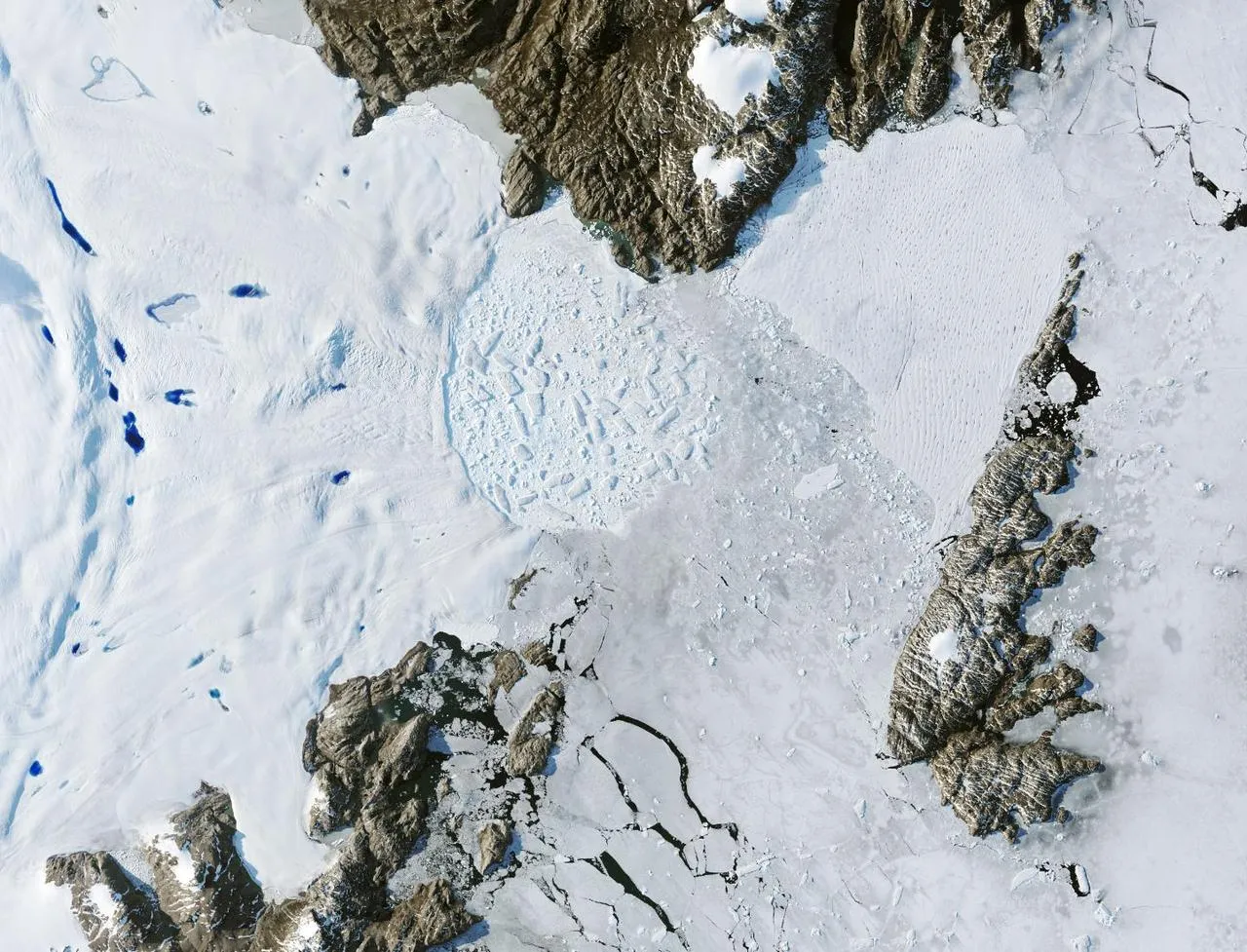
Retreat of Greenland's Zachariae Isstrom Glacier, NASA.
Scientists have uncovered a surprising event where a massive flood of subglacial lakewater burst through Greenland's ice sheet, causing it to retreat over 60 miles, according to a new paper published in Nature Geoscience.
The discovery, which marks the first time such a phenomenon has been observed, highlights the significant impact of meltwater beneath the ice sheet.
The team is now using the data to better understand the effects of such events on the surrounding ice sheet.
This finding challenges previous predictions about how the Greenland ice sheet evolves over time, even when considering climate change and accelerating ice sheet melting.
The Greenland ice sheet, which spans 1.7 million square kilometers and measures more than 3 kilometers at its thickest point, is a critical focus for climate change research.
The event also underscores the need to better understand how often subglacial lakes drain and the consequences for the surrounding ice sheet.
What this adds
The discovery of the massive flood and ice sheet retreat adds to the understanding of how climate change impacts polar regions.
The Greenland ice sheet's retreat over 60 miles is unprecedented and provides new insights into the dynamics of ice sheets under climate change.
Background
In a study involving mice and human cells, scientists at the University of California San Diego discovered a previously unrecognized process that interferes with the liver's ability to clear cholesterol.
What's confirmed
- Scientists have uncovered a surprising event where a massive flood of subglacial lakewater burst through Greenland's ice sheet, causing it to retreat over 60 miles, according to a new paper published in Nature Geoscience.
- The discovery, which marks the first time such a phenomenon has been observed, highlights the significant impact of meltwater beneath the ice sheet.
- The team is now using the data to better understand the effects of such events on the surrounding ice sheet.
- This finding challenges previous predictions about how the Greenland ice sheet evolves over time, even when considering climate change and accelerating ice sheet melting.
- The Greenland ice sheet, which spans 1.7 million square kilometers and measures more than 3 kilometers at its thickest point, is a critical focus for climate change research.
- The event also underscores the need to better understand how often subglacial lakes drain and the consequences for the surrounding ice sheet.
What's still developing
- Can’t-miss innovations from the bleeding edge of science and tech Scientists were caught by surprise after discovering a massive flood of subglacial lakewater burst through Greenland’s ice sheet, spilling copious amounts of water across its surface.
- Sediment beneath a secret Cold War base reveals a time when warmer summers helped push Greenland’s ice more than 60 miles back from its current edge.
- Exposing the ground at Camp Century would have required the ice sheet’s edge in that region to retreat more than 60 miles (97 kilometers) from its present position.
- Only one other extinct Pleistocene amphibian has been reported from North America (a tree frog from Florida), making the find exceptionally rare and offering scientists a new window into the climate and environment of prehistoric Southern California.
- In addition to the volcano, the authors discovered a 5,000-km2 (1930 square mile) area of volcanic deposits within the volcano’s perimeter presenting a large number of low, rounded and elongated, blister-like mounds.
- Drifting through the polar darkness, a team of scientists is documenting a rapidly changing Arctic.
- A scientist who spent decades convincing colleagues that the Antarctic ice sheet could serve as a telescope has won the 2026 Nobel Prize in Physics.
- Scientists investigating an enormous cloud that mysteriously appears over Mars each year have uncovered evidence of an exotic physical process never before identified in a planetary atmosphere.
- See Also Analysis: Newly Released Version of Once-Classified Report Presents New Clues About the U.S. Government’s UAP Investigations “Mars Express can also track how the cloud is changing on timescales of mere hours, which gives us an unrivalled view of short-lived phenomena on the planet,” says ESA Mars Express Project Scientist Colin Wilson.
- Scientists have been studying how life could have survived the Cryogenian era, which includes the Snowball Earth period, plus another such episode about 650 million years ago.
- About 700 million years ago, Earth was entombed in a veneer of ice hundreds of feet thick—a frozen state scientists refer to as “Snowball Earth.” Oceans cooled but managed to retain some heat to avoid freezing.
- Some scientists have argued it was caused by erosion by massive ice sheets during the Snowball Earth period between 720 million years and 635 million years ago.