
Home · Health · Nov 10 archive
FDA Mandates GLP-1 Drugs to Include Warning About Rare Eye Condition
· Confirmed
In Short: The FDA now requires makers of GLP-1 drugs to add a warning about a rare eye condition that can lead to vision loss.
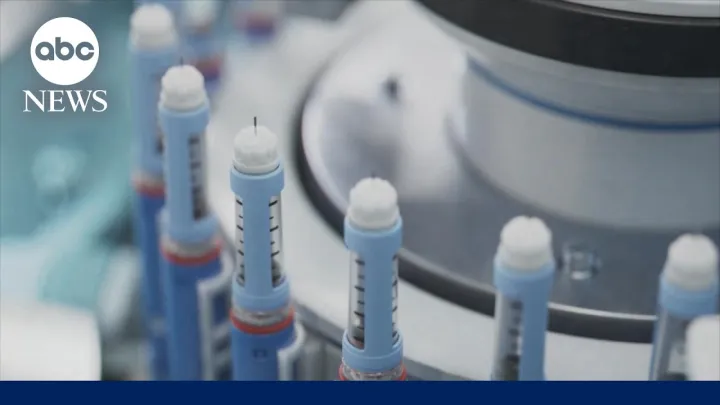
FDA orders new warning on Ozempic, Wegovy, other GLP-1 drugs over rare eye condition.
FDA orders new warning on Ozempic, Wegovy, other GLP-1 drugs over rare eye condition. ABC News
The U.S. Food and Drug Administration (FDA) announced on Monday that manufacturers of GLP-1 drugs, including Ozempic, Wegovy, Zepbound, and Mounjaro, must now include a warning about a potential increased risk of non-arteritic anterior ischemic optic neuropathy (NAION) on their drug labels.
According to the FDA, the condition is rare, occurring in between two and 10 people in 100,000 in the general population.
In a meta-analysis of 126 clinical trials, the FDA identified 15 probable NAION cases: 10 in patients taking a GLP-1 drug, five in patients who received a placebo, and none in patients on non-GLP-1 drugs.
The FDA's decision comes after an intensive review of studies and clinical trials, which included a total of 134,253 participants, of whom 78,217 received a GLP-1 medication.
While the condition is rare, the FDA noted that the risk increases to about six in 100,000 people for those taking GLP-1 drugs.
Experts say the condition is known as non-arteritic anterior ischemic optic neuropathy, or NAION, and it comes out of nowhere.
Hundreds of lawsuits across the country have been filed by patients who claim GLP-1s caused them to go blind, but scientific evidence so far does not prove a cause-and-effect relationship between GLP-1s and NAION.
What this adds
The FDA's decision reflects ongoing concerns about the safety of GLP-1 drugs and the need to inform patients and healthcare providers about potential risks.
The condition NAION is rare, but the FDA's warning underscores the importance of monitoring patients for any signs of the condition while taking GLP-1 drugs.
Background
The FDA has required drugmakers to add warnings about a potential increased risk of NAION, a rare eye condition, to the labels of all GLP-1 drugs.
The FDA has required drugmakers to add warnings about a potential increased risk of NAION, a rare eye condition, to the labels of all GLP-1 drugs.
What's confirmed
- Experts say the condition is known as non-arteritic anterior ischemic optic neuropathy, or as NAION, and it comes out of nowhere.
- The eye condition, called nonarteritic anterior ischemic optic neuropathy, or NAION, leads to sudden and often permanent vision loss.
What's still developing
- Test your knowledge with our new weekday mini crossword The Food and Drug Administration on Monday warned that GLP-1 drugs carry a potential risk for a rare but serious eye condition and required pharma companies to inform patients and doctors of the risk.
- In an interview with ABC News, Zelensky stressed that choosing national leaders belongs to Ukrainian society and that establishing safety conditions for voters requires an enforceable cessation of Russian bombardments.
- These efforts address ongoing challenges, including gaps in understanding how diseases and medicines affect women and men differently, and the need for better treatments for conditions that primarily affect women.
- President Donald Trump is expected to announce the plans Tuesday at a campaign rally in Texas, The New York Times, The Washington Post and The Hill reported citing unnamed sources speaking on condition of anonymity.
- Multiple bills have been filed to hold state prisons to the same standard and to force the state to air condition its entire prison system by 2029, but all have died in the state Senate due to the high cost.
- State law requires county jails to be kept between 65 and 85 degrees.
- Out of 104 state prisons, 38 are fully air-conditioned.
- According to AARP, in 2025, an estimated 63 million Americans cared for adults or children with a medical condition or disability.
- (OSV News) — As Pope Leo XIV undergoes surgery for a lung nodule, medical experts consulted by OSV News said the condition is typically benign — but requires careful scrutiny and early intervention to address any possible cancer.
- People with ADHD had a 70 percent higher hazard of death from any cause than people without the condition.
- “It’s important that they look at this as a real drug that’s being taken for a significant medical condition, not just, hey, I’d like to lose five pounds before a party,” he said.
- Tehran argues that negotiations cannot begin under conditions of pressure and confrontation.
Sources
- AZ Familylink
- Ars Technicalink
- Medscapelink
- NBC Newslink
- NewsNationlink
- PhillyVoicelink
- STATlink
- The Business Standardlink
- Gadgetreviewlink
- Kyivpostlink
- Emalink
- Pymntslink
- Upilink
- Kltvlink
- Wbaltvlink
- Al Jazeeralink
- ABC News — video link
- KTLA 5 — video link
- FOX 5 New York — video link
- NBC News — video link
- NBC News — video link
- WBIR Channel 10 — video link