
Home · Science · Nov 9 archive
Researchers Find Red Blood Cells in 115-Million-Year-Old Dinosaur Bone
· Confirmed
In Short: Researchers studying a 115 million-year-old dinosaur bone say they've found the strongest evidence yet of red blood cells in a fossil.
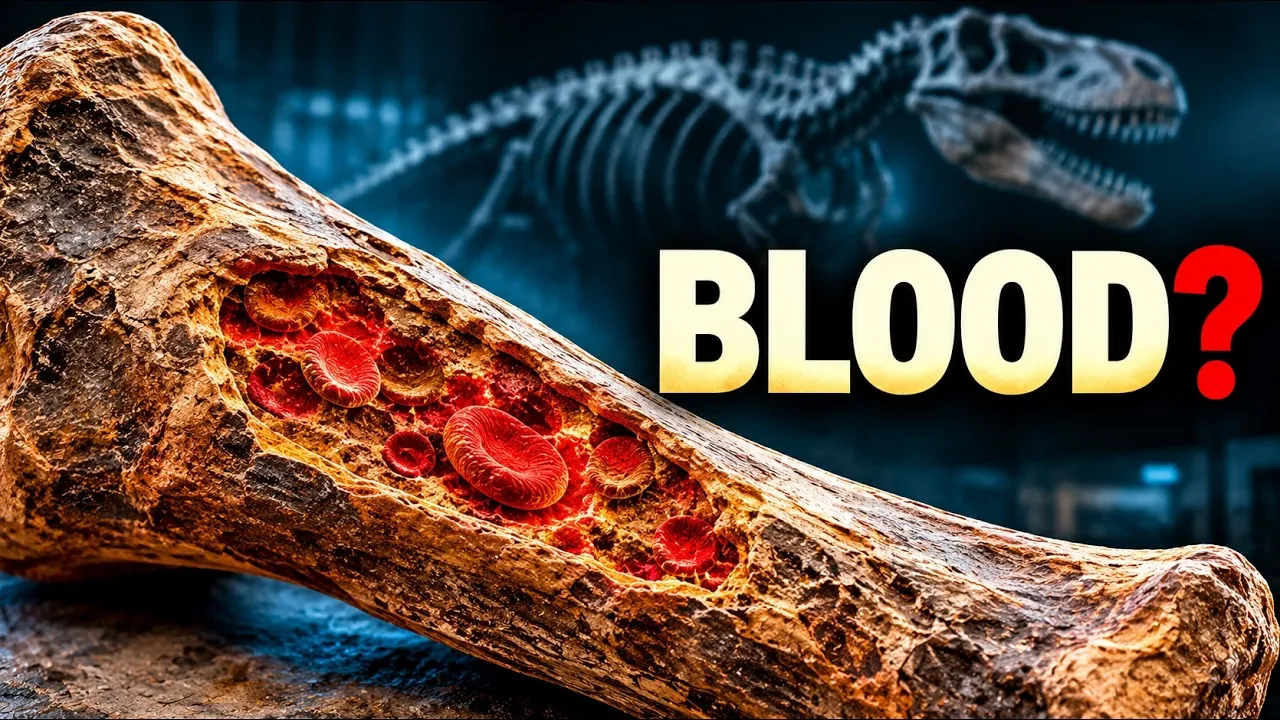
Dinosaur 🦖 Blood Found in 115 Million Year Old Fossil?. USAMYSTICA
Researchers studying a 115 million-year-old dinosaur bone say they've found the strongest evidence yet of red blood cells in a fossil. The discovery, published in the journal Proceedings of the National Academy of Sciences, uses a combination of microscopic imaging and chemical analyses to identify structures resembling red blood cells and chemical evidence of heme, a molecule in hemoglobin.
The fossil is a partial hind limb of Aratasaurus museunacionali, a theropod dinosaur that lived during the Early Cretaceous period. The bone was unearthed in 2008 at the Mina Pedra Branca site in northeastern Brazil within the Romualdo Formation, known for its exceptionally preserved fossils.
The team used scanning electron microscopy to capture images of tiny ellipsoid structures, about 20 micrometers in diameter, that may be fossilized red blood cells. They also found chemical evidence of heme within the structures themselves, marking the first time heme has been detected in situ in a dinosaur fossil.
However, not all experts are convinced that the microscopic structures are truly red blood cells. Past research has described red blood cell-like structures and possible remnants of blood chemistry in dinosaur fossils, but this study brings together multiple lines of evidence, including the structures’ location, appearance, mineral composition, and associated chemical signals.
What this adds
This report adds new details about the chemical evidence of heme and the microscopic structures resembling red blood cells, as well as expert opinions on the implications of the discovery. The BACKGROUND notes that red blood cells are the most common type of blood cell and the vertebrate's principal means of delivering oxygen to the body tissues.
Background
Researchers studying a 115 million-year-old dinosaur bone have found what they believe to be the strongest evidence yet of red blood cells in a fossil.
Red blood cells (RBCs), referred to as erythrocytes in academia and medical publishing, also known as red cells, erythroid cells, and rarely haematids, are the most common type of blood cell and the vertebrate's principal means of delivering oxygen to the body tissues—via blood flow through the circulatory system.
What's confirmed
- The new study, published Monday in the journal Proceedings of the National Academy of Sciences, used a combination of new microscopic imaging and chemical analyses to find not only microscopic structures resembling red blood cells preserved within the dinosaur bone, but also chemical evidence of heme — a molecule in hemoglobin, the protein in red blood cells that carries oxygen.
What's still developing
- Traces of prehistoric blood could reveal unprecedented clues about dinosaur biology, but they’ve been notoriously difficult to confirm.
- A few previous studies, dating back to the late 1990s, have reported structures resembling red blood cells in dinosaur and other reptile fossils, but researchers have fiercely debated their legitimacy.
- Report us A new species of predatory dinosaur, roughly the size of a large tiger and armed with long, curved claws, has been identified from a fossil that spent more than a century in the collections of London's Natural History Museum.
- Norellraptor belongs to the microraptorines, a group of small, feathered dromaeosaurid dinosaurs known for long feathers on both their arms and legs, which is why they are often called four-winged dinosaurs.
- “I couldn’t believe what I was seeing,” he says.
- Against the backdrop of mounting evidence that links per- and polyfluoroalkyl substances (PFAS) to negative impacts on human health, the National Academies of Sciences, Engineering and Medicine (NASEM) released a study that calls for testing the blood of people with extended exposure to the man-made chemicals.
- While previous studies have reported possible red blood cell structures in fossils, this study is the first to chemically prove the presence of haemoglobin-derived molecules inside the cells.
- Tissues, cells and other soft biological samples rarely ever survive the fossilization process and thus make for controversial discoveries.
- Researchers analyzed a 0.9-gram sample and determined its age through its mineral and chemical characteristics, according to a study published in Geochimica et Cosmochimica Acta.
- Using Hubble along with telescopes at the Fred Lawrence Whipple Observatory and the Roque de Los Muchachos Observatory, the researchers detected repeating patterns in Betelgeuse’s behavior.
- The researchers found no nutraceutical or phytoceutical class that was significantly less tolerable than placebo, although citicoline (a supplement typically used to boost brain function) was associated with more dropouts.
- After reviewing over 250 Webb Telescope observations of early galaxies from 800 million to 1.5 billion years after the Big Bang, University of Cambridge researchers discovered a complex and “messy” pattern of unevenness.