
Home · Faith · Nov 7 archive
Pope Leo Challenges Uruguay on Abortion, Euthanasia, and Suicide
· Confirmed
In Short: Pope Leo XIV addressed Uruguay's President Yamandú Orsi and other dignitaries in Montevideo’s Plaza Independencia, focusing on the country's stance on abortion, euthanasia, and suicide.
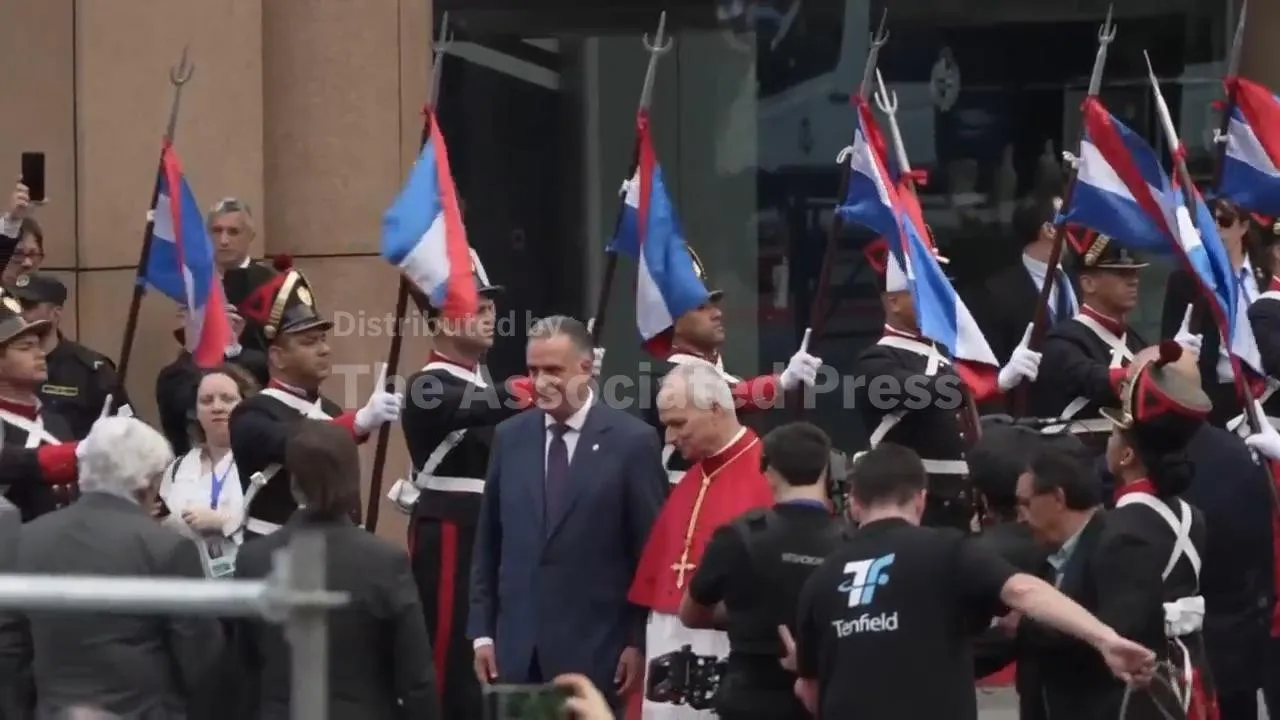
Pope Leo XIV addressed Uruguay's President Yamandú Orsi and other dignitaries in Montevideo’s Plaza Independencia, focusing on the country's stance on abortion, euthanasia, and suicide. OSV News reported that the Pope highlighted the importance of protecting the unborn and supporting mothers, fathers, and families, while Cathstan noted his emphasis on the dignity of the unborn.
Cathstan and OSV News both reported that Pope Leo XIV quoted St. Paul VI’s 1965 declaration on religious freedom, “Dignitatis Humanae,” stressing that no one should be compelled to act against their conscience or prevented from acting in accordance with it. OSV News added that the Pope acknowledged Uruguay’s secular identity, stating that state neutrality should protect freedom for believers and nonbelievers alike.
According to OSV News, Pope Leo XIV praised Uruguay’s transformation of its energy mix and its role in Mercosur, the bloc it forms with Argentina, Brazil, and Paraguay. OSV News also reported that the Pope welcomed the coexistence between people of different origins and traditions, a theme echoed by En, which noted the Pope’s emphasis on peace and dialogue in resolving differences.
Pope Leo XIV addressed the high suicide rate in Uruguay, emphasizing the importance of adequate healthcare, family ties, and community support. OSV News noted that the Pope highlighted the need for healthcare to be accessible to everyone, regardless of their resources.
OSV News reported that the Pope’s remarks carried particular weight in Uruguay, the region’s only country without a Christian majority, with Pew Research Center estimating that 52 percent of Uruguay’s population was religiously unaffiliated in 2020. OSV News also noted that the Pope’s visit opened his 12-day journey through Uruguay, Argentina, and Peru.
Pope Leo XIV stressed the importance of ensuring that each person can live with dignity and receive the care they need until the natural end of their life. OSV News noted that the Pope’s remarks on euthanasia, which is forbidden by Catholic teaching, were particularly significant in Uruguay, where the practice was approved in 2025.
OSV News reported that the Pope’s visit to Uruguay included a stop at the Cabildo and the Cathedral, where he received the key to the city. OSV News also noted that the Pope travelled in the popemobile along the waterfront promenade to Plaza Independencia, accompanied by some 3,000 volunteers.
The Pope’s visit to Uruguay was met with mixed reactions, with a Usina de Percepción Ciudadana survey finding that 37% of Uruguayans attach importance to the visit and 63% little or none.
Pope Leo XIV’s remarks on abortion, euthanasia, and suicide were particularly significant in Uruguay, where abortion was legalized in 2012 and euthanasia was approved in 2025. OSV News noted that the Pope’s emphasis on the dignity of the unborn and the importance of protecting life from conception was a reference to these laws.
Pope Leo XIV’s remarks on the importance of adequate healthcare, family ties, and community support in addressing suicide were particularly significant in Uruguay, where the Ministry of Public Health recorded 11,445 reported abortions in 2025, the highest annual figure since the law took effect.
Pope Leo XIV’s remarks on the importance of peace and dialogue in resolving differences were particularly significant in Uruguay, where the country separated Church and State in its 1919 Constitution.
Background
Pope Leo XIV will travel to Uruguay, Argentina, and Peru from November 6 to 17, 2026, despite undergoing lung surgery earlier this month.
Pope Leo XIV will travel to Uruguay, Argentina, and Peru from November 6 to 17, 2026, despite undergoing lung surgery earlier this month.
What's confirmed
- Reflecting on a figure of a mother holding a baby, the pope said “the unborn already belong to the human family,” adding that protecting unborn children must be accompanied by support for mothers, fathers and families.
- Preliminary figures indicate that about 12 people died by euthanasia during that period, while the country awaits the oversight commission’s first annual report.
- Speaking to President Yamandú Orsi, public officials and diplomats in Montevideo’s Plaza Independencia, Pope Leo framed his remarks around the bronze reliefs depicting the 1811 exodus led by national hero José Gervasio Artigas.
- The absolute dependence of the unborn on their mother “does not diminish the dignity to which they are entitled or the protection they deserve.” Uruguay legalized abortion in 2012.
- More than 129,000 were recorded from 2013 through 2025.
- “It is everyone’s responsibility to ensure that each person can live with dignity, receive the care they need, and be accompanied until the natural end of his or her life.” Euthanasia, the intentional ending of a human life in order to relieve suffering, is forbidden by Catholic teaching.
What's still developing
- Orsi welcomed him to a region “where there are no wars between countries”, called him “dear friend” and noted that in Uruguay former presidents sit together “in peace and joy”.
- “The Church wishes to continue offering the Uruguayan people what she herself has received,” the pope said, while cooperating with all who promote the common good and human dignity. – – – Inés San Martín writes for OSV News from Rosario, Argentina.
- The verses cited by the Pope in the book published by LEV, edited by journalist Alessandro Banfi, come from “Go Away You Bomb,” a protest song written by the artist in 1963, at the height of Cold War tensions.
- He also referred to the high suicide rate: “No one should feel like a stranger among their own or think that their absence matters more than their presence.” And he said secularism does not mean religion must be confined to private life.