
Home · Science · Nov 3 archive
Why does Betelgeuse keep fading? The mystery of Orion's giant star
Confirmed
In Short: Betelgeuse, a red giant star, is showing signs of recovery after a mysterious dimming event, potentially influenced by its companion star.
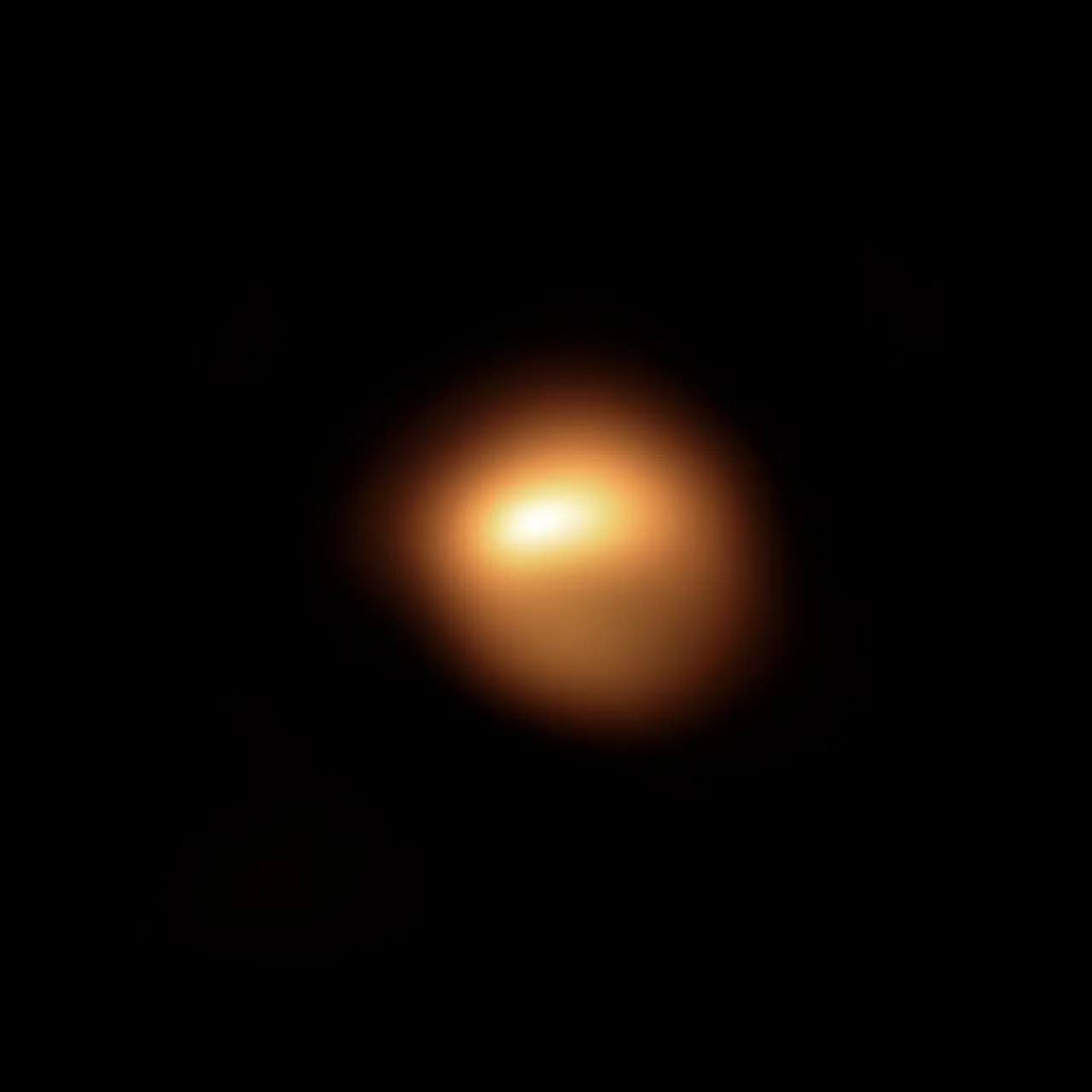
Betelgeuse, a red giant star located 650 light-years from Earth, has been observed to dim significantly, sparking speculation about its impending supernova.
According to the American Association of Variable Star Observers, Betelgeuse's recent dimming is part of its natural variability.
The star's dimming cycle includes a shorter 400-day cycle linked to pulsations within the star and a longer secondary cycle lasting about 2,100 days.
Scientists using the VLA and ALMA telescopes have observed that Betelgeuse's outer atmosphere has rebounded, hinting at the influence of its companion star.
Lynn Matthews of MIT Haystack Observatory and colleagues used VLA and ALMA telescopes to image the star at seven radio frequencies between 2021 and 2026.
The companion star, named Siwarha, is orbiting so close to Betelgeuse that it passes through its extended atmosphere, stirring up dense streams of gas.
Betelgeuse's submillimeter 'surface' deviates from a circle by roughly plus or minus 6 percent in radius, with particularly large corrugations toward the southeast.
According to orbit modeling, the next time to see the star at its greatest distance from Betelgeuse will be in November 2027.
The star's periodic variability, with a period of about 2,100 days, suggests that Betelgeuse is nearing the end of its life.
Betelgeuse's recovery from the 'Great Dimming' event of 2020 indicates that the star is still active and may continue to exhibit periodic dimming.
This companion star's influence may ultimately force astronomers to rethink how convection, shocks, and Betelgeuse's recently detected companion shape a star approaching the end of its life.
The biggest question now is when Betelgeuse will explode in a supernova, according to UC Berkeley’s Sarafina Nance, who studies Betelgeuse and stellar explosions.
What this adds
The exact nature of Betelgeuse's dimming and its companion star's influence on its behavior remains a subject of ongoing research.
The recovery of Betelgeuse's outer atmosphere suggests that the star may continue to exhibit periodic dimming and brightening cycles.
What's confirmed
- The star goes through a cycle of appearing more circular and more eggy, just as if a companion mass is distorting the star.
- Lynn Matthews of MIT Haystack Observatory and colleagues used VLA and ALMA telescopes to image the star at seven radio frequencies between 2021 and 2026.
- "This companion is orbiting so close to the star that it actually passes through its extended atmosphere."
What's still developing
- Huge, red stars like Betelgeuse live fast and die violently, exploding in stellar events called supernovae that are visible across vast distances.
- So, while Betelgeuse is a relatively young star— only about 8.5 million years old —astronomers know that it is nearing the end of its life.
- Normally, Betelgeuse is among the 10 brightest stars in the sky.
- “Now the outline of Orion is noticeably different with Betelgeuse so faint,” he says.
- After a mysterious four-month fading streak, the star known as Betelgeuse could be on its way to regaining its shine.
- Alongside its roughly 430-day pulsation, Betelgeuse shows a mysterious 2,100-day (5.75-year) dimming cycle.
- The star has long been known to have a variable cycle of about 425 days, but a second variable pattern of about 5.9 years has been discovered as well.
- Let's start with the scientific characteristics of Betelgeuse.
- Distant celestial body : Betelgeuse is 650 light-years from us, which means that the light we see from Betelgeuse today began its journey in the Middle Ages.
- The same data also showed that Betelgeuse itself has largely recovered from the " Great Dimming " that made headlines in 2020.
- The star gets brighter and darker every 400 days or so as the star grows and shrinks – think of it a bit like breathing.
- The peak, about 3,500 K at 22 GHz, now matches the star’s photospheric temperature.