
Home · Science · Nov 3 archive
NASA Seeks Private Sector Help to Save Hubble Space Telescope
· Confirmed
In Short: NASA has issued a Request for Information to commercial companies to explore ways to extend the life of the Hubble Space Telescope.
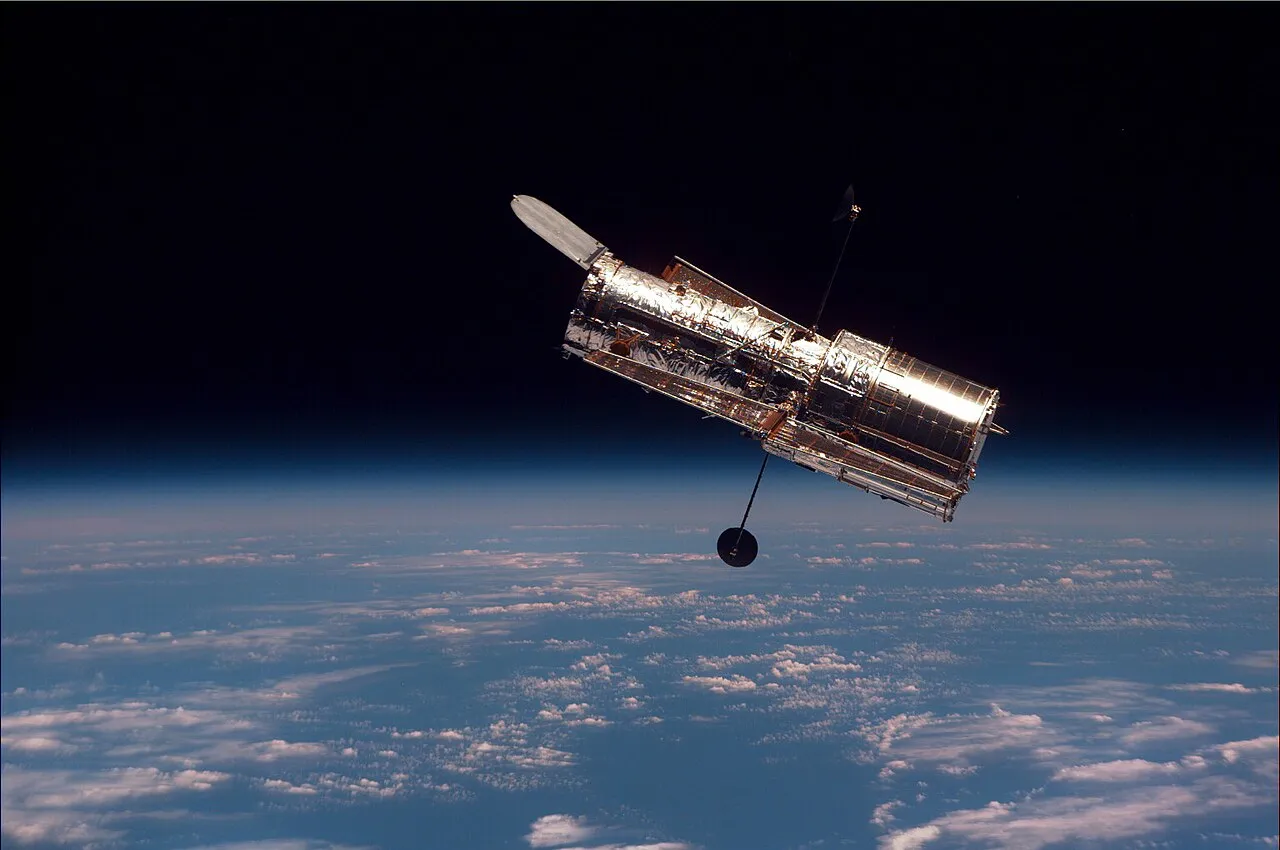
NASA has issued a Request for Information (RFI) to commercial companies to explore ways to extend the life of the Hubble Space Telescope, which has been in operation for over 30 years.
The RFI specifically seeks information on companies’ current and near-term capabilities for capturing Hubble and boosting it to an altitude of at least 373 miles (600 km), enhancing the telescope’s performance, or guiding Hubble to a controlled reentry.
The requirement includes that the boost and/or servicing mission must not harm the Hubble Space Telescope (HST) and that this mission is expected to occur by 2032.
Hubble, launched in 1990, has been a national icon that has fundamentally changed how humanity views the universe, according to Nicky Fox, associate administrator of NASA’s Science Mission Directorate.
The final shuttle servicing flight in 2009 did not reboost the telescope’s orbit, and with the retirement of the shuttle fleet two years later, Hubble has steadily lost altitude.
At its current rate of altitude loss, Hubble is expected to re-enter Earth’s atmosphere sometime between 2033 and 2034, potentially endangering human life.
Jared Isaacman, a billionaire commercial astronaut, approached NASA in 2022 about a servicing mission to Hubble with a team of astronauts on SpaceX’s Dragon spacecraft.
Isaacman proposed funding most of the mission, which would have reboosted Hubble by at least 30 miles (50 km).
It took 24 years for Hubble, which lacks onboard propulsion, to glide from its 2002 altitude of 362 miles (583 km) to its current orbit some 292 miles (470 km) above Earth.
The Hubble Space Telescope still shines in the eyes of astronomers after 36 years in orbit, but it is not as nimble as it once was.
Some outlets write 373 miles and others 372, which comes from rounding 600 km.
The Hubble Space Telescope has been operating for more than 30 years and continues to deliver discoveries that deepen our understanding of the universe.
What this adds
The RFI invites companies to express interest in three potential activities: boosting Hubble to a higher orbit to extend its scientific lifetime, servicing the telescope to enhance its capabilities, or safely disposing of it through a controlled atmospheric re-entry or orbital disposal at the end of its mission.
The observation it took on the day of its 200,000th orbit was characteristic of the very scientific objective for which Hubble was named: measuring the expansion rate of the Universe.
Background
The Hubble Space Telescope is a space telescope that was launched into low Earth orbit in 1990 and remains in operation. It was not the first space telescope, but it is one of the largest and most versatile, renowned as a vital research tool and as a public relations boon for astronomy.
What's confirmed
- NASA issued a Request for Information Oct. 29 to learn more about industry capabilities for in-space servicing to support the agency’s Hubble Space Telescope.
- “Hubble is a national icon that has fundamentally changed how humanity views our universe for more than 35 years,” said Nicky Fox, associate administrator, Science Mission Directorate, NASA Headquarters in Washington.
- In a post on NASA’s site, Administrator Jared Isaacman said: Hubble still has important science ahead of it, and we should be looking at every reasonable opportunity to keep it delivering for as long as possible … If there are innovative and cost-effective ways to extend the life of an asset already on orbit, we owe it to the American taxpayer and the scientific community to explore them.
- The Hubble Space Telescope has been operating for more than 30 years and continues to deliver discoveries that deepen our understanding of the universe.
- The space agency released a Request For Information (RFI) on Thursday asking commercial companies for ideas on how to reboost, service, or conduct a controlled disposal of Hubble.
What's still developing
- Sad news for space aficionados: the famous Hubble Space Telescope, responsible for some of the most jaw-dropping images of our solar system taken more than three decades since its launch into low-Earth orbit in 1990, is on a slow path towards a fiery fate.
- So NASA is taking proposals from the private sector to see if anyone can save it.
- The agency issued a Request for Information on October 29, 2026, and Gizmodo framed the move under the headline “NASA’s Begging the Commercial Space Industry to Save the Doomed Hubble Telescope.” The core ask is a Hubble reboost: capture the 36-year-old observatory, lift it to at least 600 km (about 373 miles), and finish the job by 2032.
- The RFI invites companies to express interest in three potential activities: boosting Hubble to a higher orbit to extend its scientific lifetime, servicing the telescope to enhance its capabilities, or safely disposing of it through a controlled atmospheric re-entry or orbital disposal at the end of its mission.
- The weird weather pattern didn’t show up in years of observations by NASA’s Cassini mission An image captured by the Hubble Space Telescope shows a 10-sided atmospheric wave surrounding Saturn’s south pole, as seen on August 29, 2025.
- The decagon first became apparent in Hubble images gathered last autumn; astronomers then revisited observations from as early as 2023 and confirmed it was visible then as well, albeit less defined.
- Using Hubble along with telescopes at the Fred Lawrence Whipple Observatory and the Roque de Los Muchachos Observatory, the researchers detected repeating patterns in Betelgeuse’s behavior.
- NASA’s Hubble Space Telescope just revealed a mystery in our cosmic neighborhood.
- In a paper published Monday in The Astrophysical Journal, researchers using Hubble studied 37 nearby dwarf galaxies — small galaxies containing a few thousand to hundreds of millions of stars — and found that much of the oxygen they expected to see is missing.
- The 42-foot-long 18,000-pound telescope is named for the late Nancy Grace Roman, NASA’s first chief astronomer who championed the value of space telescopes throughout her career and was instrumental in the development of the Hubble Space Telescope.
- As such, she is often referred to as “the mother of Hubble.” The the new telescope is scheduled for launch atop a triple-core SpaceX Falcon Heavy rocket at the Kennedy Space Center at 7:26 a.m.
- Chandra X-ray data (magenta) pinpoint powerful black hole activity and hot gas, while optical data (blue and white) from NASA’s Hubble Space Telescope and infrared data from NASA’s James Webb Space Telescope illuminate vast stellar nurseries hidden behind interstellar dust.