
Home · Science · Nov 3 archive
NASA's Swift Observatory Faces Fiery Demise After Failed Rescue
Confirmed
In Short: NASA's Swift Observatory, launched in 2004, will re-enter Earth's atmosphere after a failed attempt to rescue it.
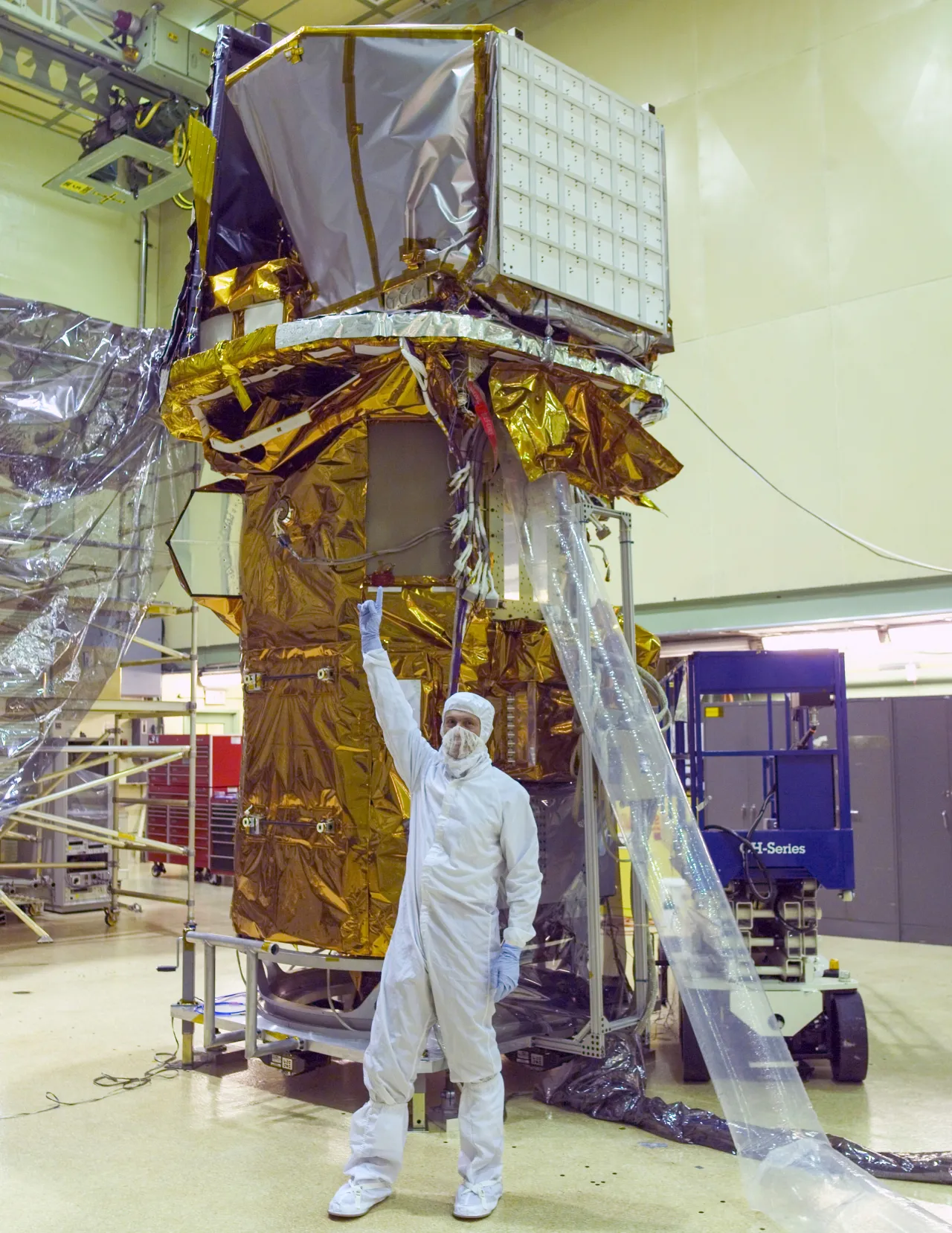
NASA's Swift Observatory, launched in 2004, is set to re-enter Earth's atmosphere after a failed rescue attempt.
The Swift Observatory, designed to study gamma-ray bursts, has been in orbit for over two decades, making significant contributions to astrophysics.
During its tenure, Swift observed between five and ten 'targets of opportunity' daily, tallying hundreds or even thousands in a year.
Swift's mission was originally planned for two years but extended over 22 years, contributing to about 7,000 scientific papers.
A rescue mission by Katalyst Space, aimed at boosting Swift's orbit, launched in July but encountered technical issues, leaving Swift to fall uncontrollably.
NASA and Katalyst announced on August 19 that the rescue mission would not proceed, leaving Swift to re-enter the atmosphere.
The Space Force is tracking Swift's path, predicting re-entry on or around Friday, November 4, at approximately 3:30 a.m. EST, with an uncertainty of 11 hours.
Swift's chief scientist, Brad Cenko, noted that a handful of pieces, including some mirror parts, could potentially reach the ground.
Swift's mission leader, John Nousek, expressed both mourning and gratitude for the telescope's contributions, emphasizing the importance of applying Swift's lessons to future missions.
Swift's last scientific data was gathered on October 20, as it descended to an altitude of about 275 kilometers, where atmospheric drag made observations impossible.
Swift observed over 2,000 gamma-ray bursts and studied more than 1,400 supernova explosions during its career.
Shawn Domagal-Goldman, director of the Astrophysics Division at NASA Headquarters, praised Swift's lasting return on investment, noting its productivity far exceeded its initial two-year mission.
What this adds
The rescue mission by Katalyst Space was intended to serve as a preview for a similar mission planned for a 36-year-old observatory.
Tech billionaires, including Jared Isaacman before his NASA appointment, have shown interest in satellite servicing missions.
Background
NASA's Swift Observatory, launched in 2004, will end its mission with a fiery reentry after a failed rescue attempt.
NASA's Swift Observatory, launched in 2004, will end its mission with a fiery reentry after a failed rescue attempt.
What's confirmed
- But a handful of pieces made of denser-than-lead tungsten and some mirror parts could survive reentry, according to NASA's Brad Cenko, the mission’s chief scientist.
- “Our fervent hope is that the lessons learned by the successes of Swift can be applied to new generations of space missions to accelerate our discoveries about the universe,” Nousek said in an email.
- “We’ve known this day would come since before Swift was launched. At least in low-Earth orbit, what goes up must come down. And that end is catastrophic,” said Pennsylvania State University’s John Nousek, an astronomer who led the control team.
- Swift resumed observations once the rescue attempt was called off, discovering even more gamma ray bursts and other ultrahigh-energy events.
- NASA hired Katalyst Space a year ago to mount a rush rescue.
- The Space Force is tracking the telescope’s dwindling path.
- Intense solar activity over the past few years dragged Swift down faster than usual.
- Space Force predicts the Swift Observatory will come crashing down on or around Friday.
- Its cosmic cremation has the Swift team mourning yet full of gratitude for the observations the telescope made during its 22 years in orbit.
- A NASA telescope is barely clinging to space after a failed rescue effort left it tottering lower and lower.
- Most of the 1 ½-ton telescope is expected to burn up in the atmosphere.
What's still developing
- “Almost immediately after launch, Swift started discovering things,” says astrophysicist Lynn Cominsky of Sonoma State University in Rohnert Park, Calif.
- As Swift’s tenure unfolded, astronomers started asking to borrow the nimble observatory to study a whole range of objects changing on the sky.
- WASHINGTON — NASA has shut down an astronomy spacecraft in a decaying orbit after a failed attempt to reboost it with a commercial spacecraft.
- The X-ray Telescope aboard NASA’s Neil Gehrels Swift Observatory captured this image of Tycho’s supernova remnant on Wednesday, Aug. 26, 2026.
- NASA predictions had shown the shift to low-drag operations had extended Swift’s time above 185 miles (300 kilometers) until October.
- The mission's data has contributed to about 7,000 published scientific papers to date, according to NASA officials.
- Swift — which was officially renamed the Neil Gehrels Swift Observatory in 2018, after its first principal investigator, who died a year earlier — gathered its last scientific data on Oct. 20, according to NASA's Friday update.
- The dramatic situation unfolded roughly 340 kilometers above Earth, where NASA’s Neil Gehrels Swift Observatory, is losing altitude, thanks to atmospheric drag and a recent bout of unusually strong solar activity.
- Katalyst sought to mount a similar mission to the 36-year-old observatory, and the Swift operation was meant to serve as a preview of that.
- Satellite servicing is a growing field, with government agencies and commercial companies around the world practicing high-flying maneuvers. (Tech billionaires are interested, too: Before he was appointed to the top job at NASA, administrator Jared Isaacman offered to mount a SpaceX mission to raise Hubble’s orbit.) “The technology to enable servicing is on a very good path,” says David Barnhart, an astronautical engineer at the University of Southern California in Los Angeles, citing advancements in rendezvous sensors, propulsion systems and, the all-important element, robotic arms.
- NASA’s Neil Gehrels Swift Observatory has ended its science mission now that the spacecraft is orbiting less than 171 miles (275 kilometers) above Earth’s surface.
- The Swift Observatory could plunge back to Earth as early as this Friday, US authorities said.