
Home · Science · Nov 3 archive
NASA Identifies 4.1-Billion-Year-Old Martian Meteorite in Sahara
· Confirmed
In Short: A rose-colored meteorite found in the Sahara Desert in 2022 has been identified as a 4.1-billion-year-old chunk of Mars, one of the oldest Martian rocks ever discovered on Earth.
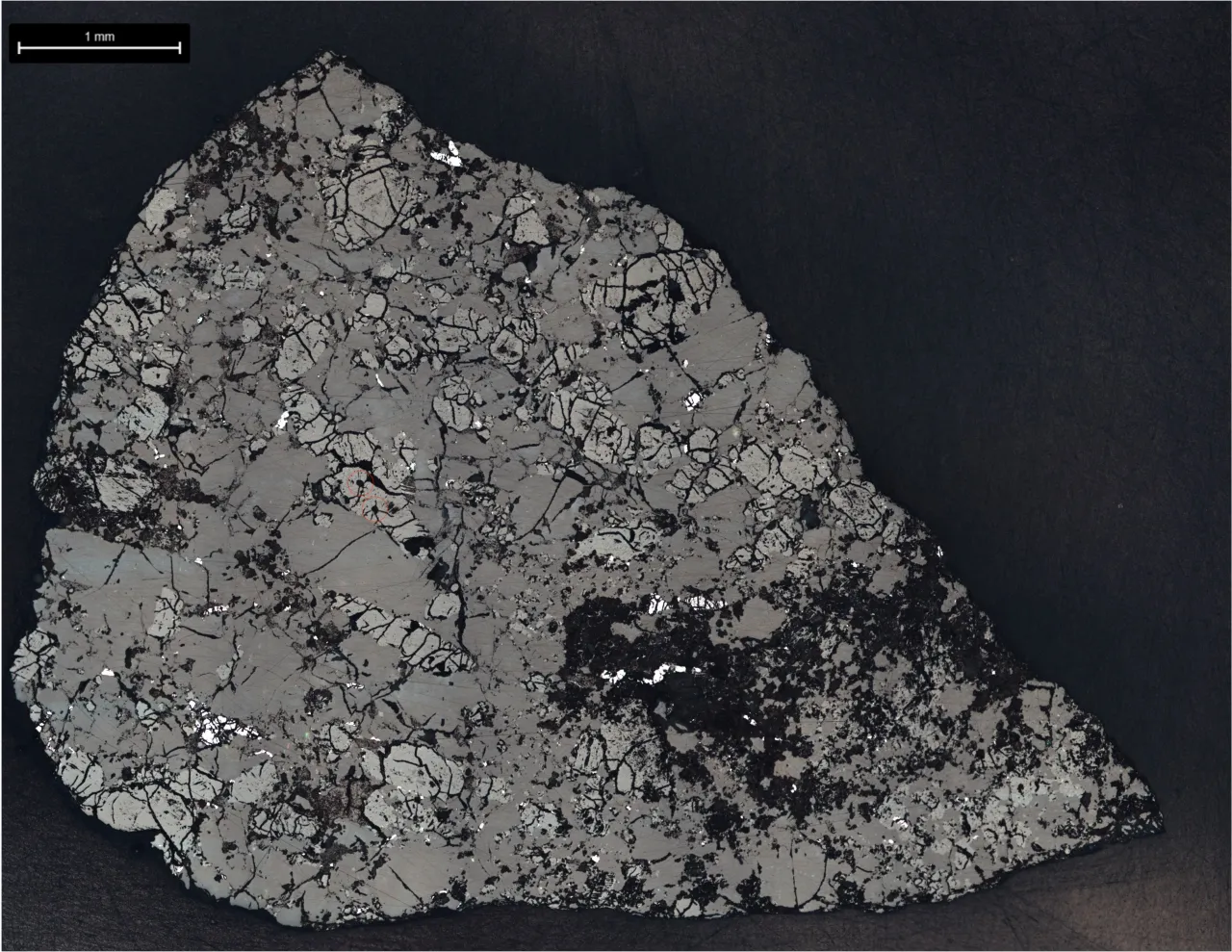
A rose-colored meteorite found in the Sahara Desert in 2022 has been identified as a 4.1-billion-year-old chunk of Mars, one of the oldest Martian rocks ever discovered on Earth, according to a NASA study. The meteorite, named Teghaza 001, was discovered in the Teghaza salt plain in Mali and is one of roughly 435 known Martian meteorites.
Carl Agee, the institute’s director, noticed that its oxygen values resembled those of NWA 7034, the famous Martian meteorite nicknamed Black Beauty, and that some patches were rich in manganese oxide. Previously, only two meteorites provided snapshots of a young Mars, which formed around 4.5 billion years ago: Allan Hills 84001, dated at 4.1 billion years old, and Northwest Africa 7034, which contains fragments dated at more than 4.3 billion years old.
The rock is a snapshot in time that shows how a wetter early Mars with a thick atmosphere could have supported habitable conditions but that these conditions were waning rapidly over the first billion years or so of Mars' existence, trending towards its currently dry and inhospitable environment, says study co-author Lee Saper, a planetary scientist at NASA's Ames Research Center.
Francis Tissot, a geochemistry professor at Caltech, helped the researchers use a pioneering age-dating method that studied a piece of meteorite smaller than a fingernail. This analysis showed the rock had been altered by Martian water about 4.1 billion years ago. The meteorite is made of a unique mix of volcanic minerals, including zircon crystals, matching samples observed by NASA's Mars Reconnaissance Orbiter in the planet's southern highlands.
Yang Liu, the lead author of the study, emphasized the meteorite’s uniqueness, likening its significance to a “Rosetta Stone for Mars.” Liu noted that the crystallization age would be older than 4.1 billion years, indicating that there was active circulation of water through Martian crust. This implies that when this rock was forming, Mars had a hydrosphere reacting with its crust intensely.
The meteorite, designated Northwest Africa 13441, was found in the Sahara in 2019. Most known Martian meteorites belong to the shergottite group and date to roughly 600 million years ago, while only two specimens are believed to be about 2.4 billion years old. The other meteorite, nicknamed “Black Beauty,” formed about 2.1 billion years ago and is composed of small, volcanic rock fragments.
Researchers at the University of New Mexico had already identified it as Martian based on its oxygen isotopes, which serve as geochemical fingerprints for different planetary bodies. The meteorite’s characteristics were unexpected because no other Martian meteorite of the same type had previously been dated to 1.27 billion years. The rock’s mineral composition also resembles terrain observed by NASA’s Mars Reconnaissance Orbiter in the planet’s southern highlands.
One of the paper’s reviewers called it a “Rosetta Stone for Mars.” Study co-author Lee Saper of NASA’s Ames Research Center said the findings support the idea that early Mars had the ingredients and conditions to harbor life, but do not directly answer whether life existed there.
What this adds
The meteorite’s unique composition and age provide new insights into Mars’ ancient crust and water history, challenging previous assumptions about the planet’s early environment.
Background
NASA has identified a 4.1-billion-year-old meteorite found in the Sahara Desert as a fragment of Mars, one of the oldest Martian rocks ever discovered on Earth.
A rose-colored meteorite found in the Sahara Desert in 2022 has been identified as a 4.1-billion-year-old piece of Mars.
What's confirmed
- Age-dating of the meteorite led researchers to conclude it was about 4.1 billion years old, making it one of the three most ancient Martian meteorites found on Earth, NASA said.
- The rock — which scientists named Teghaza 001 after the Teghaza salt plain in Mali where it was found — is one of the most ancient Martian meteorites identified on Earth.
- “This is really our first piece of Martian crust from a part of Mars we’ve never had a sample of before,” said Lee Saper, the study’s second author, who did the work as a postdoctoral scholar at NASA’s Jet Propulsion Laboratory and is now a scientist at NASA’s Ames Research Center.
- The other meteorite, nicknamed “Black Beauty,” formed about 2.1 billion years ago and is composed of small, volcanic rock fragments.
- NASA says the nearly two-pound meteorite, named Teghaza 001 after the salt plain in Mali where it was found, dates back at least 4.1 billion years, putting it among the three oldest of the 435 known meteorites from Mars, CBS News reports.
- A meteorite found in Mali in 2022 is among the oldest Martian rocks known on Earth, a recent study says, dating back more than 4.1 billion years and offering scientists rare insights into Mars’ ancient crust and water history.
- NASA-funded researchers determined that Teghaza 001, a meteorite weighing about 800 grams (1.8 pounds) that was found in the Sahara Desert, originated on Mars and is one of the oldest Martian meteorites ever discovered on Earth.
- NASA-funded researchers have determined that a meteorite discovered in Mali's Sahara Desert in 2022 represents one of the oldest Martian rocks ever found on Earth, according to a study published Thursday in the journal Science.
- The meteorite, designated Northwest Africa 13441, was found in the Sahara in 2019.
- Most known Martian meteorites belong to the shergottite group and date to roughly 600 million years ago, while only two specimens are believed to be about 2.4 billion years old.
- In 2022, a strange, rosy stone was discovered in the Sahara Desert.
- Previously, only two meteorites provided snapshots of a young Mars, which formed around 4.5 billion years ago : Allan Hills 84001, dated at 4.1 billion years old, and Northwest Africa 7034, which contains fragments dated at more than 4.3 billion years old.
What's still developing
- With shergottites being the most common of the three meteorite types — constituting 90 percent of the current Martian meteorite collection, according to a 2025 study in Geochimica et Cosmochimica Acta — Teghaza 001 was not seen as anything special upon first glance.
- Meteorites can be verified as having been part of Mars by comparing their chemical and mineral makeup to samples and data collected by NASA's Martian missions.
- Another study of the meteorite, published in June, focused on the rock's water content and considered how water might have shaped the early topography of Mars.
- The three main classes of Martian meteorites—shergottites, nakhlites, and chassignites—are all 2.4 billion years old or younger.
- Meteorites hold a record of the forces at work 4.5 billion years ago before the sun formed Clouds of gas and dust, like the one in this Hubble Space Telescope image, are the birthplaces of planetary systems.
- That ancient record is preserved in meteorites — time capsules of material that formed long ago.
- Researchers initially suspected the 800-gram (2-pound) specimen was just another common shergottite — a familiar class among the roughly 435 Martian rocks that have crashed into Earth.
- NASA explores the unknown in air and space, innovates for the benefit of humanity, and inspires the world through discovery.
- Researchers identified 13 possible source areas, although its precise Martian origin remains unknown.
- “To change it, you really require some kind of hydrothermal fluid,” Liu said.
- “When I got to the sample, I looked around, I said, ‘That’s boring,’” Liu said.
- “For slow-cooled rock, they tend to have time to grow bigger,” Liu said.
Sources
- BGNESlink
- Business Insider Africalink
- CBS Newslink
- Discovermagazinelink
- Education Timeslink
- English Bombay Samacharlink
- Martin Cid Magazinelink
- Newserlink
- SSBCracklink
- The Nation (Pakistan )link
- Türkiye Todaylink
- Yeni Şafak Englishlink
- NASAlink
- Smithsonianmaglink
- Pasadenanowlink
- Thebrightersidelink
- Stellar Quill — video link