
Home · World · Nov 1 archive
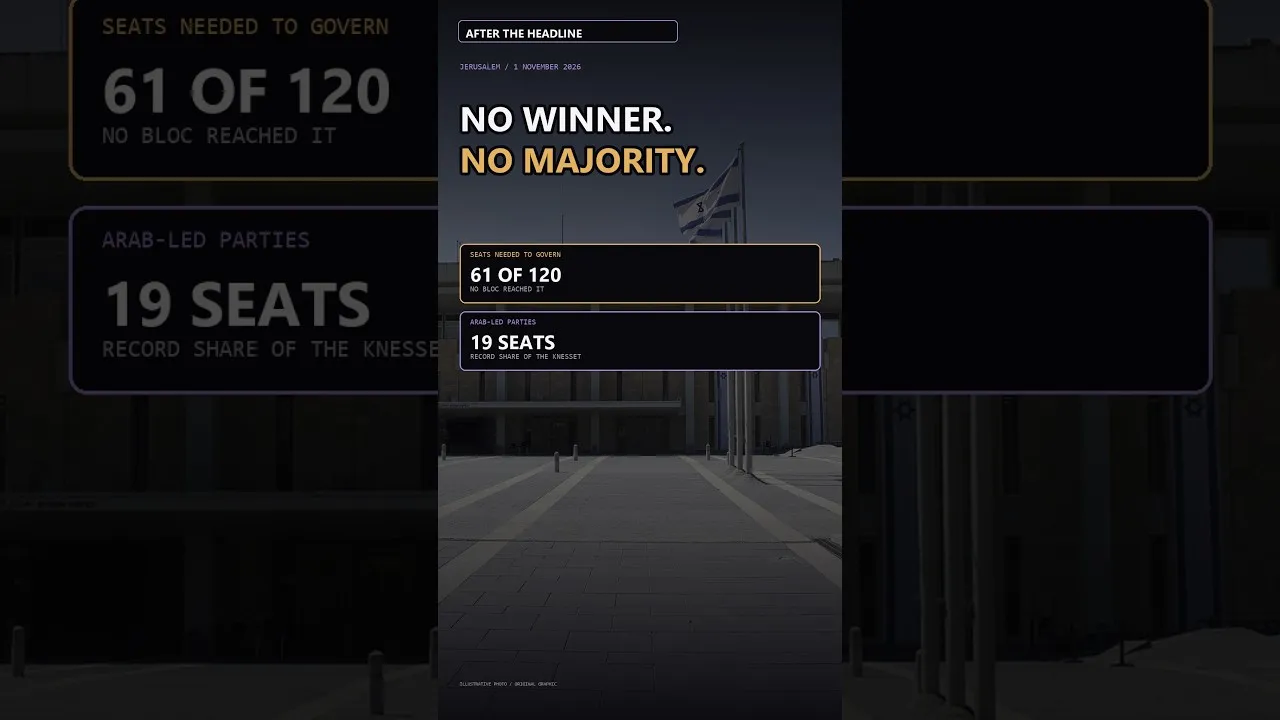
Arab Parties Project 18-19 Seats in Israel's General Election
· ConfirmedShare on
In Short: In Israel’s electoral system, parties failing to secure at least 3.25 percent of ballots have their votes discarded, leading to frequent mergers before elections.
At a pharmacy in Tira, a young cashier urged Amal, a Palestinian citizen of Israel, to vote in the Israeli general election on Tuesday, highlighting a sense of determination among younger voters.
Arab citizens, mostly of Palestinian heritage, account for about 21 percent of Israel’s population of 10 million people, emphasizing their significant demographic impact.
Israel's TV news stations Channel 12 and Channel 13 projected 50 seats for Netanyahu’s bloc, 52 to 53 for the opposition bloc, and 18 to 19 for Arab parties, indicating a close race.
Amal’s encounter reflected a broader sentiment among Arab voters, marked by pride, urgency, and long lines at polling stations in Arab communities.
Witnesses reported cars displaying flags in support of Netanyahu’s Likud party driving through Jerusalem, broadcasting the Islamic call to prayer and urging supporters to vote because the 'Arabs are voting,' highlighting tensions.
The cofounders of the Israeli coexistence group Standing Together launched a new Arab-Jewish political party, A Place for Us All, aiming to shift the country’s direction.
In Israel’s electoral system, parties failing to secure at least 3.25 percent of ballots have their votes discarded, leading to frequent mergers before elections.
Alon-Lee Green, one of the founders of A Place for Us All, emphasized the importance of Arab-Jewish partnership, stating, 'There aren’t enough votes without the votes of the Palestinians.'
The political makeup of the Arab parties includes the Joint List, which brings together three parties: Hadash, Ta’al, and Balad, reflecting a diverse coalition.
The Joint List’s political strength, in terms of the number of seats, has grown in recent years, making it a significant player in potential coalition negotiations.
The election results underscore the evolving role of Arab parties in Israeli politics, with their support potentially crucial for forming a government.
What this adds
The sources have not established the exact coalition negotiations or the final coalition formation, but the projections indicate a significant role for Arab parties.
Background
In Israel's general election on Tuesday, Arab citizens, mostly of Palestinian heritage, accounted for about 21 percent of the country's 10 million people, urging each other to vote.
What's confirmed
- At a pharmacy in Tira, a young cashier urged Amal, a Palestinian citizen of Israel, to vote in the Israeli general election on Tuesday, highlighting a sense of determination among younger voters.
- Arab citizens, mostly of Palestinian heritage, account for about 21 percent of Israel’s population of 10 million people, emphasizing their significant demographic impact.
- Israel's TV news stations Channel 12 and Channel 13 projected 50 seats for Netanyahu’s bloc, 52 to 53 for the opposition bloc, and 18 to 19 for Arab parties, indicating a close race.
- Amal’s encounter reflected a broader sentiment among Arab voters, marked by pride, urgency, and long lines at polling stations in Arab communities.
- Witnesses reported cars displaying flags in support of Netanyahu’s Likud party driving through Jerusalem, broadcasting the Islamic call to prayer and urging supporters to vote because the 'Arabs are voting,' highlighting tensions.
- The cofounders of the Israeli coexistence group Standing Together launched a new Arab-Jewish political party, A Place for Us All, aiming to shift the country’s direction.
- In Israel’s electoral system, parties failing to secure at least 3.25 percent of ballots have their votes discarded, leading to frequent mergers before elections.
- The political makeup of the Arab parties includes the Joint List, which brings together three parties: Hadash, Ta’al, and Balad, reflecting a diverse coalition.
- The Joint List’s political strength, in terms of the number of seats, has grown in recent years, making it a significant player in potential coalition negotiations.
- The election results underscore the evolving role of Arab parties in Israeli politics, with their support potentially crucial for forming a government.
What's still developing
- “If we don’t wake up now, we’ll find ourselves with a government of Mansour Abbas and Ahmed Tibi,” he said, referring to two leading Arab politicians.
- “I voted. As a Palestinian Arab woman and elected public official in Israel — this is an immense and incomprehensible privilege to vote and influence,” she wrote in Hebrew.
- Georgia's Constitutional Court has started hearings on a lawsuit by the ruling Georgian Dream party to ban five major opposition parties.
- The lawsuit claims these parties aim to overthrow the constitutional order.
- Fox News correspondent Mark Meredith has the latest on the key storylines shaping the race to the 2026 midterm elections, including the political fallout from the Supreme Court's Missouri redistricting decision, the battle for control of Congress, and the issues driving voters as both parties intensify their push toward November on 'Special Report.' The Missouri Supreme Court signaled Tuesday that it was considering holding Secretary of State Denny Hoskins in contempt amid an escalating battle over proposed congressional maps.
- On February 28, 2026, the world awoke to the fury of a new war in the Middle East after the United States and Israel had launched their joint assault against Iran, with President Trump and Prime Minister Netanyahu standing shoulder to shoulder against their common foe.
- Trump called Netanyahu again, telling him in a brief call that now that Iran and Israel had each “had their fun,” that Israel should stand down.
- Benjamin Netanyahu, the longest-serving prime minister in Israel’s history, with 19 years in office, is seeking another term while standing trial on corruption charges.
- “The film presents a false, misleading, and biased narrative that defames the State of Israel and the [Israeli military] internationally, severely damaging Israel’s standing,” he added.
- The escalating trade dispute between Canada and the United States is increasingly shaping Quebec’s provincial election campaign, with the major parties offering competing visions for how to protect jobs and businesses from the impact of tariffs.
- "has agreed that the non-disclosure provisions (NDAs) contained in the parties' June 2025 settlement of the 2020 lawsuit are terminated and void; this action has therefore achieved its purpose."
- Green declined to confirm whether his party would disband ahead of the election if it is not on track to meet the threshold but said that there was also an option of “running as a united bloc of a few parties” and signaled that some negotiations with other parties had already taken place.
Sources
- Jewish Telegraphic Agencylink
- Middle East Eyelink
- Arabnewslink
- Starbeaconlink
- Fox Newslink
- Fpiflink
- Al Jazeeralink
- Madhyamamonlinelink
- Englishlink
- The Guardianlink
- Global Newslink
- Tmzlink
- Meriplink
- Ynetnewslink
- WarpBeat — background on Israel's Arab Parties Seek Representation in General Election link
- After the Headline — video link