
Home · Science · Oct 31 archive
University of Utah Reveals Freshwater Reservoir Beneath Great Salt Lake
· Confirmed
In Short: Researchers from the University of Utah have discovered a vast reservoir of freshwater beneath the Great Salt Lake, according to a new study published in Attheu.
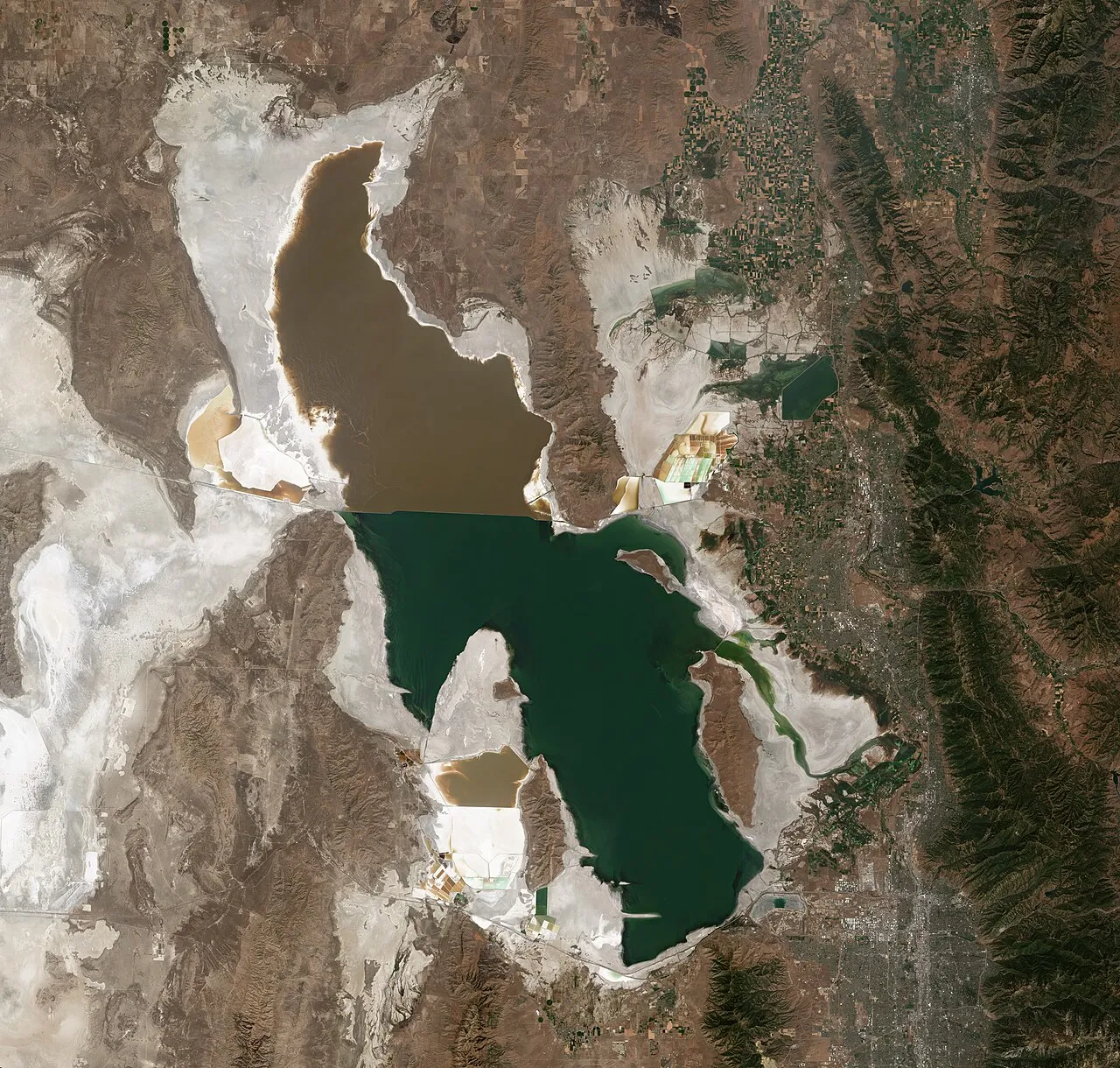
Researchers from the University of Utah have discovered a vast reservoir of freshwater beneath the Great Salt Lake, according to a new study published in Attheu. The study used airborne electromagnetic (AEM) surveys to map the freshwater reservoir beneath the lake’s hypersaline surface.
The analysis shows that freshwater saturates the sediments beneath the lake to depths of 3 to 4 kilometers, or about 10,000 to 13,000 feet. This discovery was made possible by measuring electrical resistivity to a depth of about 100 meters via airborne electromagnetic surveys, which helped distinguish freshwater from brine.
The Great Salt Lake has been experiencing declining water levels since 1986, dropping by about 22 feet. This has exposed 800 square miles of lake playa, which has become a major source of dust pollution in Utah’s population centers.
The helicopter-borne geophysical survey was conducted last year after U scientists documented freshwater welling up under pressure at several spots on the lake’s exposed playa in Farmington Bay, manifesting as strange phragmites-choked mounds.
The unexpected part of this discovery was not the salt lens near the surface across the playa, but the fact that the freshwater extends so far into the interior of the lake and possibly under the entire lake, according to Bill Johnson, a UT hydrologist and coauthor of the study.
The study demonstrated for the first time the ability of AEM methods to detect freshwater underneath the thin layer of conductive salt water at the surface of the Great Salt Lake. The team also characterized the spatial extent of the freshwater reservoir beneath Farmington Bay and studied the potential depth of freshwater-saturated sediments by delineating the basement structure.
The data showed a continuous freshwater reservoir layer stretching from about 330 feet down to 2.5 miles. This discovery could have practical applications, such as using the freshwater to wet dust hotspots and douse them without perturbing the freshwater system too much.
Researchers from the US analyzed a 120-meter sediment core taken from the lake bed, dating its layers by the radioactive decay of the minerals it carried. This analysis revealed that for most of the past 240,000 years, the lake stayed about the same size but briefly grew 10 times larger on two separate occasions.
Suspicions of the subterranean freshwater reservoir first arose with the sudden appearance of strange reed-covered islands, each 50 to 100 meters in diameter, in the dried-out lakebed.
The unexpected part of this discovery was that the freshwater underneath the salt lens extends so far into the interior of the lake and possibly under the entire lake, according to Johnson. This finding could reshape our understanding of subsurface water flow in the region.
...Suspicions of the subterranean freshwater reservoir first arose with the sudden appearance of strange reed-covered islands, each 50 to 100 meters (164 to 328 feet) in diameter, in the dried-out lakebed.
Researchers from the US analyzed a 120-meter (394-foot) sediment core taken from the lake bed, dating its layers by the radioactive decay of the minerals it carried, which revealed the lake had dried up approximately 5,000 years ago.
What this adds
The study adds to the understanding of the Great Salt Lake's subsurface water dynamics, potentially offering solutions to dust pollution issues. The dynamic nature of red blood cells, as revealed in a separate study published in Blood, underscores the adaptability of biological systems to changing environmental conditions.
Background
Researchers from the University of Utah have discovered a significant body of freshwater hidden beneath the Great Salt Lake playa, a finding that could reshape our understanding of subsurface water flow in the region.
What's confirmed
- “There are beneficial effects of this groundwater that we need to understand before we go extracting more of it. A first-order objective is to understand whether we could use this freshwater to wet dust hotspots and douse them in a meaningful way without perturbing the freshwater system too much,” Johnson said.
- “We were able to answer the question of how deep this potential reservoir is, and what its spatial extent is beneath the eastern lake margin. If you know how deep, you know how wide, you know the porous space, you can calculate the potential freshwater volume,” said Zhdanov, a distinguished professor of geology & geophysics and director of the Consortium for Electromagnetic Modeling and Inversion, or CEMI.
- This groundwater fills tiny pore spaces within sediments that occupy the basin west of the Wasatch Mountains and lies beneath a salty layer roughly 30 feet thick.
What's still developing
- Can’t-miss innovations from the bleeding edge of science and tech The Great Salt Lake is harboring an unexpected secret: a huge stash of water that’s decidedly not salty.
- That clued them in to an even bigger find: a sudden drop in the lake’s subterranean layer called a basement, going from just a few hundred yards deep to over 2.5 miles.
- We can often understand more about the future by looking into the past – and in the case of a new study published in Paleoceanography and Paleoclimatology, almost 240,000 years into the history of the Great Salt Lake in Utah.
- Whether you’re planning a night out down the canyon or just curious how Salt Lake’s headlines may impact your daily life in the Wasatch, this is your link to the metro pulse. by Utah News Dispatch Published: Jul 16, 2026 TownLift Is Brought To You In Part By These Presenting Partners.
- If you’re in Park City or the surrounding mountains and want to stay tapped into what’s happening in the big city, this is your gateway to Salt Lake City news, events, and regional insight.
- The researchers said Gerrothorax maritimus evolved from armored freshwater ancestors.
- "When a frog swims in seawater, it loses its body water because the seawater sucks out the body water through the permeable skin through osmotic pressure. It cannot drink water either for the same reason. As a result, it loses body weight and will have to rest in freshwater to recover. This key feature prevents amphibians from becoming fully marine."
- “What we would normally expect as hydrologists is that the brine would occupy the entire volume underneath that lake,” he explained in an interview on KPCW’s Cool Science Radio show, cited in the university release.
- In a study published in Blood, scientists identified over 3,775 proteins in mature human red blood cells, revealing a surprisingly dynamic network that adapts quickly to changing oxygen levels.
- The dynamic nature of red blood cells, as revealed in the study, underscores the adaptability of biological systems to changing environmental conditions.
- "There was a freshwater amphibian that happened to have the equipment needed to colonize the sea — the body armor. The armor protected the animal from predators in freshwater but it could also be used to protect the bearer from seawater when the lineage colonized the saltier part of the water system," Motani said, like a person wearing a dive suit for underwater exploring.