
Home · Science · Oct 31 archive
The Witch Head Nebula rises near Orion on Halloween
· Confirmed
In Short: The Witch Head Nebula, also known as IC 2118, rises near the constellation Orion before midnight on Halloween.
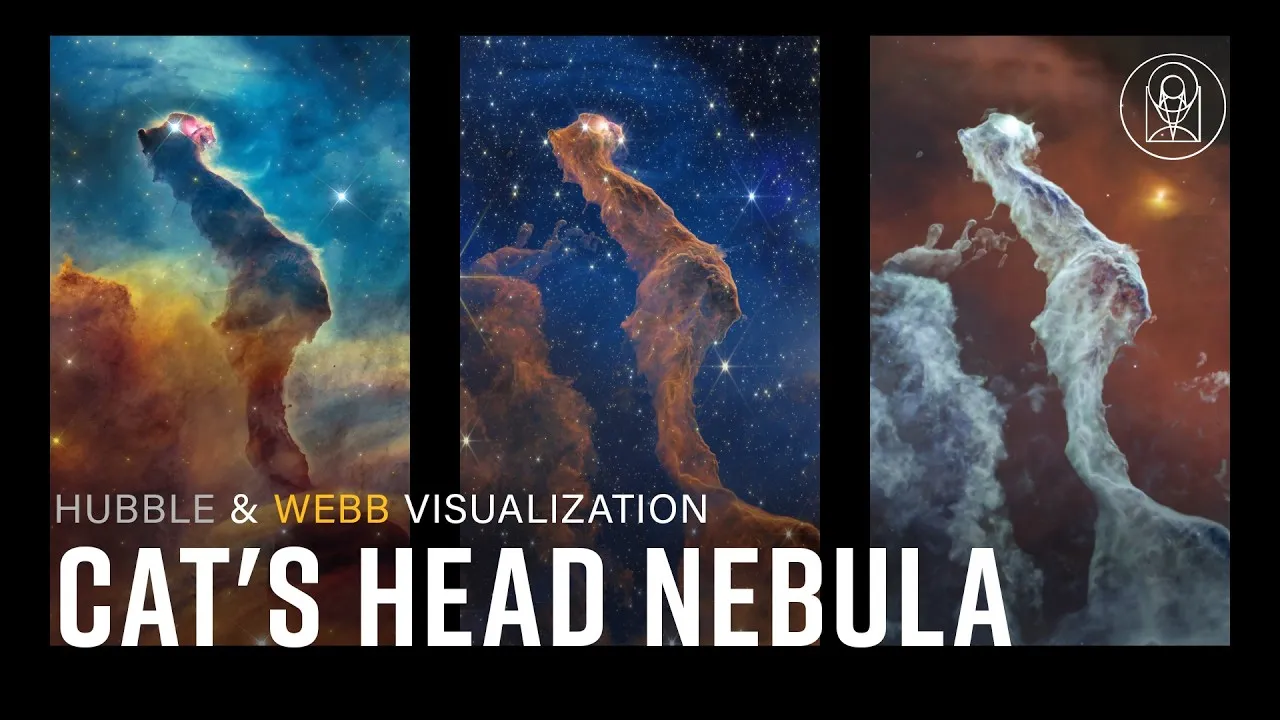
NASA's Hubble and James Webb Space Telescopes have captured eerie images of nebulae that resemble a witch's head and a cat's head, coinciding with Halloween.
The Witch Head Nebula, also known as IC 2118, rises near the constellation Orion before midnight on Halloween. This reflection nebula, located 900 light-years from Earth, is exceptionally faint, visible only through large telescopes.
In contrast, the Cat's Head Nebula, nestled within the larger Carina Nebula, is about 7,500 light-years away from Earth. The nebula's distinctive shape, resembling a cat's head, is due to intense ultraviolet radiation and stellar winds from nearby massive stars.
According to Space.com, the Cat's Head Nebula's name comes from its 'cat's head' shape visible on the left-hand side of images captured by both Hubble and James Webb Space Telescopes.
The James Webb Space Telescope, using its Near-Infrared Camera and filters, captured a near-infrared image of the Cat's Head Nebula on May 27, 2026, revealing distant galaxies behind the nebula.
Universe Today reported that astronomers using the Chandra X-ray Observatory and James Webb Space Telescope focused on a wispy region of the Carina Nebula, finding a ghostly cloud among other gas and dust clouds.
The Cat's Head Nebula's eerie appearance is due to hydrogen interacting with ultraviolet radiation from a star in the constellation Cassiopeia, as noted by Scientific American.
The Witch Head Nebula, while faint, is categorized as a reflection nebula, shining with the aid of nearby star Rigel, though the nebula itself receives most of the attention.
Space.com quoted the nebula's resemblance to a witch's cauldron, complete with glowing red 'eyes,' while Popsci highlighted the James Webb Space Telescope's role in capturing these spooky images.
What this adds
The Witch Head Nebula and the Cat's Head Nebula are both reflection nebulae, but they are located at different distances from Earth and have distinct features due to their unique environments.
What's confirmed
- Astronomers call the structure the Cat’s Head Nebula, a compact formation nestled inside the much larger Carina Nebula roughly 7,500 light-years from Earth.
- Intense ultraviolet radiation and winds from massive nearby stars have spent ages carving the surrounding material, leaving denser pockets to resist the erosion and form the long, irregular pillar that now resembles a feline body, head, and downward tail.
What's still developing
- One of the spookiest views in the night sky is of the Witch Head Nebula, with the catalog designation IC 2118.
- And, if the field of view was large enough to include the blue supergiant star, you could see that the witch appears to be gazing at Rigel.
- There are also some faint wispy strands visible to the left of this pillar, which are being blasted by the same radiation that is causing this nebula to shrink.
- The end result is a near-infrared image that reveals what is truly going on in this region, which would otherwise be obscured by the dust.
- With the telescope’s clarity, it’s easy to see some very distant galaxies sitting well behind the nebula, providing us a view of what’s going on behind the Milky Way.
- The Cat’s Head Nebula gets its nickname from a towering column of dust that resembles a cat sitting with its back toward the viewer.
- Skeletons and disembodied heads are a hallmark of Halloween, but this phantasmic apparition, called the exposed cranium nebula, lurks above us all year long.
- According to NASA, JWST will help give astronomers opportunity to compare and contrast observations of star formation in the Tarantula Nebula with the telescope’s deep observations of distant galaxies from the actual era of cosmic noon. 2026 Popular Science Home of the Future Awards 39 products that will improve your everyday life.
- Not only that, but it helps them piece together more information about the larger Carina Nebula, which lies more than 7,500 light-years away from us.
- Most of us are familiar with one of the brilliant and weird objects that lights up the nebula: Eta Carinae.