
Home · Science · Oct 31 archive
Scientists Uncover Ancient Human DNA on Cave Walls
· Confirmed
In Short: For the first time, scientists have extracted ancient human DNA from cave walls, opening new avenues for studying prehistoric human behavior.
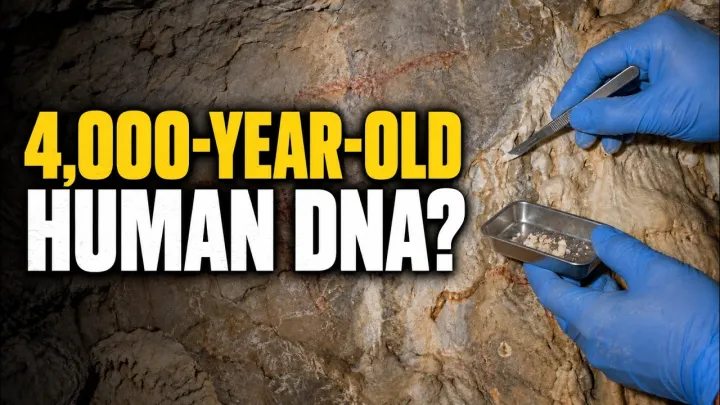
Scientists have successfully extracted ancient human DNA from cave walls for the first time, marking a significant breakthrough in the study of prehistoric human behavior. This discovery was reported by Archaeology News Online Magazine, ScienceAlert, and Archaeologymag, among others.
The research team, led by Alba Bossoms Mesa, a doctoral researcher at the Max Planck Institute for Evolutionary Anthropology, collected samples from 11 caves in Spain and Portugal. They analyzed red pigment and calcite from cave walls, sediments, bones, and a prehistoric airbrush tool.
From these samples, they found ancient human DNA belonging to a Homo sapiens who lived at least 4,000 to 5,000 years ago, though likely much older, potentially during the Upper Paleolithic period (between 12,000 and 50,000 years ago).
The findings, published in the journal Nature Communications, show that cave walls can indeed preserve ancient human DNA for thousands of years. This discovery was highlighted by National Geographic and Sci.News.
The team took 54 samples from 24 different rock art panels, including hand stencils, simple lines and dots, and pigment that fell off iconic red bison imagery found on the ceilings of Altamira Cave in Spain.
One of the samples came from an unassuming red dot found in Escoural Cave in Portugal known as “Panel 11.” This sample, along with four others from unpigmented walls in Covarón Cave in Spain, yielded ancient human DNA.
The female sample showed signs of animal DNA, suggesting it may have been indirectly transferred to the wall, for example, by dirt on the ground being rubbed onto it.
This new method of extracting ancient DNA from cave walls could help scientists link cultural artifacts to the human groups who created them, as noted by Sci.News.
The discovery marks a new era in the study of rock art and prehistoric human behavior, according to researchers.
In addition to the cave wall DNA, scientists also uncovered six bone fragments in Abauntz cave in northern Spain that belonged to a male Neanderthal who lived approximately 46,000 years ago, as reported by People.
These discoveries offer clues about how Neanderthals may have used the cave thousands of years ago and could reveal new details about their lives.
The findings from both cave wall DNA and Neanderthal bones provide unprecedented insights into prehistoric human behavior and the lives of ancient humans.
What this adds
This report adds to the understanding of how cave walls can preserve ancient human DNA, providing new insights into prehistoric human behavior. The sources have not established the exact age of the DNA found on the cave walls beyond the range of 4,000 to 5,000 years ago, though it is potentially much older.
Background
Scientists have discovered ancient human DNA on cave walls for the first time, marking a significant breakthrough in the study of prehistoric human behavior.
What's confirmed
- Ancient human DNA has been found on cave walls for the first time, giving scientists a new way to study people who lived thousands of years ago.
- Scientists collected samples from painted and unpainted cave walls, cave sediments, bones, and a prehistoric airbrush tool.
- Paleogeneticists have, for the first time, extracted ancient human DNA from cave walls, including from a crusty red dot painted thousands of years ago.
What's still developing
- For decades, efforts to decipher genetic clues from ancient humans and their relatives have relied on sequencing material from bones and dirt found in caverns where these ancient species left behind art or artifacts.
- The radius is among five remains from Bianfu Cave in Yunnan Province that a new study identified as Denisovan.
- Scientists are getting astonishingly good at extracting ancient human DNA from mere dirt and dust, even when there are no physical remains left… A small scoop of sediment from a cave in Spain has now offered up ancient DNA from several individuals who lived roughly 22,000 years ago.
- When designing drugs to treat diseases, scientists want to select which mirror-image they are getting.
- Scientists found a human genetic element in a poxvirus and discovered it was both an important gene for brain function and a jumping gene capable of moving and inserting itself in genomes.
- By engineering yeast, scientists have developed a system that can transform compounds from plastic and agricultural waste into edible proteins, vitamins, flavorings, and other food ingredients.
- Scientists uncover the molecular switch that reshapes aging muscle One of the most stubborn puzzles in the biology of aging concerns a change that happens inside nearly every human body: as we grow older, our muscles become weaker and more easily fatigued, yet at the same time they quietly transform their internal composition, shifting away from the fast, powerful fibers of youth and toward slow-twitch fibers that rely most heavily on the very cellular machinery that is failing.
- Scientists already know both can have a profound impact on the human body, but just how much of one, and how long that impact can last, remain a mystery.
- A new study shows that digital twins don’t respond like the individuals they were modeled after A new study suggests that behavioral scientists should use digital twins with caution.
- Scientists are warning that exposure to deep-space radiation could cause lasting damage to the human heart, raising new concerns about the health risks of sending people to the Red Planet.
- Scientists say it is the furthest recorded distance for any African land mammal searching for a mate, offering hope that wildlife can travel across vast distances despite growing human pressures.
- Neanderthals disappeared around 40,000 years ago, during a period when modern humans were expanding across Europe.