
Home · Science · Oct 31 archive
Once again, NASA is asking for ideas to rescue Hubble from certain death
· Confirmed
In Short: NASA has issued a Request for Information to commercial space companies to help extend the life of the Hubble Space Telescope.
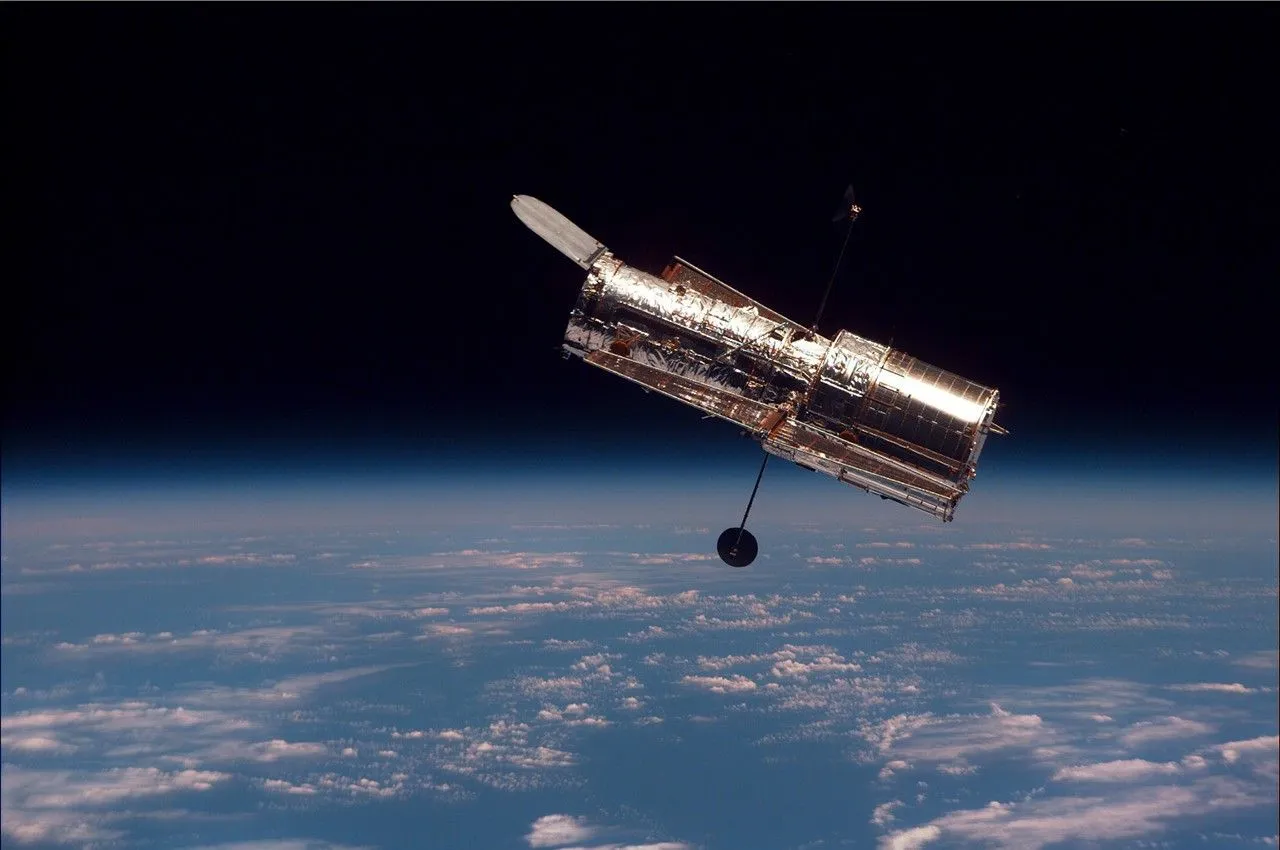
NASA is seeking information from commercial space companies about their capabilities to capture and boost the Hubble Space Telescope to an altitude of at least 373 miles (600 km), as reported by Ars Technica.
The final shuttle servicing flight in 2009 did not reboost the telescope’s orbit, and with the retirement of the shuttle fleet two years later, Hubble has steadily lost altitude with no way to stave off eventual destruction, according to Ars Technica.
NASA's request includes that any mission must not harm the Hubble Space Telescope and must be completed by 2032, as stated in the Request for Information.
In 2022, billionaire commercial astronaut Jared Isaacman approached NASA about a servicing mission to Hubble with a team of astronauts on SpaceX’s Dragon spacecraft.
Hubble, a 36-year-old observatory, has traveled more than 8 billion km (5 billion mi) and gathered more than 1.7 million observations of the Universe, as noted by Universe Today.
The Hubble Space Telescope and the James Webb Space Telescope have captured eerie star-forming scenes within the Carina Nebula, located approximately 7,500 light-years away from Earth, as reported by ESA.
Hubble’s visible-light view shows the cat as a dark, elongated dust pillar and hints of young forming stars, while Webb’s infrared-light imagery unveils many stars and other hidden details.
The observation Hubble took on the day of its 200,000th orbit was characteristic of the very scientific objective for which Hubble was named: measuring the expansion rate of the Universe.
NASA Administrator Jared Isaacman emphasized the importance of Hubble, stating, “Hubble still has important science ahead of it, and we should be looking at every reasonable opportunity to keep it delivering for as long as possible.”
NASA is also asking respondents to describe their technology readiness, risks, and how they would reduce them.
Hubble’s mirror had a very small polishing defect that caused blurred images, discovered by NASA in 1990.
What this adds
The request for information highlights the ongoing efforts to preserve Hubble's scientific contributions despite its aging infrastructure.
The collaboration between Hubble and the James Webb Space Telescope showcases the continued relevance of Hubble in modern astronomy.
What's confirmed
- Chandra X-ray data (magenta) pinpoint powerful black hole activity and hot gas, while optical data (blue and white) from NASA’s Hubble Space Telescope and infrared data from NASA’s James Webb Space Telescope illuminate vast stellar nurseries hidden behind interstellar dust.
What's still developing
- “Hubble is a national icon that has fundamentally changed how humanity views our universe for more than 35 years,” said Nicky Fox, associate administrator, Science Mission Directorate, NASA Headquarters in Washington.
- WASHINGTON — NASA is restarting a search for commercial missions to reboost or service the Hubble Space Telescope, more than two years after concluding existing options were too risky.
- The weird weather pattern didn’t show up in years of observations by NASA’s Cassini mission An image captured by the Hubble Space Telescope shows a 10-sided atmospheric wave surrounding Saturn’s south pole, as seen on August 29, 2025.
- The decagon first became apparent in Hubble images gathered last autumn; astronomers then revisited observations from as early as 2023 and confirmed it was visible then as well, albeit less defined.
- The 42-foot-long 18,000-pound telescope is named for the late Nancy Grace Roman, NASA’s first chief astronomer who championed the value of space telescopes throughout her career and was instrumental in the development of the Hubble Space Telescope.
- As such, she is often referred to as “the mother of Hubble.” The the new telescope is scheduled for launch atop a triple-core SpaceX Falcon Heavy rocket at the Kennedy Space Center at 7:26 a.m.
- “Like a spectral form rising out of a cold mist, NASA’s Hubble and James Webb Space Telescopes have captured a hauntingly dynamic star-forming scene,” NASA writes.
- Though the astronomy community has previously found evidence with Hubble that an intermediate-mass black hole lurks at its centre, models suggest that this star cluster should contain about 10,000 smaller, stellar-mass black holes.
- Long time coming Based on the precise data from Hubble and Webb, the team could chart the star’s path over 20-plus years, which fortunately was during its closest approach to its black hole companion when it moved the fastest across the sky.
- The Hubble Space Telescope previously observed the nebula in 2000, imaging the lion face-shaped target in visible light.
- In broad terms, the Lion Nebula looks similar in Webb’s infrared observations to the structure seen earlier by Hubble.