
Home · Politics · Oct 31 archive
Appeals Court Rejects DOJ Bid to Segregate Suspected Noncitizen Ballots in California
· Confirmed
In Short: A federal appeals court has rejected the Justice Department's bid to segregate ballots from alleged noncitizens in California's elections, a move the DOJ argued was necessary to prevent illegal voting.
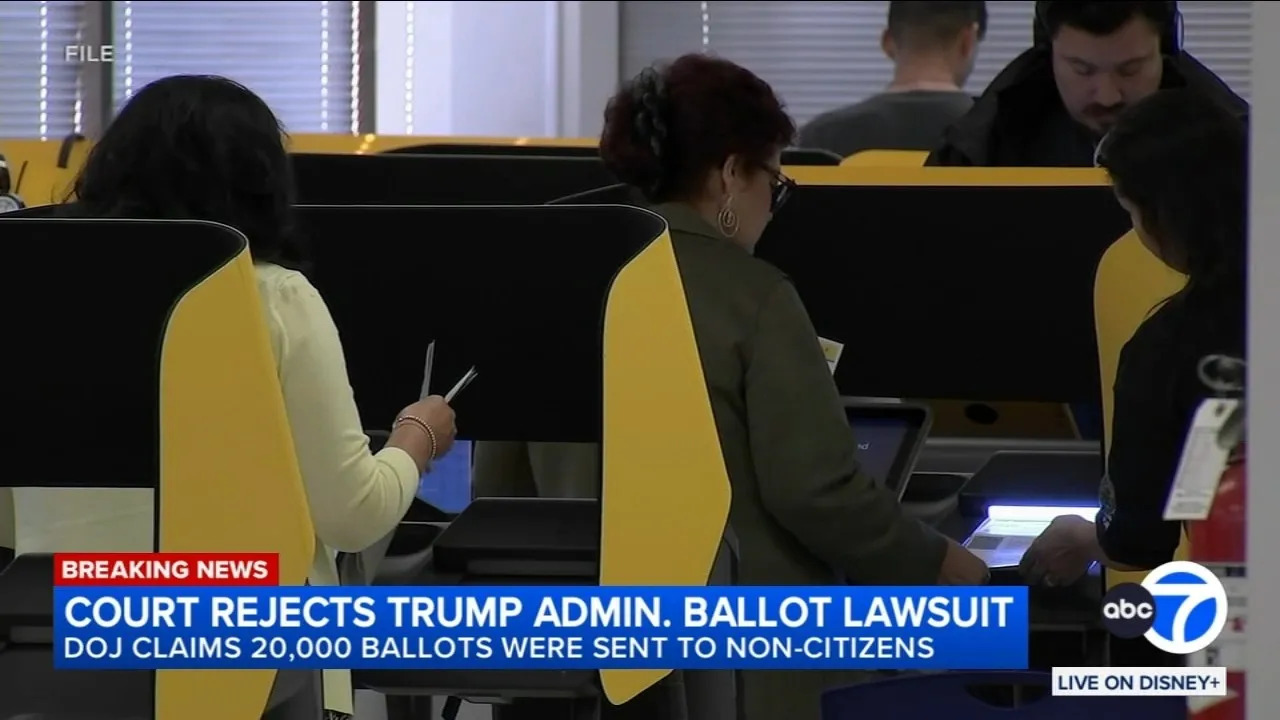
The Trump administration had sued California on October 15, setting a 48-hour deadline for state officials to review and set aside ballots from a list of over 20,000 people the administration suspects are noncitizens illegally registered to vote.
In its ruling, the appeals court stated, 'We decline the United States’s invitation to contravene the Elections Clause by undermining the Constitution’s plain text,' emphasizing the legal constraints on such actions.
The court also noted that there is 'no feasible way to identify and segregate the ballots of specific individuals without potentially catastrophic effects on the entire system,' highlighting the complexity and potential disruption of such a process.
California officials have consistently rebuffed the DOJ's demands, questioning the reliability of the federal government’s data given its poor track record in proving allegations of noncitizen voter fraud.
In Santa Clara County, the DOJ identified 902 suspected noncitizen voters and demanded access to their confidential registration records.
Registrar of Voters John Gardner said his office reviewed a sample and found that 55% of those checked were no longer eligible to receive ballots, including people who had died.
Despite the legal losses, the DOJ is expected to appeal to the U.S. Supreme Court, continuing its efforts to force Washington state to segregate ballots from hundreds of people it alleges are noncitizens.
The request likely violates the National Voter Registration Act, which prohibits systemic voter purges less than 90 days from election day.
California has maintained that its safeguards against noncitizen voting are robust and that the Justice Department’s assertions rely on suspect data.
Millions of people in California have already voted, making the segregation of ballots a complex and potentially disruptive process.
The appeals court's ruling underscores the ongoing legal challenges and the need for careful consideration of election integrity measures.
What this adds
The appeals court's decision adds to the growing body of legal challenges facing the Trump administration's efforts to address alleged noncitizen voting.
The court's ruling does not address the underlying issue of noncitizen voting but focuses on the procedural and constitutional issues surrounding the segregation of ballots.
California officials have emphasized that their existing measures are sufficient to prevent noncitizen voting, and the DOJ's data has not been verified by independent sources.
Background
A federal appeals court panel has rejected the Justice Department's request to segregate ballots from alleged noncitizens in California's elections, a move that the DOJ argued was necessary to prevent illegal voting.
A panel of the Ninth U.S. Circuit Court of Appeals on Friday rejected the Justice Department's request for California to set aside disputed ballots received in the midterm election.
What's confirmed
- “As the district court found—and we discern no clear error—there is no feasible way to identify and segregate the ballots of specific individuals without potentially catastrophic effects on the entire system,” they said.
- Circuit Judge Mark Bennett told Justice Department attorney Matthew Donnelly that the DOJ appeared to be asking the court to 'issue an injunction that is entirely inconsistent with the law that the California Legislature has adopted pursuant to the Elections Clause.' The court ruled 2-1 that it lacked jurisdiction over the appeal and granted a motion by the top elections official from Los Angeles County to dismiss the effort.
What's still developing
- “If California receives these suspect ballots, mixes them with legitimate ballots, and then processes them, the potentially illegal votes will be counted toward the election of our representatives — threatening to dilute the vote of eligible citizens,” he wrote.
- Bumatay said DOJ had proposed “a modest remedy” to the prospect that noncitizens might vote illegally.
- After a district judge had scheduled an Oct. 27 hearing on the issue, the federal government appealed to the 9th Circuit Court, arguing that a faster decision was needed to prevent the further counting of votes.
- The Ninth U.S. Circuit Court of Appeals ruled 2-1 on October 26, 2026, that the Justice Department had appealed prematurely after giving a federal judge just 15 hours to act on its demand that California separate the disputed ballots and verify voters' citizenship before counting them.
- The district judge scheduled a hearing for Oct. 27, days after the case was assigned, but the federal government appealed to the 9th Circuit Court of Appeals, seeking an expedited decision.
- The 9th U.S. Circuit Court of Appeals voted 2-1 to deny an injunction requiring officials to separate the flagged ballots and verify voters’ citizenship before counting them.
- The Trump administration appealed to the Ninth Circuit despite the fact that a district court judge has yet to rule in the dispute.
- I mentioned yesterday that the Trump DOJ was seeking an immediate ruling on its emergency application for a temporary restraining order to force Los Angeles County to segregate and not count certain alleged noncitizen ballots.
- The three-judge panel ruled 2-1 against the request.
- The dispute began in July when federal immigration agencies informed California officials that they had identified thousands of registered voters believed to be noncitizens.
- The Trump administration is demanding an emergency court order to stop California from counting ballots tied to more than 20,000 suspected noncitizens, warning that once the votes are mixed in, there may be no way to undo it.
- California officials have countered that the list is unverified and includes the names of lawful voters, despite recent charges announced by DOJ of roughly 28 individuals from the list accused of voting and immigration-related crimes.