
Home · Science · Oct 30 archive
Mars Cloud Reveals Unseen Physics
Confirmed
In Short: Scientists have discovered a mysterious cloud on Mars, known as the Arsia Mons Elongated Cloud (AMEC), which may reveal physics never seen in nature.
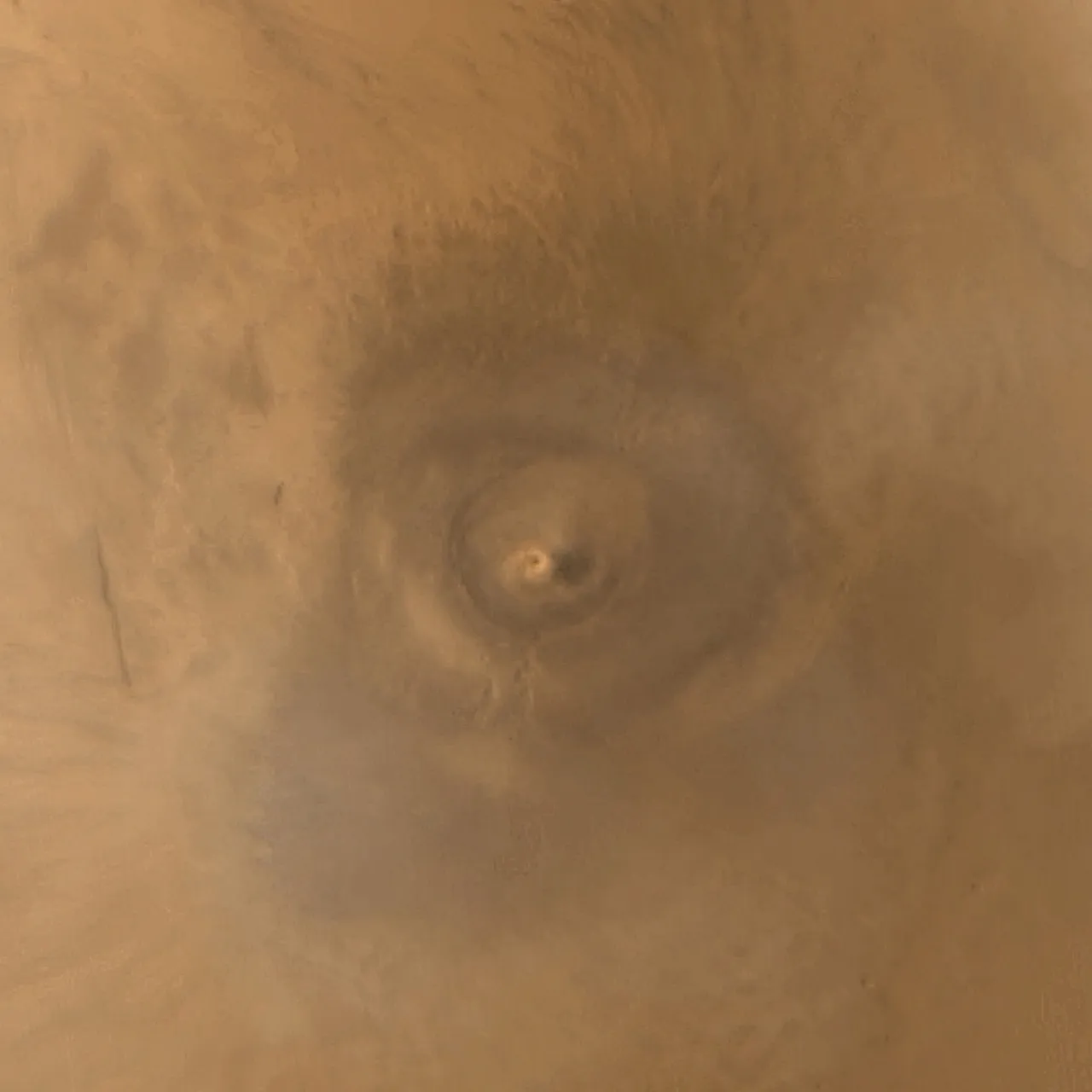
Since its first recording by a probe in 2018, the AMEC has puzzled researchers, appearing every day during spring and summer on Mars as a long, wispy ribbon stretching up to 1,800 kilometers.
Jorge Hernández-Bernal, a planetary scientist at Paris’ Sorbonne Université, explained that the AMEC's formation requires extreme conditions, including a sharp temperature drop of 30° Celsius within 10 minutes and high relative humidity.
Hernández-Bernal noted, “It’s wholly unexpected. It’s akin to droplets of condensation appearing in the middle of a room, rather than on a window.”
In a recent study published in Earth and Planetary Science Letters, Hernández-Bernal and his team found that including exotic physics in their simulations led to the emergence of the AMEC, as observed.
These exotic physics, while included in textbooks, are typically treated as theoretical and not thought to occur in nature. The team’s findings suggest that the AMEC might not need dust to form, challenging previous assumptions.
The Perseverance rover, which recently surpassed the distance record set by the Opportunity rover, uses an autonomous navigation system called AutoNav to navigate Mars’ terrain.
Perseverance can cover up to 1,351 feet (412 meters) in a single sol, thanks to its ability to image the terrain, build a 3D map of hazards, and plot its course between waypoints selected by Earth-based planners.
Meanwhile, NASA’s Curiosity rover has captured a stunning 360-degree view of Mars, revealing unusual stone ridges known as boxwork patterns in Gale Crater.
Curiosity stitched together 291 Mastcam photos to create a color-balanced panorama of these spiderweb-like stone lattices hardened by ancient groundwater.
The discovery of the AMEC and the unique geological features on Mars continue to expand our understanding of the Red Planet’s complex and often surprising atmospheric and geological processes.
What this adds
The AMEC's formation challenges existing theories about cloud formation on Mars, potentially opening new avenues for research into atmospheric physics.
The Perseverance rover's autonomous navigation system, AutoNav, allows it to cover significant distances on Mars, contributing to ongoing exploration efforts.
Curiosity's panoramic images provide valuable insights into Mars' geological history, highlighting the planet's diverse and intricate landscapes.
What's confirmed
- “It’s akin to droplets of condensation appearing in the middle of a room, rather than on a window,” Hernández-Bernal explained.
- “Once we included this physics in our simulations, the AMEC emerged just as we hoped.” On Earth, clouds usually form when water vapor creates droplets or ice crystals in the presence of tiny particles, such as dust or salt.
- “We found that we needed to include some exotic physics… physics that, while included in textbooks, is treated as theoretical and usually thought not to happen in nature. It certainly hasn’t been seen in action before,” Jorge Hernández-Bernal, a planetary scientist at Paris’ Sorbonne Université and lead author of the study, said in a press release.
What's still developing
- A new model suggests Mars may host ice-forming physics never directly observed before.
- Since it was first recorded by a probe in 2018, scientists have been unable to find a plausible explanation for the existence of this cloud, often referred to as the Arsia Mons Elongated Cloud (AMEC).
- Scientists investigating an enormous cloud that mysteriously appears over Mars each year have uncovered evidence of an exotic physical process never before identified in a planetary atmosphere.
- During its seasonal appearance, the cloud can stretch up to 1,800 kilometers long, forming in the early morning before dissipating later in the day.
- When we think of asteroids, we often think of the main asteroid belt between Mars and Jupiter that contains the majority of the known asteroids in our solar system.
- While Chariklo is about 125 kilometers in radius, the inner ring (C1R) and outer ring (C2R) orbit about 265 kilometers (165 miles) and 280 kilometers (174 miles) from Chariklo’s surface, respectively.
- The unusual combination of shergottite and chondritic characteristics in NWA 13441 suggests that portions of Mars may have retained relatively unchanged material despite billions of years of geological activity.
- They believe NWA 13441 formed near the boundary between Mars’ crust and mantle before volcanic activity brought the material to the surface.
- He gained international recognition for his lunar research before moving to Cambridge University, where he analysed meteorites found in Antarctica that were believed to have come from Mars.
- Analysts identified features of Beagle 2 in photos of Mars Pillinger died in May 2014 after suffering a brain haemorrhage and falling into a coma.
- Their analysis revealed that pressures of at least 17.5 kilobars were required to produce the aluminum-rich clinopyroxene found in the meteorite.
- Provisionally designated Noctis Mons, the newly-discovered volcano is located just south of Mars’ equator, in Eastern Noctis Labyrinthus, west of Valles Marineris, the planet’s vast canyon system.