
Home · Science · Oct 28 archive
NASA Unveils Ambitious Plan for Habitable Worlds Observatory
· Confirmed
In Short: NASA has unveiled plans for the Habitable Worlds Observatory (HWO), a mission dedicated to searching for signs of life on planets beyond our solar system.
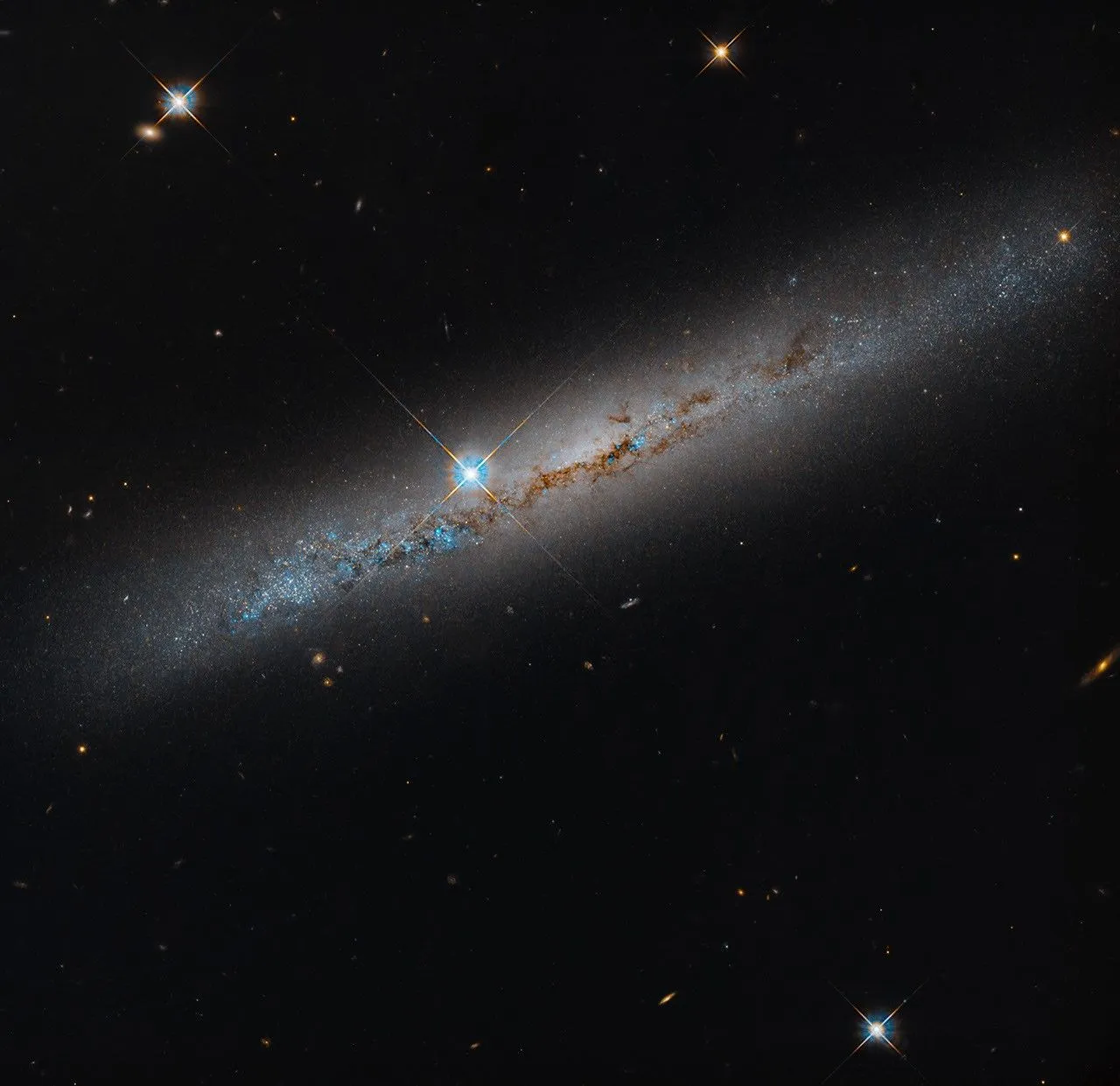
NASA has unveiled plans for the Habitable Worlds Observatory (HWO), a mission dedicated to searching for signs of life on planets beyond our solar system. The observatory, pronounced 'who' and referred to as Hab Worlds for short, will be positioned in a gravitationally stable orbit approximately 1.5 million kilometers from Earth.
From this vantage point, HWO will collect data on exoplanets by observing the gases in their atmospheres. To achieve this, it will use a coronagraph that suppresses starlight by a factor of 10 billion, a significant technological leap from current capabilities.
The observatory's High Resolution Imager (HRI) will serve as the main imaging camera, providing grism spectroscopy and sub-microarcsecond astrometry, as well as fine guidance, wavefront sensing, and pupil imaging.
Astronomers identified HWO as their top-priority large mission in the 2020 Decadal Survey on Astronomy and Astrophysics, with an estimated budget of $11 billion. The mission aims to directly image at least 25 Earth-like worlds.
NASA awarded contracts worth a combined $17.5 million to BAE Systems, Lockheed Martin, and Northrop Grumman in May to advance key stabilizing technology for the observatory.
The observatory's primary mission will feature a 300-megapixel infrared camera with a field of view 100 times larger than the Hubble Space Telescope’s, collecting data 1,000 times faster.
Lee Feinberg, a NASA HWO lead and principal architect, said the team is in communication with representatives from SpaceX, Blue Origin, and United Launch Alliance to track the progress of their super heavy-lift launchers.
The preliminary Habitable Worlds team is considering building the telescope with a 6- to 8-meter mirror, larger than the James Webb Space Telescope’s 6.5-meter mirror.
Nicola Fox, head of NASA’s Science Mission Directorate, emphasized the importance of ensuring that the technology is ready before the mission begins. She noted that the mission will require robotic servicing capabilities far beyond current geostationary-geosynchronous servicing.
The observatory will search for key chemical fingerprints like oxygen, water, carbon dioxide, and methane, which could indicate potentially habitable worlds.
Evgenya Shkolnik, a professor of astrophysics at Arizona State University, said, “This is our first chance to directly search for life because we live in a time where technologically we think we know how.”
What this adds
The observatory will use a coronagraph to suppress starlight by a factor of 10 billion, a significant technological advancement.
The mission aims to directly image at least 25 Earth-like worlds, advancing the field of exoplanet research.
The observatory's primary mission will feature a 300-megapixel infrared camera with a field of view 100 times larger than the Hubble Space Telescope’s, collecting data 1,000 times faster.
What's confirmed
- HWO (pronounced “who” and called Hab Worlds for short) is NASA’s first-ever mission dedicated to searching for signs of life on planets beyond the solar system.
- Finally, mission planners also want to build in the capability for robotic craft to service the telescope all the way out at L2 — a far cry from the basic servicing possible today in the geostationary-geosynchronous realm 35,000 km above Earth.
- [astro-ph.IM] The Habitable Worlds Observatory (HWO) will be NASA’s next flagship astrophysics mission, designed to search for signs of life on planets around nearby stars and conduct transformational science across astrophysics.
- Its High Resolution Imager (HRI) is not only the observatory’s main imaging camera, but also provides grism spectroscopy and sub-microarcsecond astrometry, as well as the observatory’s fine guidance, wavefront sensing and pupil imaging.
- We present a design concept for HRI, developed during concurrent design sessions by flowing down science requirements within the envelope of NASA’s EAC-1 telescope architecture.
- With the emergence of Starship, New Glenn, and SLS rockets, NASA engineers are reimagining what is possible for future space telescopes and our search for life in the universe.
- Preliminary design discussions have commenced, and in May, NASA awarded BAE Systems, Lockheed Martin, and Northrop Grumman contracts worth a combined $17.5M to advance key stabilizing tech.
- The goal is for HWO to directly image at least 25 of these types of worlds.
- NASA is developing plans for the Habitable Worlds Observatory, a next-generation space telescope designed to search for Earth-like planets and possible signs of life beyond the solar system, according to Universe Today.
- NASA is working with researchers across the astronomy community to determine which capabilities would deliver the greatest scientific return.
What's still developing
- “A lot of it is making sure that the technology is ready to go, so before you actually start sprinting with a mission, you’ve actually assured that you can do the mission,” Nicola Fox, head of NASA’s Science Mission Directorate, told reporters at an April press event.
- Finding an Earth-like world beyond the solar system is the Holy Grail of exoplanet research, and the field has experienced incredible technological advancements in searching for and identifying exoplanets since the first exoplanet was discovered in 1995.
- Scanning vast swaths of sky, NASA’s next flagship observatory, the Nancy Grace Roman Space Telescope, promises to revolutionize our understanding of dark matter and dark energy while discovering some 100,000 exoplanets.
- “No other space observatory has this capability.” Savransky plans to attend the telescope’s launch from Kennedy Space Center aboard a SpaceX Falcon Heavy rocket, along with three doctoral students who have supported the work: Isabela Huckabee, Saanika Choudhary and Rifah Tasnim.
- But after years of planning, he hopes Roman – named for NASA’s first chief astronomer – begins revealing exoplanets by early next year, and imparting lessons that could inform the proposed Habitable Worlds Observatory.
- To further develop and mature today’s limited versions of these technologies to meet HWO’s stringent requirements, NASA in January awarded three-year, fixed-price contracts to seven companies.
- Slated for launch in the 2040s, the telescope represents an enormous technological leap forward in multiple ways — which has also prompted NASA to reimagine its approach for developing flagship missions.
- “‘Are we alone?’ is the most ambitious question that has really ever been addressed by any mission, and an observatory capable of addressing this question must also be ambitious and powerful,” says Breann Sitarski, deputy principal architect for HWO at NASA’s Goddard Space Flight Center in Maryland.
- A special Announcement of Opportunity (AO) is soliciting the participation of the European community in the role of ESA-appointed representatives to the NASA Great Observatory Maturation Program’s (GOMAP) Science, Technology, Architecture Review Team (START) for the Habitable Worlds Observatory (HWO) mission.
- The 2020 National Academy of Sciences Decadal Survey on Astronomy and Astrophysics (Astro2020) recommended a "Great Observatories Mission and Technology Maturation Program" as its highest priority in Enabling Programs for Space.
- In response to these recommendations, NASA has established the Great Observatory Maturation Program (GOMAP).
- Full details of this AO and the relevant submission forms can be found in the ESA HWO-START call.