
Home · World · Oct 28 archive
EU backs away from offer to Canada to start ‘associate member’ talks
· Confirmed
In Short: European officials have walked back from their offer to Canada to start talks on becoming an 'associate member' of the EU, opting for softer language instead.
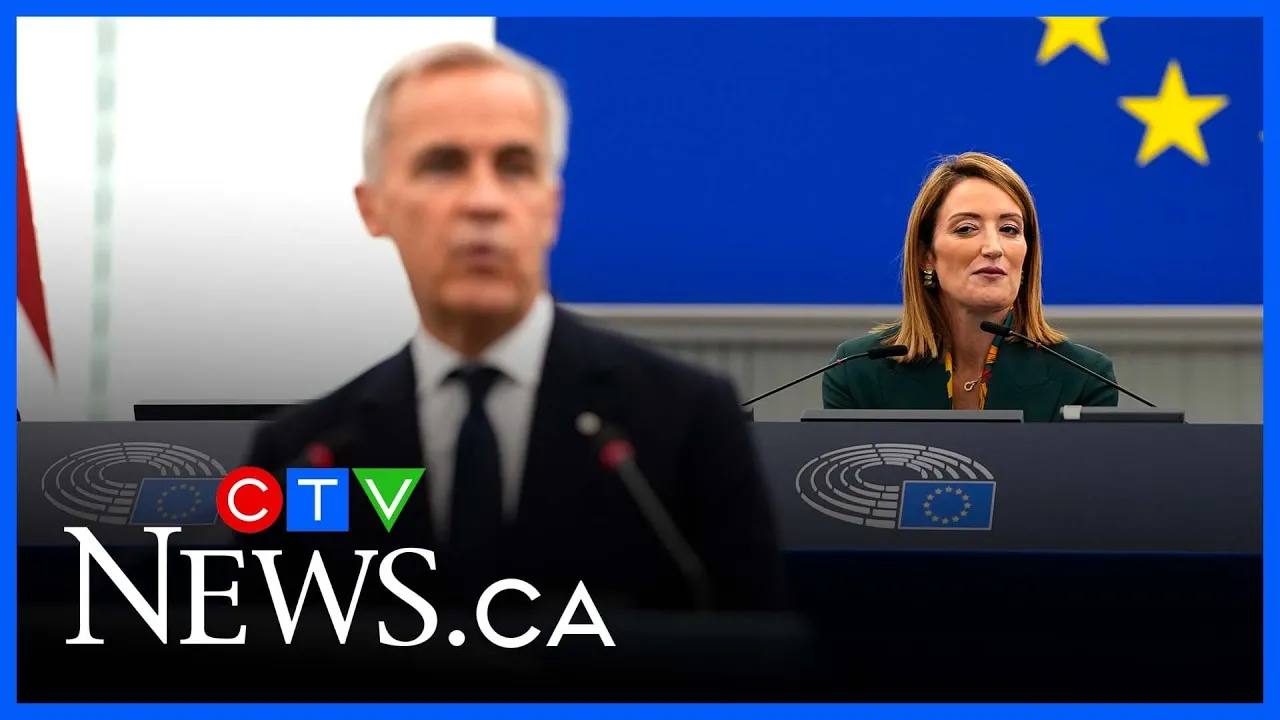
European officials have walked back from their offer to Canada to start talks on becoming an 'associate member' of the EU, opting for softer language instead. The BBC (United Kingdom) and The Guardian reported that the bloc has since dropped the term 'associate member,' opting for the phrase 'ever closer association' to describe the relationship with Canada.
The BBC (United Kingdom) and Nationalpost (Canada) reported that the EU's decision to backtrack came after disagreements among member states. The Guardian noted that the declaration had been hailed as a landmark in EU history, offering a non-EU country such close ties to the bloc.
The BBC (United Kingdom) and The Guardian stated that Ursula von der Leyen, the European Commission President, told the European Parliament on Wednesday she wanted to work on 'opening the door' for Canada, which would involve closer ties on various key sectors. Von der Leyen emphasized that Canada could contribute liquefied natural gas (LNG) and hydrogen 'at large scale to support Europe's energy security,' while Canada could benefit from Europe's leadership on clean energy technologies.
The BBC (United Kingdom) and Nationalpost (Canada) reported that Canada and the EU believe in democracy and partnerships are a strategic choice for Europe. Carney, the Canadian Prime Minister, argued that Canada and the EU should cooperate even more to build up their defense industrial bases, develop sovereign compute, and regulate artificial intelligence.
The BBC (United Kingdom) and Nationalpost (Canada) noted that Canada and the EU have signed over 30 agreements since January 2025, reflecting Canada’s broader effort to strengthen relationships with European partners while expanding cooperation in trade, energy, technology, and security.
The BBC (United Kingdom) and The Guardian reported that the EU's decision to backtrack from the 'associate member' status was due to disagreements among member states. The Guardian emphasized that the declaration had been hailed as a landmark in EU history, offering a non-EU country such close ties to the bloc.
The BBC (United Kingdom) and The Guardian reported that the EU's decision to backtrack from the 'associate member' status was due to disagreements among member states. The Guardian emphasized that the declaration had been hailed as a landmark in EU history, offering a non-EU country such close ties to the bloc.
The BBC (United Kingdom) and The Guardian reported that the EU's decision to backtrack from the 'associate member' status was due to disagreements among member states. The Guardian emphasized that the declaration had been hailed as a landmark in EU history, offering a non-EU country such close ties to the bloc.
The BBC (United Kingdom) and The Guardian reported that the EU's decision to backtrack from the 'associate member' status was due to disagreements among member states. The Guardian emphasized that the declaration had been hailed as a landmark in EU history, offering a non-EU country such close ties to the bloc.
The BBC (United Kingdom) and The Guardian reported that the EU's decision to backtrack from the 'associate member' status was due to disagreements among member states. The Guardian emphasized that the declaration had been hailed as a landmark in EU history, offering a non-EU country such close ties to the bloc.
The BBC (United Kingdom) and The Guardian reported that the EU's decision to backtrack from the 'associate member' status was due to disagreements among member states. The Guardian emphasized that the declaration had been hailed as a landmark in EU history, offering a non-EU country such close ties to the bloc.
The BBC (United Kingdom) and The Guardian reported that the EU's decision to backtrack from the 'associate member' status was due to disagreements among member states. The Guardian emphasized that the declaration had been hailed as a landmark in EU history, offering a non-EU country such close ties to the bloc.
Background
The European Union has walked back from its offer to Canada to start talks on becoming an 'associate member' of the bloc, opting instead for softer language.
What's confirmed
- Europe and Canada believe in democracy." She added: "Partnerships are a strategic choice for Europe.
- Speaking on Wednesday, European Commission President Ursula von der Leyen told Canadian Prime Minister Mark Carney during her annual State of the European Union address: "I would like to work with you on opening the door for Canada being the first associate member of the EU."
- "If it's a good intention, that's fine. If it's a bad intention, we'll put very heavy tariffs on Europe, which is a possibility."
What's still developing
- European officials said that details of a new agreement with Canada would not be solidified until next year.
- All 27 EU states are members and there are seven non-EU members.
- Carney says he is seeking a "unique" relationship with the EU, in an apparent reference to the fact that EU treaties do not currently provide for associate membership.
- "work to define by the 2027 EU-Canada Summit the concept of Associate Member that will reflect, through this even closer association, our common endeavour and cooperation towards our shared goals of prosperity, economic security and strategic autonomy."
- While what that means remains to be seen, Carney used his speech to pitch Canada as a natural ally for the block of 27 European countries in the face of international upheaval — a “tremendous storm,” in his words — and the creation of the next world order.
- "I think it's laughable," Trump told reporters when asked about the plan.
- While Ottawa is diversifying away from Washington, it still exports 75% of its goods to its southern neighbour, while the EU accounts for less than 6% of Canadian exports.
- Ten Member States – many of which face elections in 2027 – still need to ratify the Comprehensive Economic Trade Agreement (CETA) which was signed in 2017.
- Rare basking shark surprises Halifax-area residents during unusual visit to Bedford Basin Canada wins silver after 77-76 thriller against US at wheelchair basketball world championship Carney appears to mimic Trump hand gesture during Liberal caucus speech Trump threatens heavy tariffs on Europe over proposed Canada-EU ‘associate membership’ EU chief proposes Canada as bloc’s first ‘associate member’ Your email address will not be published.
- The memorandum specifically cited Canada's "Buy Canadian" policy and restrictions imposed by Canadian provinces.
- Canada already has a preferential trade deal with the EU in the form of the 2016 Comprehensive Economic and Trade Agreement (Ceta).
- Since late August, the Canadians have been pushing hard for the Europeans to build a closer relationship with them, though full EU membership is not an option as Canada is not a European state.