
Home · Politics · Oct 28 archive
Dolores Huerta, Labor Activist and Civil Rights Icon, Dies at 96
Confirmed
In Short: Huerta's resolve and dedication cemented her place in history as one of the nation's most influential labor leaders, civil rights icons, and feminist activists.
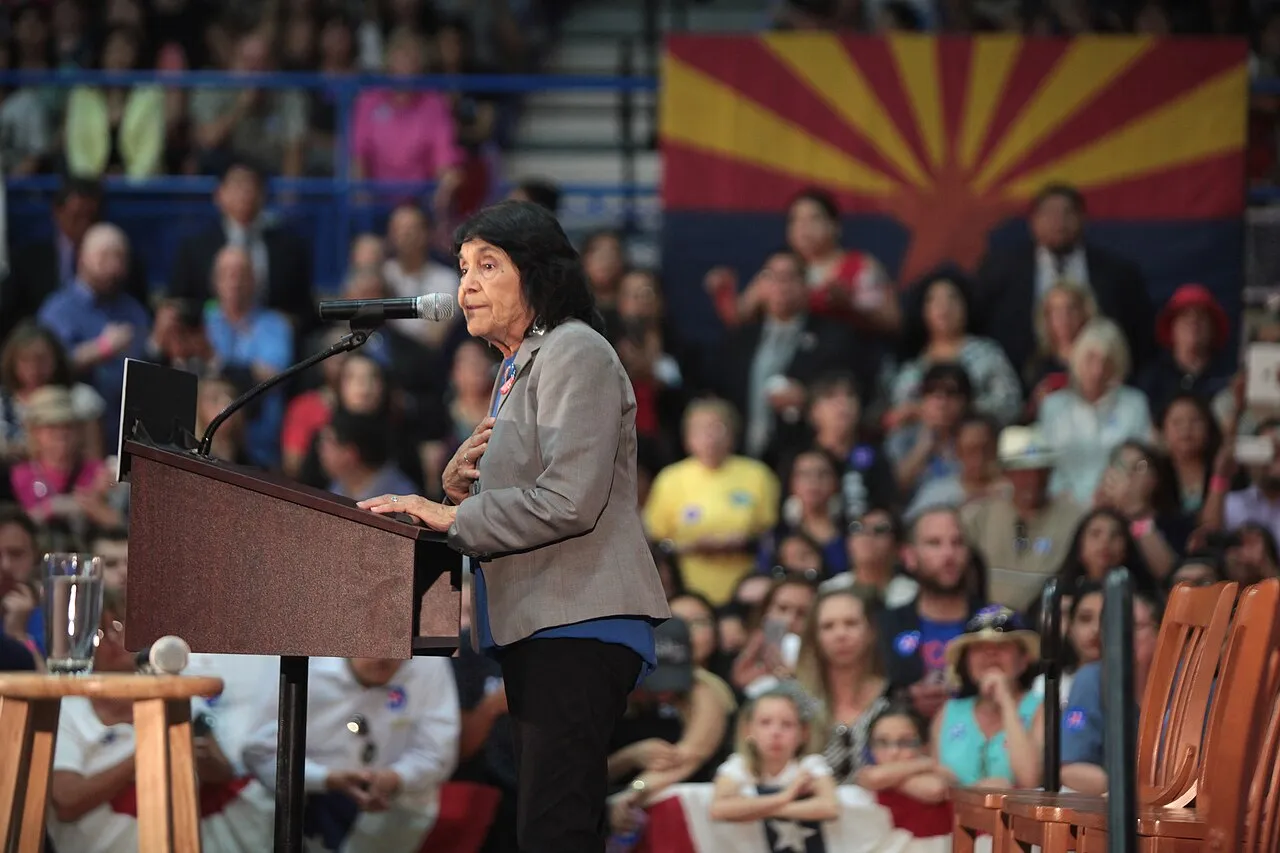
Dolores Huerta, the labor activist and civil rights leader who co-founded the United Farm Workers with Cesar Chavez, has died, her family announced on Wednesday. Huerta, known for her tireless advocacy for farmworkers' rights and her influential slogan 'Sí, se puede' (Yes, it can be done), passed away at home.
Born in 1930 in Dawson, New Mexico, Huerta moved to California's Central Valley where she left a teaching career to organize farmworkers. She co-founded the National Farm Workers Association in 1962, which later became the United Farm Workers.
Huerta's work was marked by significant achievements, including leading voter registration drives and staging boycotts that brought corporate bosses to the negotiating table. In 1993, she became the first Latina inducted into the National Women’s Hall of Fame.
Despite her many accomplishments, Huerta faced personal challenges. She revealed in 2026 that she was sexually abused by Chavez in the 1960s, leading to the birth of two children, a secret she kept for 60 years.
Huerta's family said in a statement, 'As you can imagine, this is an incredibly difficult time for us, and we ask for privacy as we grieve this incredible loss to our family.'
California Governor Gavin Newsom paid tribute to Huerta, stating, 'California mourns a giant. Dolores Huerta gave voice to the voiceless, dignity to the fields and hope to generations.'
Huerta's legacy as a civil rights leader is profound. She once said, 'I couldn’t stand seeing kids come to class hungry and needing shoes,' highlighting her commitment to improving the lives of workers and their families.
In her UFW heyday, Huerta was a fierce advocate, rallying workers and leading marches. She believed that organizing farmworkers was more impactful than teaching hungry children, as she stated, 'I thought I could do more by organizing farmworkers than by trying to teach their hungry children.'
Huerta's resolve and dedication cemented her place in history as one of the nation's most influential labor leaders, civil rights icons, and feminist activists.
In a 2026 interview with Latino USA, Huerta reflected on keeping the secret of her abuse, saying, 'It was my personal pain, it was my personal problem and, you know, I think it was worth it because it was my cross to bear. I'll say it that way.'
What this adds
Huerta's family announced her death on Wednesday, and her passing has sent shockwaves through the Latino community and beyond.
What's confirmed
- "I couldn't stand seeing kids come to class hungry and needing shoes," she said in a 2017 PBS Independent Lens documentary on her life.
- When then-President Barack Obama presented the award in 2012, he praised Huerta as a tenacious leader and joked that he had stolen her slogan for his 2008 campaign.
- This year, Huerta sent shockwaves through the Latino community when she revealed that she was sexually abused in the 1960s by Chavez, leading to the birth of two children, a secret she kept for 60 years and long after he died.
- "I thought I could do more by organizing farmworkers than by trying to teach their hungry children."
What's still developing
- “I felt that I had to help people that need to be organized so they could help themselves.” Born Dolores Clara Fernandez in Dawson, New Mexico, in 1930, advocacy was in her blood.
- Garcia, professor at Dartmouth College and author of the 2014 book, “From the Jaws of Victory: The Triumph and Tragedy of Cesar Chavez and the Farm Worker Movement.” In her UFW heyday, Huerta cut a striking figure, a fierce young Latina shouting through a bullhorn, rallying workers and leading marches.
- "To dedicate your life to building a dream of a union for farmworkers, to take on agriculture, which to this today is still a powerhouse.... That took a lot of guts," he had said.
- In 1960, when Huerta started organizing farmworkers, they were paid extremely low wages — between 75 to 90 cents an hour on average nationally, according to U.S. Department of Agriculture statistics — and had virtually no labor protections.
- A male union leader can be heard shouting “Don’t say nothing, dilapidated bitch,” presumably to Huerta, in a 1978 meeting, the New York Times reported in 2026 based on an audio recording of the incident.
- Huerta founded the Stockton Community Service organization at age 25 after spending much of her childhood in the city.
- Huerta was born in New Mexico and raised by a single mother in California's San Joaquin Valley, where she worked as a school teacher and then helped found a local chapter of a grassroots organization that fought segregation and police brutality.
- Her three-word Spanish-language slogan — which translates to "Yes, it can be done" — was grounded in the belief that people could affect change.
- From the early 1970s on, Huerta's life partner was Richard Chavez, César's brother, and together they had four kids.
- Huerta, now 95, said in the statement that she kept the secret for the last sixty years because, “I believed that exposing the truth would hurt the farmworker movement I have spent my entire life fighting for.” She told the Times about two separate encounters with Chavez that turned sexually violent, one in 1960 and another in 1966.