
Home · Science · Oct 28 archive
Astronomers Spot Atmosphere on Dwarf Planet Candidate Beyond Pluto
· Confirmed
In Short: Astronomers have detected an atmosphere on a dwarf planet candidate beyond Pluto, the second known TNO with an atmosphere.
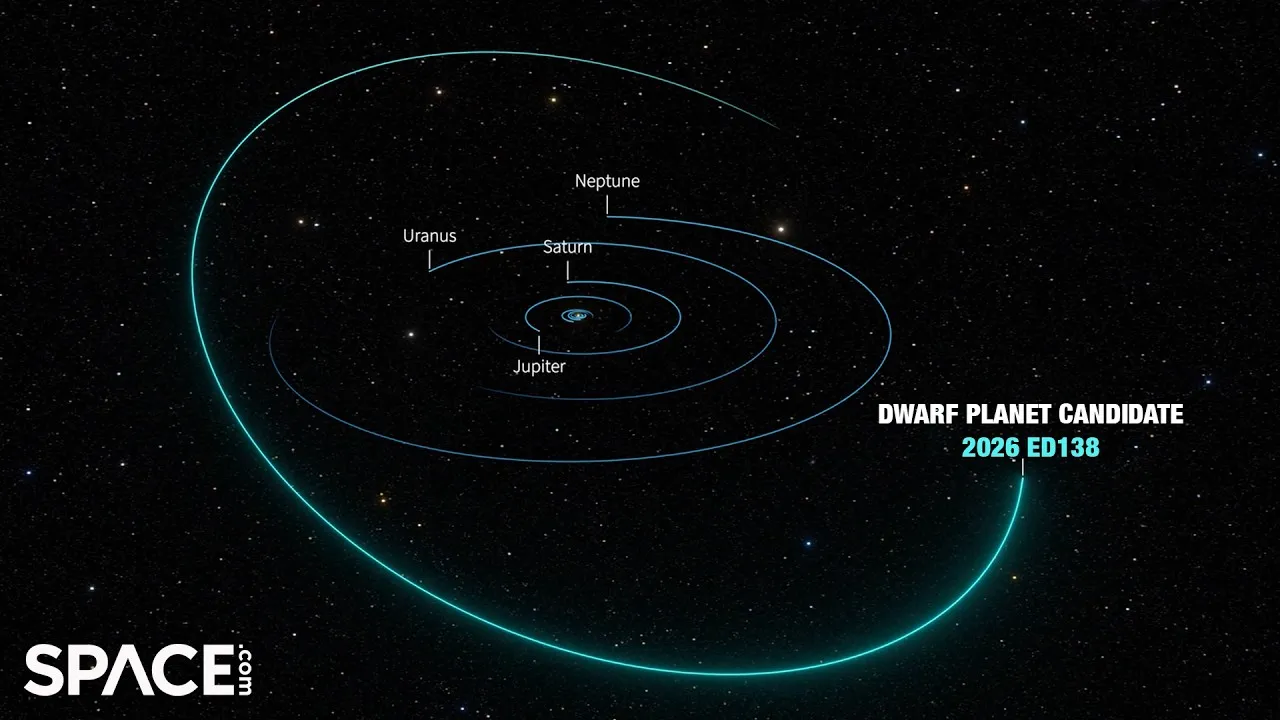
Astronomers have detected an atmosphere on a dwarf planet candidate beyond Pluto, marking the second known trans-Neptunian object (TNO) with an atmosphere.
The discovery was made by a team of astronomers in Japan, led by Ko Arimatsu, an associate professor and senior lecturer at the National Astronomical Observatory of Japan.
The object, dubbed 2002 XV93, is estimated to be about 311 miles across, roughly a fifth of Pluto's diameter.
The team observed 2002 XV93 as it passed in front of a bright star, a rare event known as a stellar occultation, on January 10, 2024.
The observation data showed a smooth change in the star's brightness near the edge of the shadow, lasting about 1.5 seconds, indicating the presence of a thin atmosphere around the object.
This kind of smooth brightness change is naturally explained if the starlight was bent by a very thin atmosphere around the object.
The atmosphere around 2002 XV93 is extremely thin, anywhere from five million to ten million times thinner than Earth's atmosphere.
The Kuiper Belt, a scattered disc of minor planets beyond Neptune, has long fascinated astronomers due to the unusual behavior of objects orbiting the Sun in this region.
The region's extreme distance from the Sun makes it incredibly difficult to study, shrouding the nature of TNOs in enduring mystery.
Meanwhile, another significant discovery was made with the Vera C. Rubin Observatory, which identified a possible sixth dwarf planet beyond Pluto on October 27, 2026.
The object, named 2026 ED138, could measure up to 1,500 kilometers (930 miles) across, making it one of the largest objects discovered in the outer solar system in roughly 20 years.
Initial measurements indicate that 2026 ED138 has a diameter between 600 and 1,500 kilometers (373 and 932 miles), which makes it one of the largest dwarf planet candidates yet detected.
What this adds
The Vera C. Rubin Observatory's detection of 2026 ED138 marks a significant milestone in the search for new dwarf planets beyond Pluto.
The exact classification of the newly discovered exomoon remains a topic of debate among astronomers.
Background
Astronomers have discovered an atmosphere on a dwarf planet candidate beyond Pluto, the second known TNO with an atmosphere.
What's confirmed
- "Objects like this are very rare, so I immediately started checking whether I or the code had done something wrong." Everything we have managed to learn so far about the Solar System beyond Neptune (about 30 astronomical units from the Sun) indicates that there's a lot more out there than meets the eye.
- Astronomers may have just discovered our solar system’s sixth dwarf planet Located farther away from Earth than Pluto, the object was hidden in the light of the Milky Way’s stars In the outer reaches of our solar system, beyond the orbit of Pluto, the Vera C.
- Astronomers announced the discovery of a possible sixth dwarf planet beyond Pluto on 27 October 2026, after Matthew Holman identified the distant object in data from Chile's Vera C.
What's still developing
- Artist's impression of CD-35 2722, red dwarf in the distance, brown dwarf close up, and the newly discovered sub-Jupiter that orbits the brown dwarf between.
- After considering several explanations, Hoy and his colleagues conclude that an object about 90 percent as massive as Jupiter in an orbit lasting 170 days around the brown dwarf fits the data almost perfectly.
- For many years, scientists have reconstructed the space beyond Pluto from breadcrumbs – scattered discoveries and indirect clues gleaned from the motion of those objects we have actually detected.
- Then, they looked further back – and found the object hiding in archival observations from the Dark Energy Camera, dating all the way back to February 2016.
- Scientific American is affiliated with LabX Media Group, which owns or has commercial relations with other B2B and B2C brands (many of them can be found at www.labxmediagroup.com ).
- Researchers calculated the strength of the magnetic field of the planet to be at least 1.25 kilogauss (kG) based on the highest frequency detected.
- β Pictoris b is a huge, hot planet similar to Jupiter that orbits around a bright star called β Pictoris, which is located approximately 63 light-years from Earth.
- They protect a planet’s atmosphere from being stripped away by the sun’s (or another star’s) “wind.” They also store information about the inside of the planet, such as whether it has a liquid core or a layer of material that can conduct electricity.
- However, this study discusses how UCDs could be prime targets since astronomers have been detecting radio waves from them for several decades.
- Studying exoplanets has provided astronomers with a plethora of insights regarding what characteristics need to be searched to find life beyond Earth.
- In recent years, astronomers have recognized that a planet’s magnetic field, which shields the Earth from harmful radiation, could be a prime characteristic for identifying Earth-like worlds.
- Astronomers have found new evidence that 3I/ATLAS, only the third confirmed interstellar object ever detected entering the Solar System from beyond, formed in an extremely cold environment far from any star.
Sources
- Futurismlink
- IFLSciencelink
- International Business Times UKlink
- Notebookchecklink
- Science News Exploreslink
- ScienceAlertlink
- Scientific Americanlink
- Space.comlink
- The Daily Galaxylink
- WPSD Local 6link
- ZME Sciencelink
- wyomingnewsnow.tvlink
- Techexploristlink
- Universe Todaylink
- Scilink
- Phys.orglink
- VideoFromSpace — video link